
In 1986, the CD format had only been on the market for four years, but Sony was already working on its fourth generation ES (Extremely High Standard) CD players. The first generation of Sony players was not yet fully mature, but the second generation introduced linear motor mechanics, a new design, the so-called music calendar function and simpler, more logical controls. The players also had a digital (for now coaxial) output. In order to improve the analog filters, 2x oversampling was also introduced. In fact, the second generation was where Sony should have started (let’s consider the wonderful first generation CDP-701ES as a cuckoo’s egg). The third generation developed these achievements further.
By 1986, they thought it was time for a small update to the image of the players. The style remained essentially unchanged, but the players became a bit thicker and cleaner. Internally, oversampling was increased to 4x, further reducing the negative effects of analog filters. Playback was made more resistant to disc errors. But there was no radical innovation here, rather gradual improvements.
The new ES generation was released in October 1986, with three new CD players:
- CDP-555ESD, price: 150,000 yen
- CDP-333ESD, price: 89,800 yen
- CDP-222ES, price: 66,800 yen
The D at the end of the model number referred to the digital output. This was the beginning of the three-way division of the ES group (upper-middle-lower category with numbers 5-3-2, later 7-3-2). Just for comparison: in 1986, the lowest-end Sony CDP-M30 player in Japan cost 39,800 yen. The average monthly payment was 273,000 yen.
The CDP-555ESD was therefore the pinnacle of Sony CD players when it was released in Japan in October 1996. It was released in Europe and overseas sometime in 1987, I don’t know the exact date, but it was already tested in the September 1987 issue of the German magazine Fono Forum (and received a reference rating). Its price at the time was 3,000 German marks. In the United States, it was released as the CDP-705ESD for $1,500 (which would be about $4,400 today, adjusted for inflation).

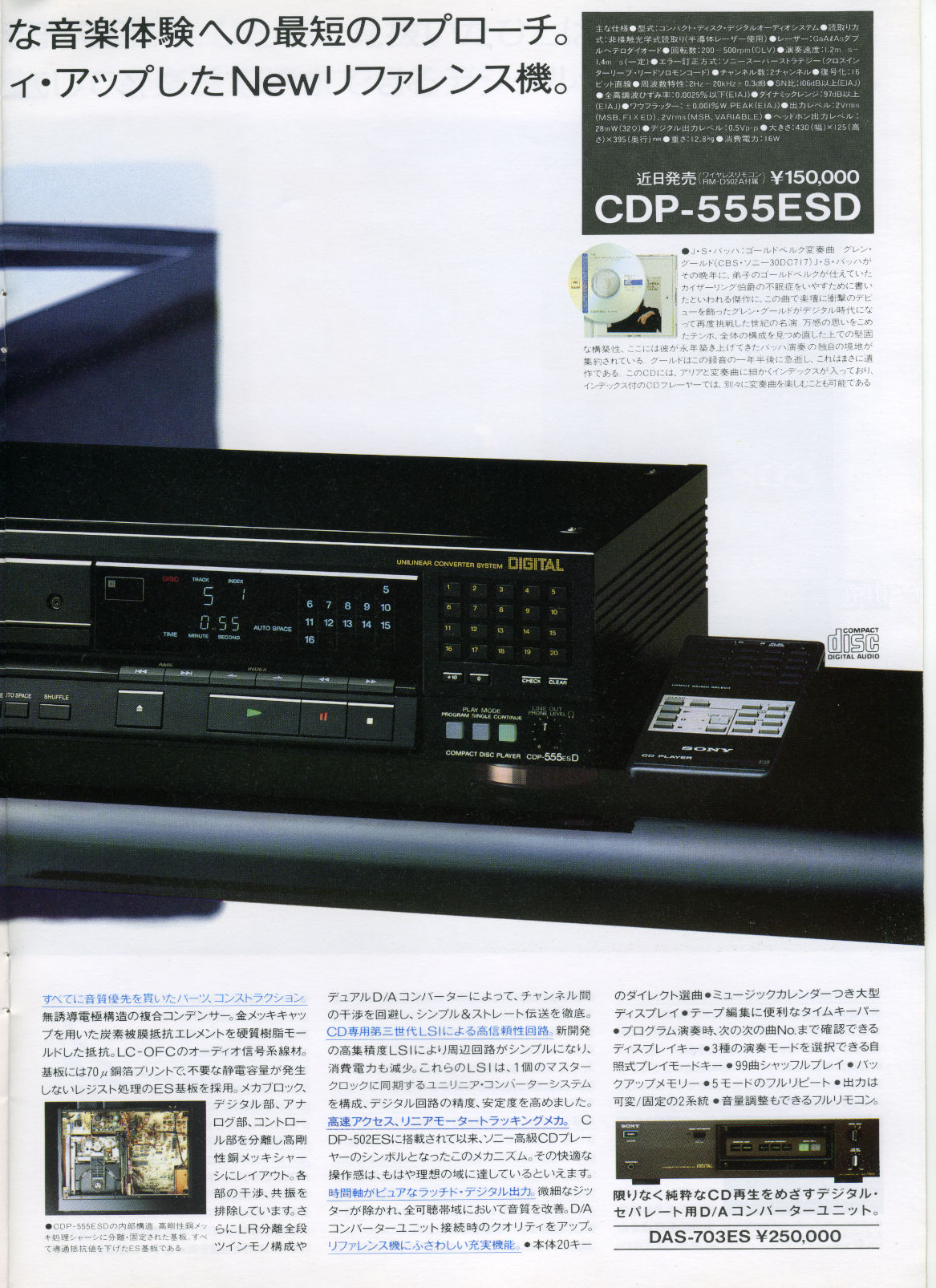
Photo of Sony CDP-555ESD and RM-D502A remote control from April 1987 Japanese catalog
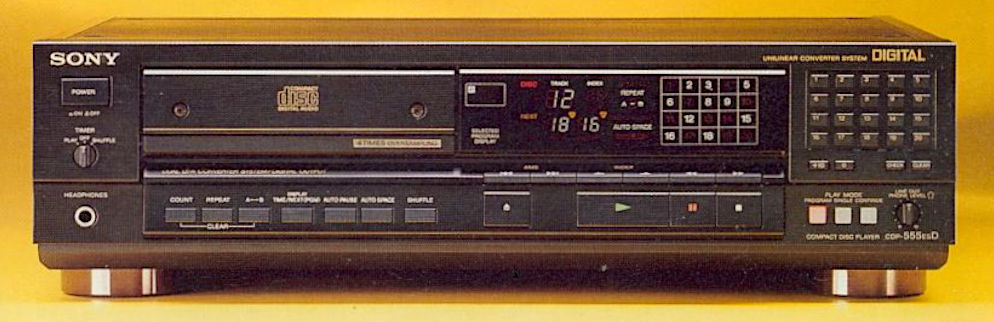
Sony CDP-555ESD in the 1988 German catalog
Today, 40 years later, many of them are still in working order (if they have been well cared for and maintained over the past few decades) and the 555ESD is a sought-after and cherished treasure among collectors and vintage hi-fi enthusiasts. I have long wanted to own one of these players, and now that I have managed to acquire one, I would like to introduce this truly special model.
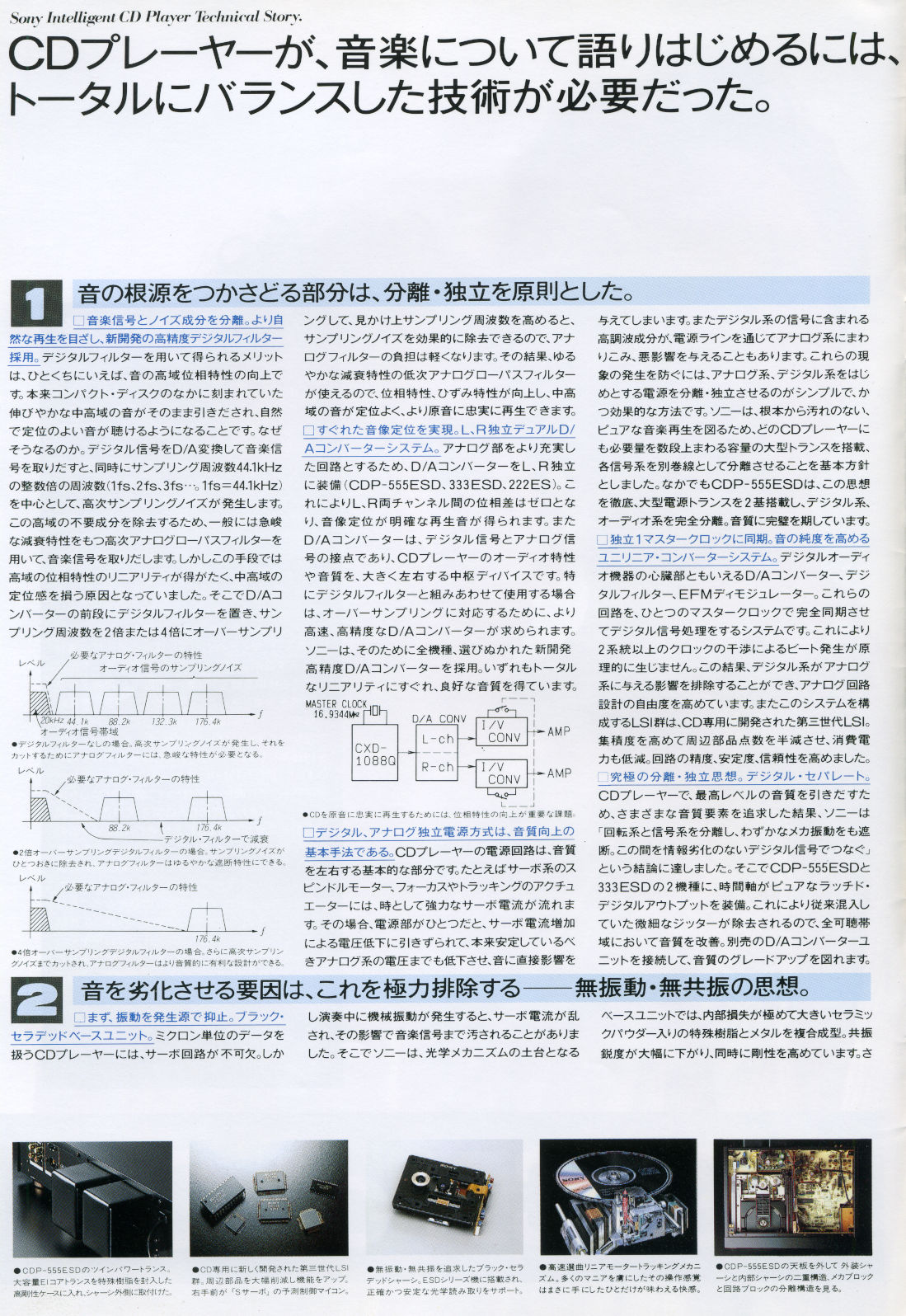
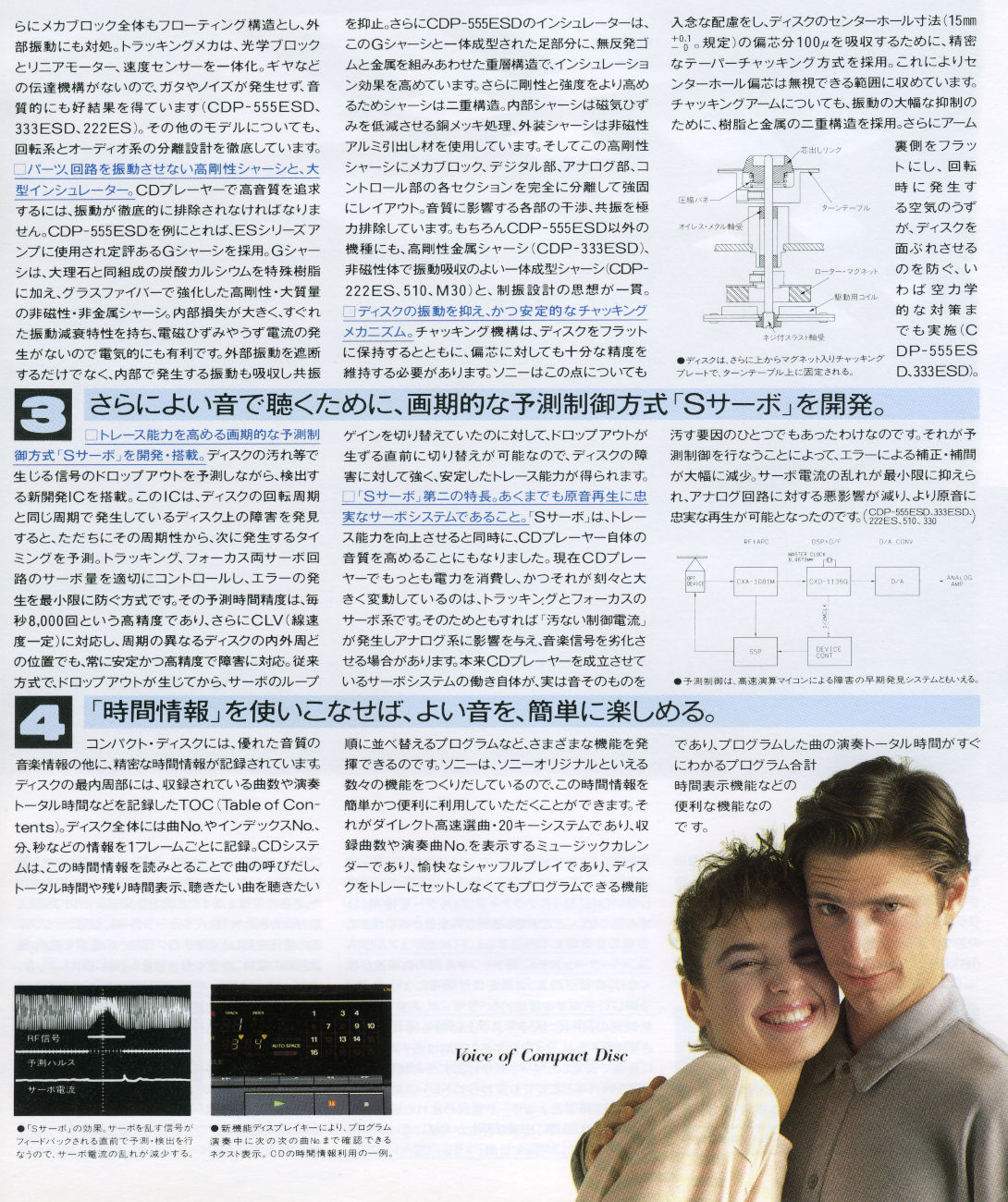
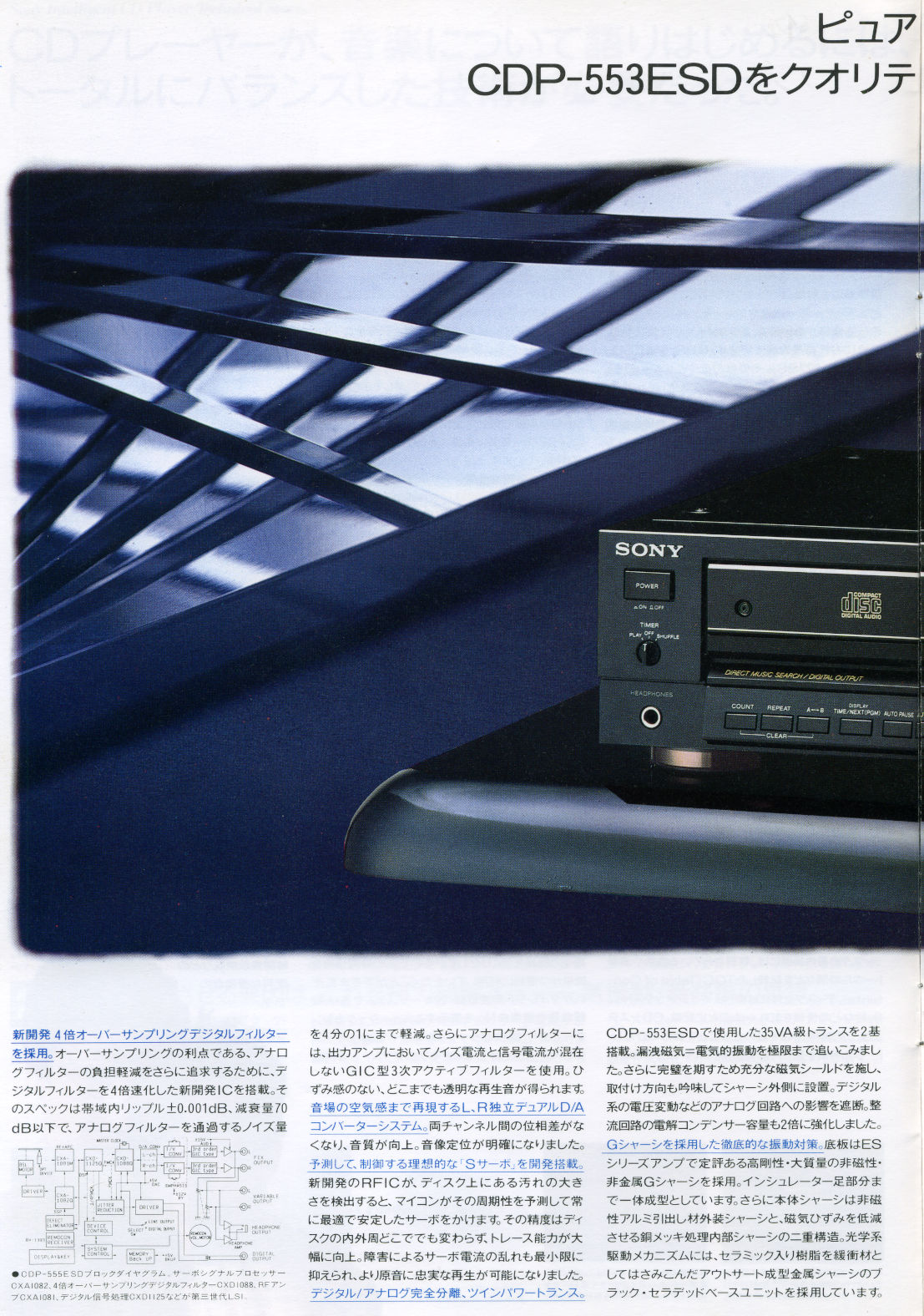
The album below shows the 1986 October Japanese catalogue pages (click to enlarge).
Exterior
So in 1986, Sony renewed the look of its CD players. In the high-end segment, the previous thin design was slightly thicker, the look was made more modern, and the controls were rearranged, but the basic features were essentially unchanged. Since I had used the 555ESD’s „little brother”, the CDP-710, also from 1986, for more than 10 years and loved it very much (I still have it), the look was familiar.
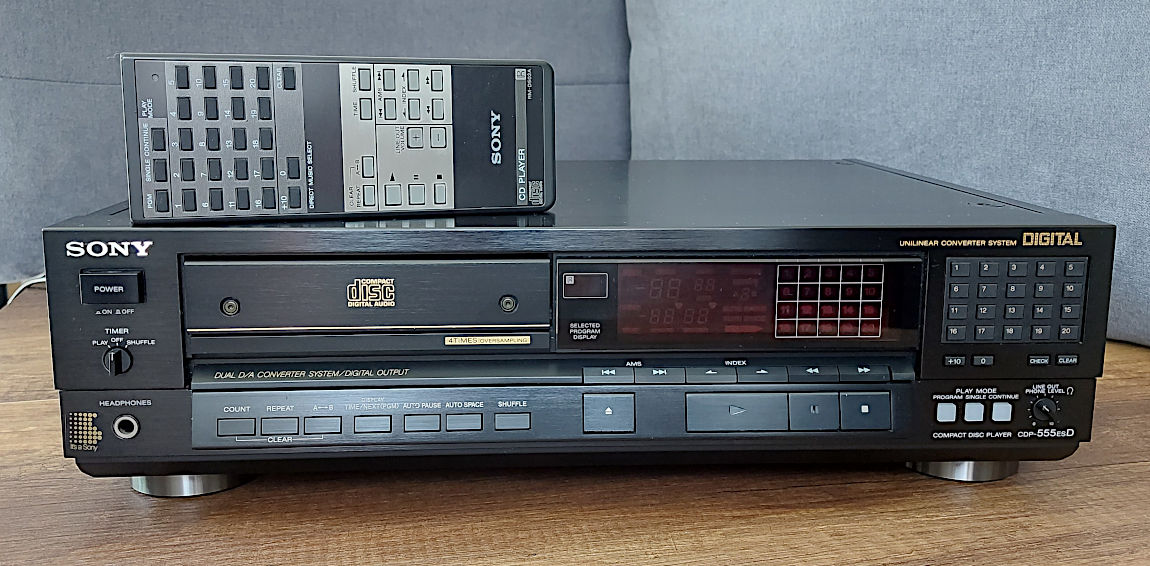
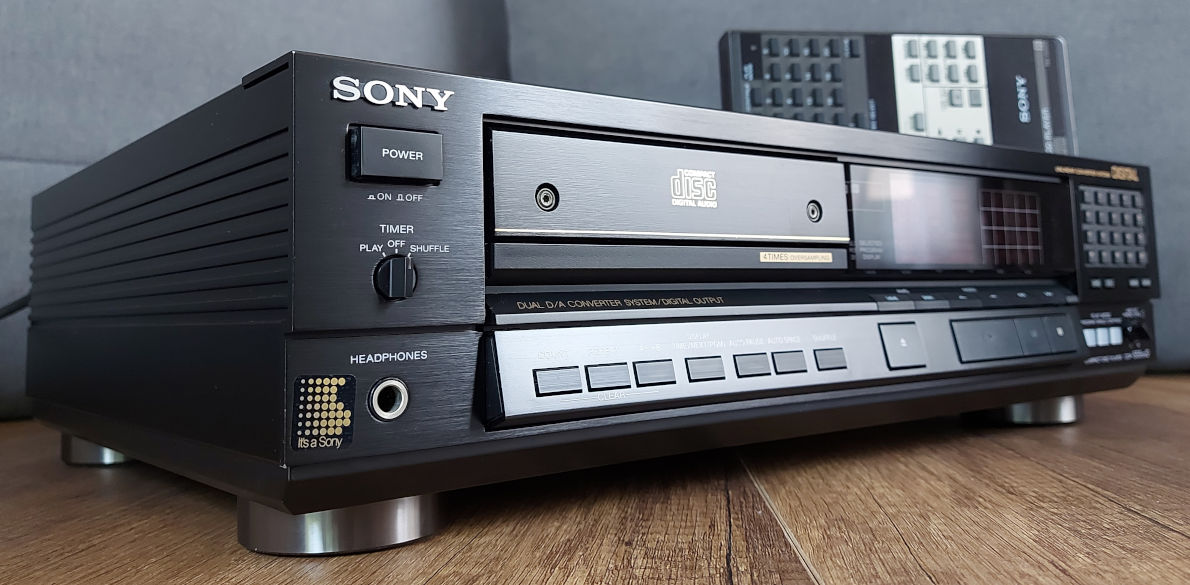
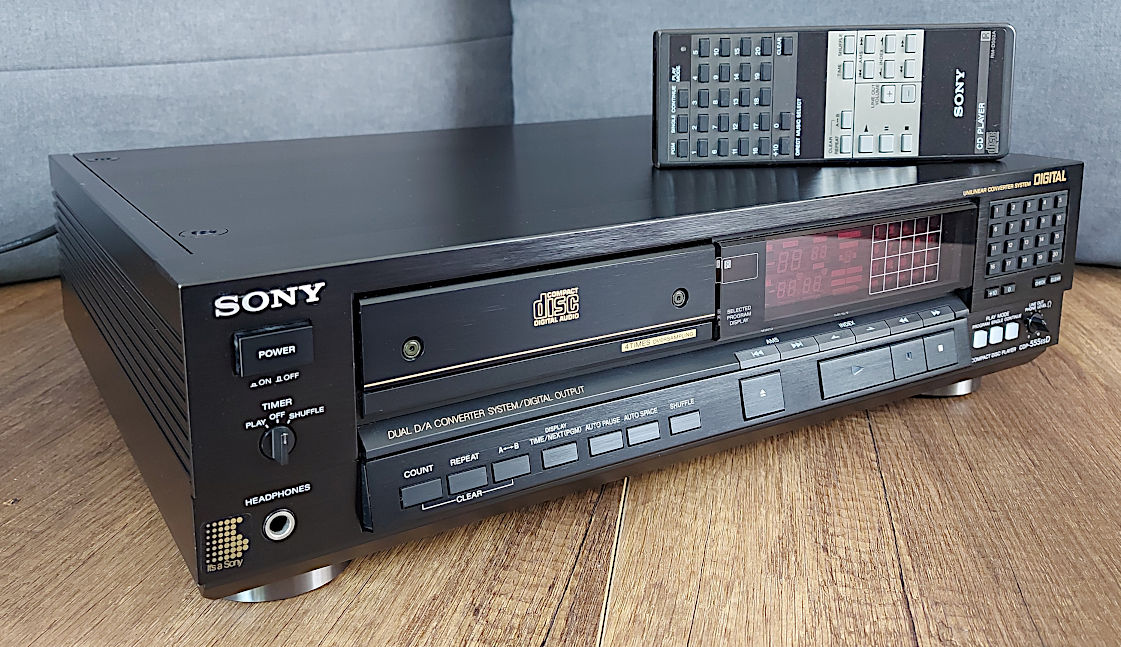
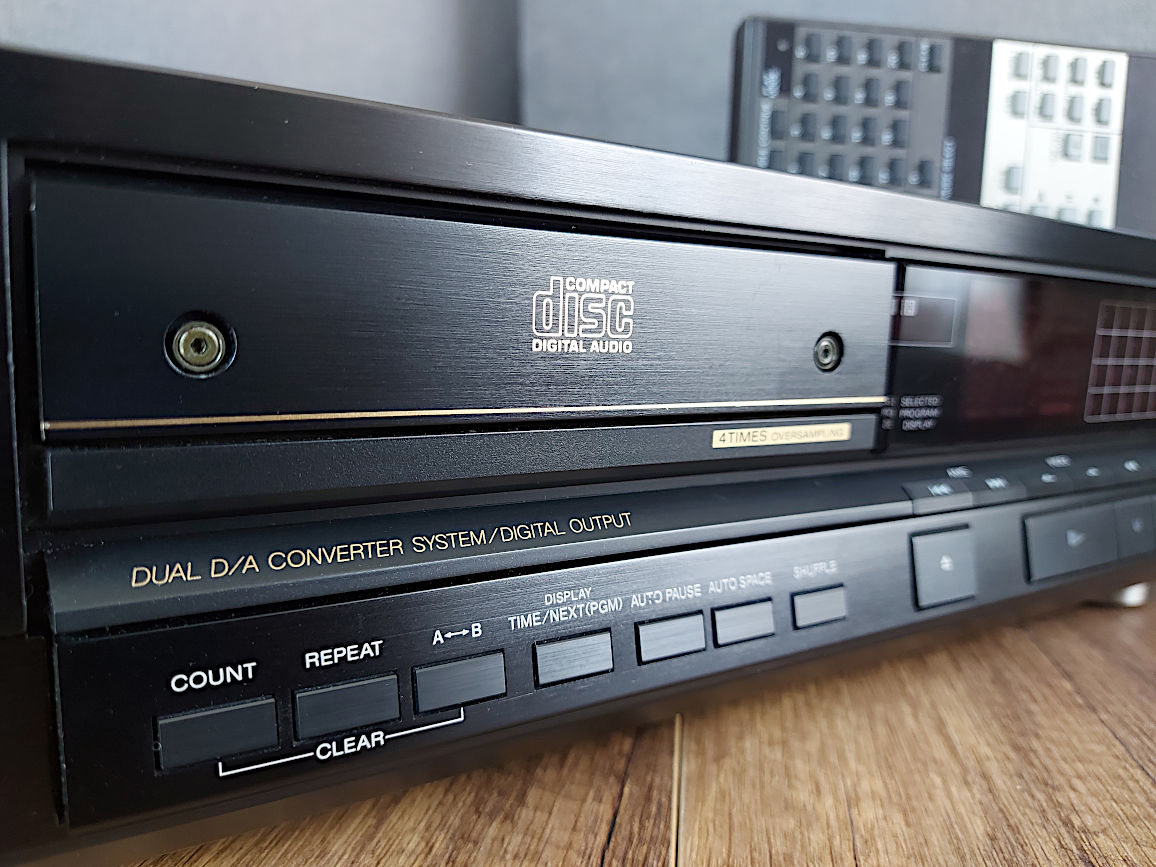
The 555ESD got a massive and heavy case. It looks a bit bumfordish, but it’s likable (at least for me), and the details are sophisticated. It’s not too big in size, 32 cm deep and 43 cm wide without the transformers.
In these old players, the mechanism had to be locked for transport, and this is also the case with the 555ESD: you can lock and unlock the mechanism for transport with a screwdriver on the bottom of the player.
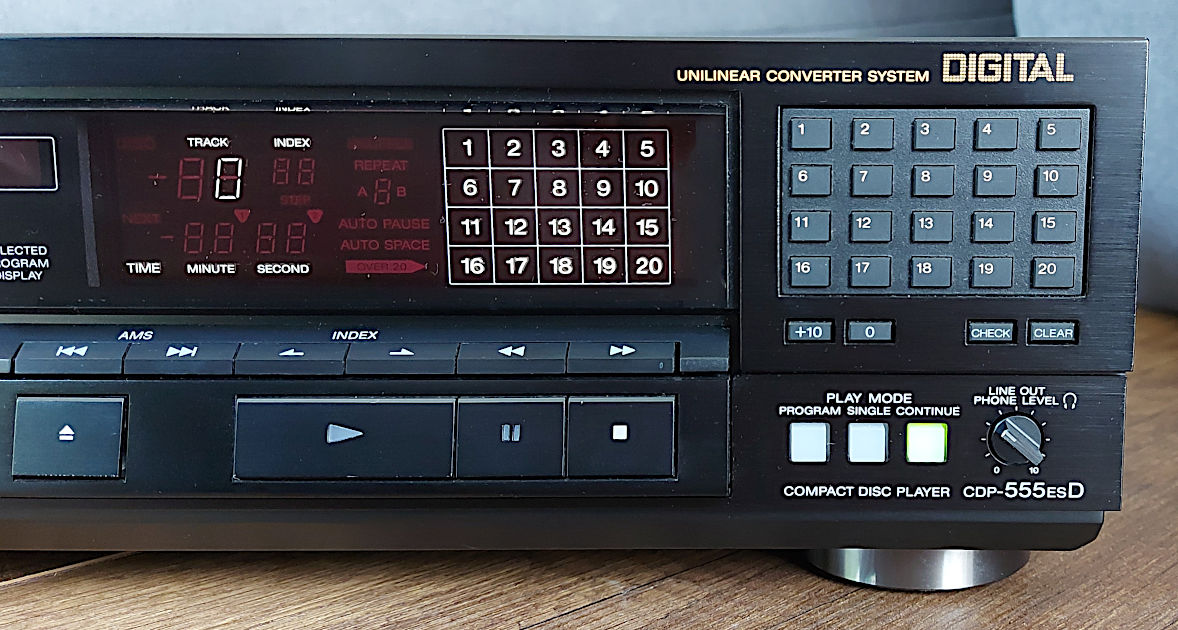
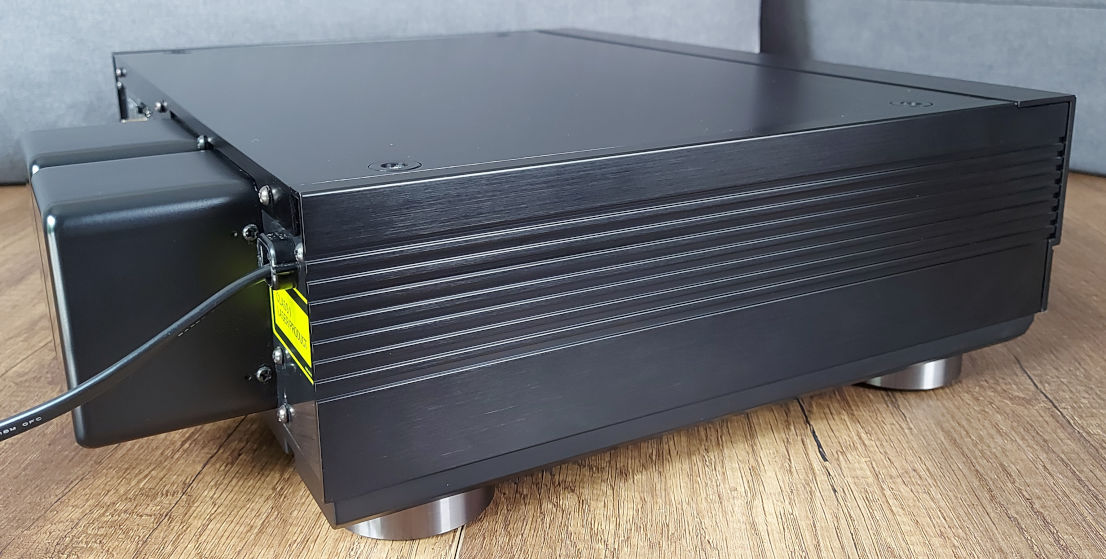
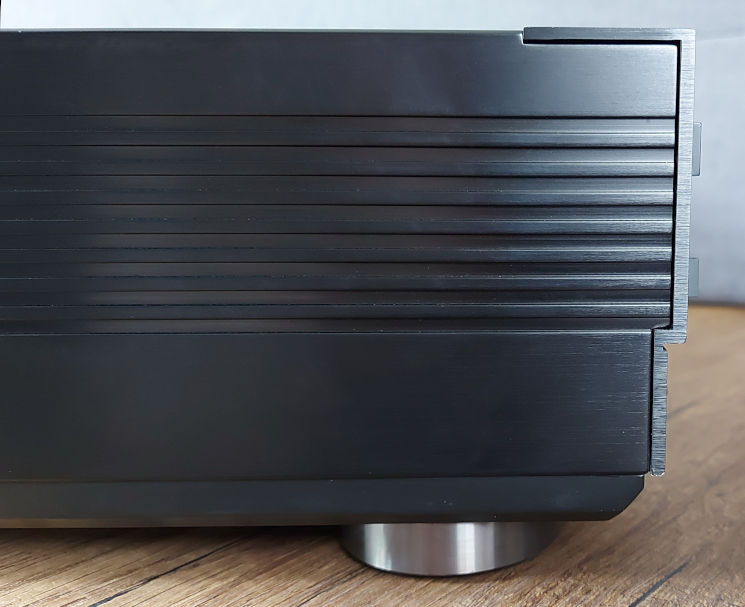
The front panel is a 3 mm thick brushed metal plate, the side panel is 2 mm thick, polished. The top of the player is also 3 mm thick. At that time, all Sony CD players were black, the champagne color only appeared in the top category years later. The external joints of the 555ESD are top quality. The brushed front panel on the top is very nice, the meeting of the top panel and the polished side panel, the stripe running lengthwise. The four upper screws were placed in a metal sealing ring, but the top panel was also fixed at the back. The side panel has a striped pattern, similar to the previous players, but there are no screws on it. (The wooden side panel only appeared in the next generation of CD players.) These details alone make the player stand out in the ES series, but what makes it even more of a curiosity is the almost one and a half cm thick G-chassis.
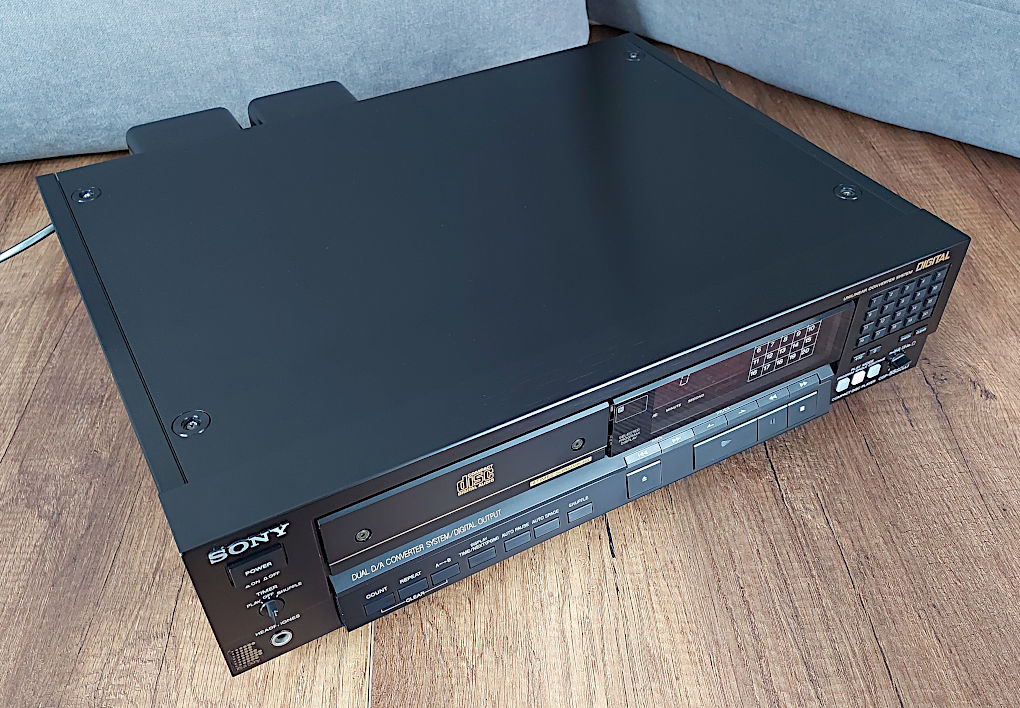
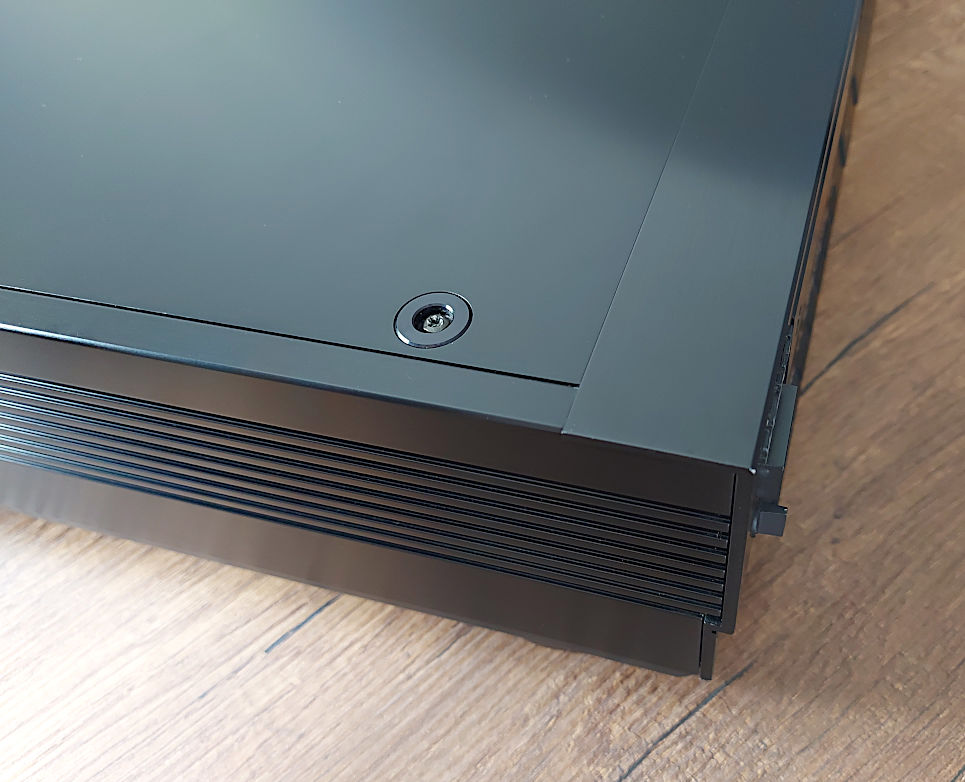
Sony invented the so-called cerasin material sometime in the 70s, which – as far as can be gleaned from the marketing materials – is a kind of metal-resin-ceramic mixture and began to be used in hi-fi devices due to its high strength and vibration-absorbing properties. This was replaced by the fancy material Gibraltar (abbreviated as G). It is not clear to me whether G and cerasin essentially mean the same thing. According to the marketing materials, the G material is a resin-calcium-carbonate-fiberglass mixture. In the mid-80s, Sony started to make so-called G-chassis: a thick, lattice chassis was created from the material called Gibraltar and the ES class amplifiers were built on it. The Japanese brochures said that for vibration-absorbing and shielding reasons it would be best to build the amplifiers on a large rock. Like the rock in the Strait of Gibraltar, for example. That’s why they created this solid material and named it Gibraltar, and the chassis built from it are called G-chassis.
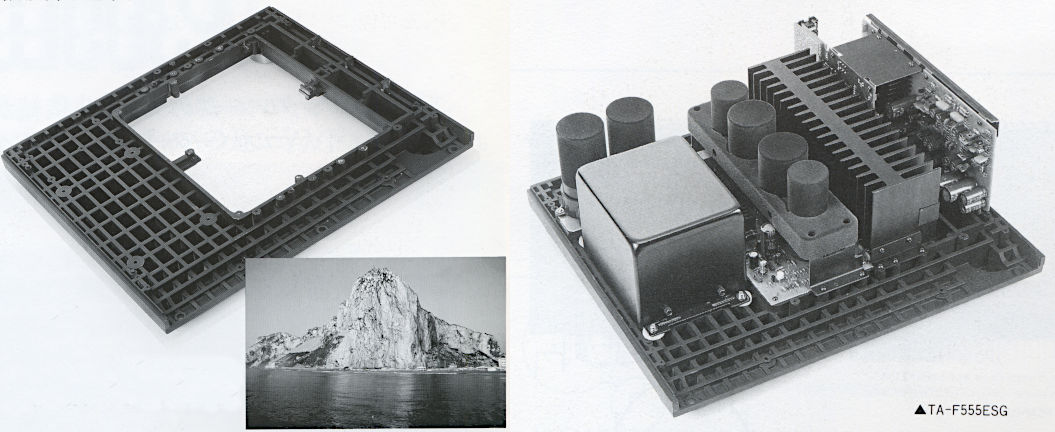
G-chassis and amplifier built on it from the late 80s from Sony brochures of the time. In the 80s and early 90s, many ES series amplifiers were built in this construction.
Sony engineers thought this material could be good for CD player chassis, so they built the 555ESD on this G chassis. This chassis is almost one and a half centimeters thick, is cast from a single material, has a lattice structure inside, is heavy and rigid. (I won’t take a picture of the inside, because I don’t want to completely disassemble my player, there is a photo of it on this page.)
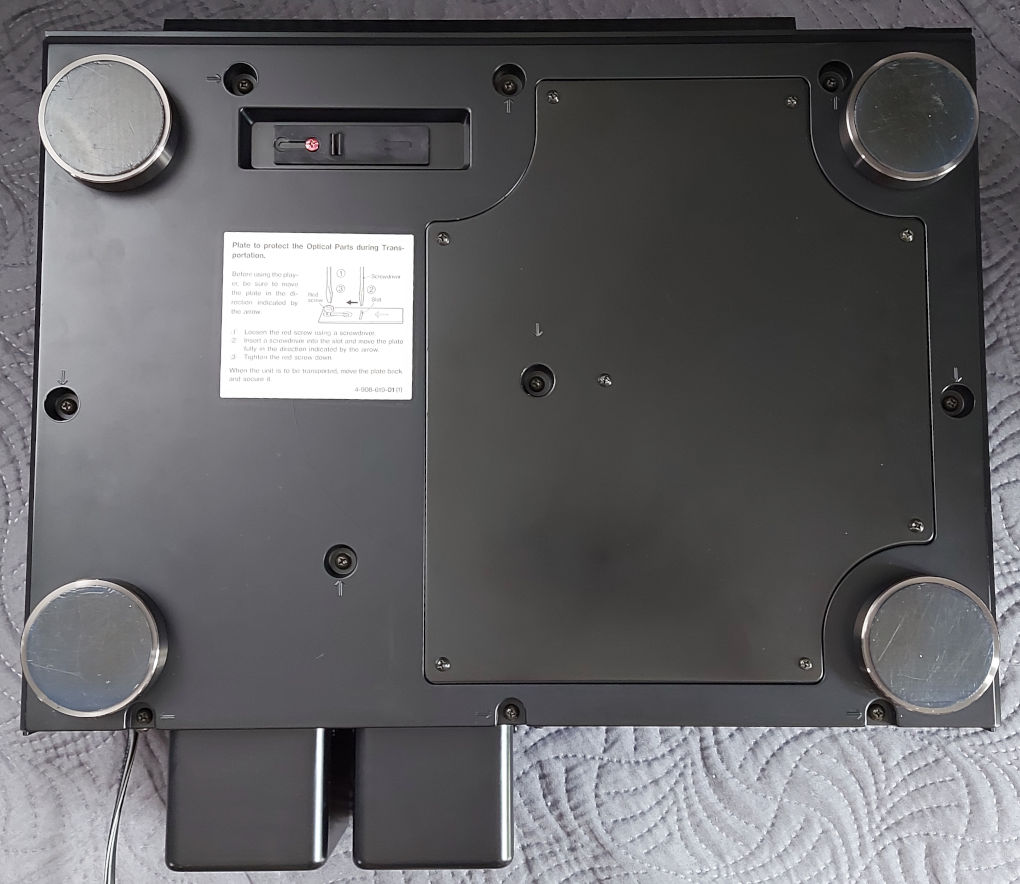
The bottom of the player. The transport lock mechanism is on top. The G-chassis on the bottom of the player is completely filled, there are no large holes in it like in amplifiers. The large metal plate on the right is just an extra plate on the G-chassis, probably for shielding purposes.
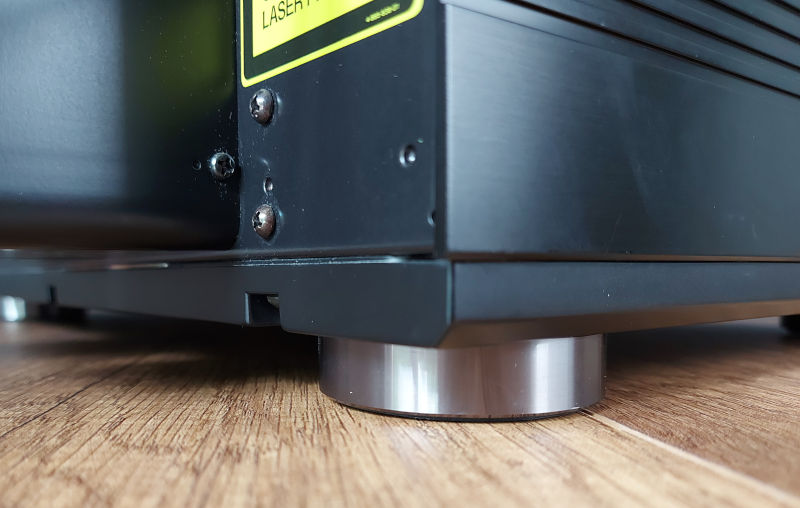
This photo shows how thick the G-chassis is. The base of the player is also molded from the G-chassis, but it has a rubber foot and a beautiful shiny gray metal ring. It’s a shame the whole player wasn’t painted a similar shiny gray!
For some reason, Sony later returned to the much more prosaic sheet metal chassis and the so-called FB chassis (the player was built into a kind of metal frame). Thus, the 555ESD is the only CD player in history that has a G chassis! I don’t know why they didn’t continue this construction, maybe it was too expensive? But then the entire line of ES amplifiers with G chassis probably wouldn’t have been produced until 1993 (although they used the same shape for years, but in the case of CD players it would have had to be redesigned for each new model). I can’t say that it didn’t work out, because many of the 555ESDs are still functional today and there are no problems with the chassis. I don’t know the reason, but it is certain that a case of this quality and design was not produced later. Some people say that the 555ESD has the best case of all time among ES series CD players. (It is true that the CDP-557ESD and CDP-337ESD still had a G-chassis under the mechanism, but the housing itself no longer contained Gibraltar material.)
The 555ESD was the first to have separate transformers for the digital and analog sections, and they were housed in a resin-cast housing. This is also its most distinctive feature, as they were located on the back of the housing. This may not be the most elegant solution, but there would have been no room for them inside. Later, all my new high-end players had two (or one double-core) transformers, only inside the housing (as electronics took up less and less space).
The front panel controls are made of plastic, the factory power cable is quite long, about 2 meters. The player weighs more than 14 kilos, most of which is due to the two transformers and the G-chassis.
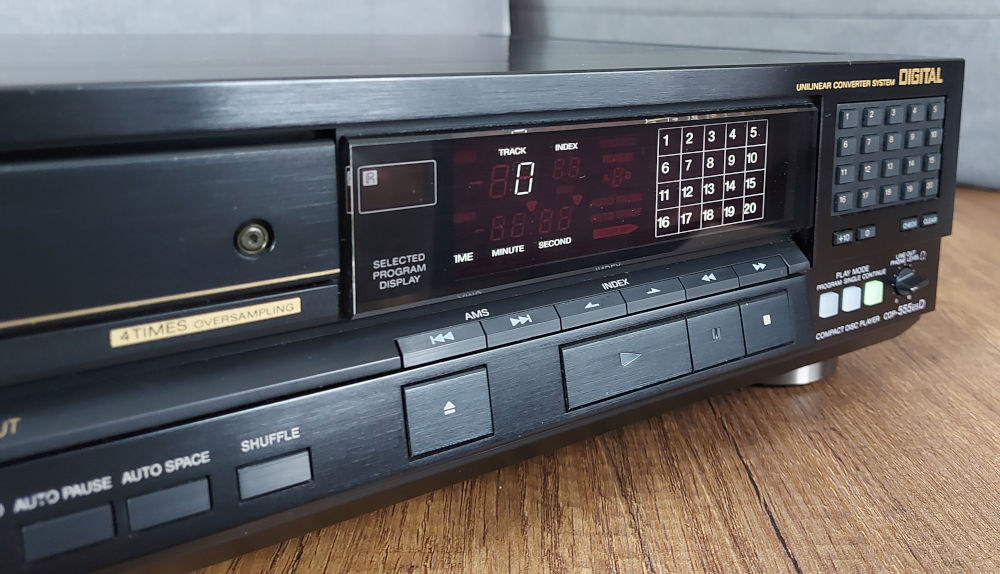
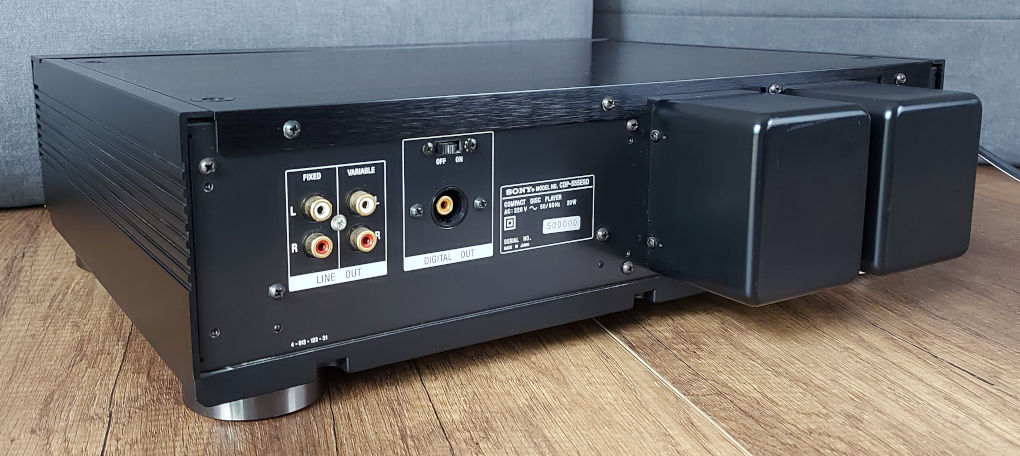
Disc tray
The tray part of the disc tray is plastic, with plastic disc holding plates, in a metal plate frame and with a metal front panel. There are small plates attached to the bottom of the tray for some unknown purpose. Although according to the aforementioned Fono Forum magazine, the disc tray is the best among the players of the time, the more massive, rounded trays of Gibraltar material of later players represented an improvement in this regard. Although I have to admit, the more I use it, the more I like it. Moreover, the two sides of the 555ESD tray are quite close to the disc, so removing the disc is inconvenient for someone who – like me – holds both sides. The disc tray moves quite quickly on a clean and maintained player, it even knocks the disc a little when opening, but this does not cause a problem. The fast movement of the disc tray, the lightning-fast track access and rewind create a pretty impressive overall impression. In the case of more worn-out mechanism, the tray opens slower. By the way, the tray of the next player, the 557ESD, and even the CDP-R1 player, also has a similar design. Although they accept small 8-inch discs, which the 555ESD does not yet.
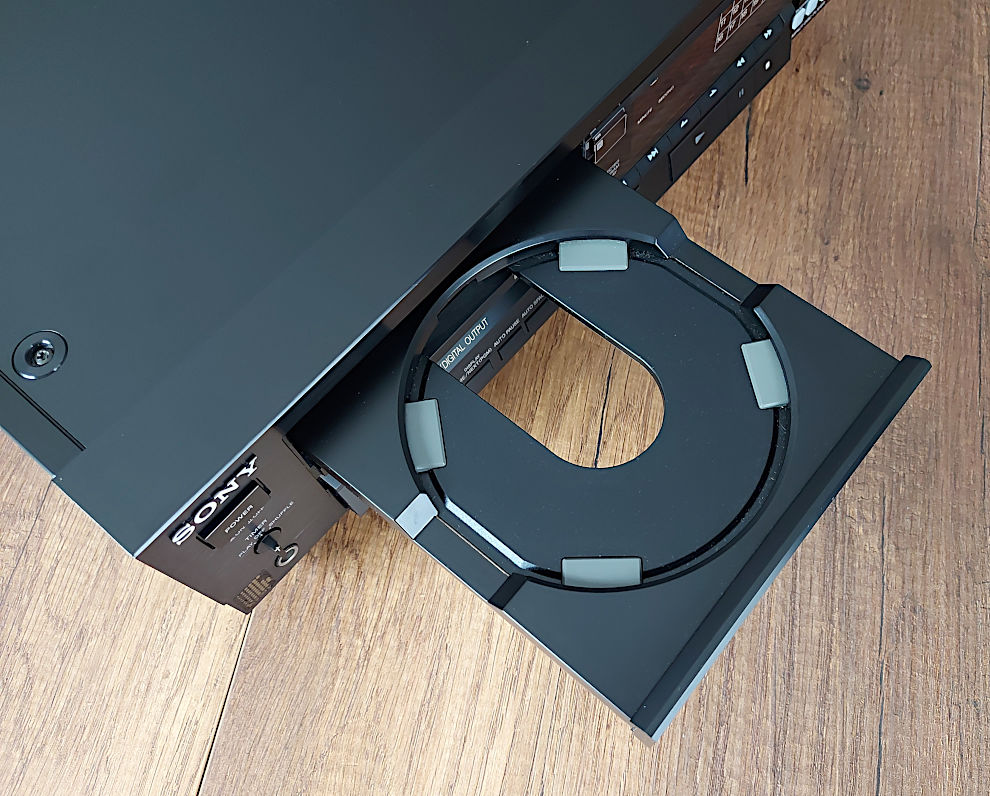
The CD is supported on the disc tray only by four small gray plates, otherwise it does not touch anything else. The frame and front of the tray are metal, but the middle part is plastic. When the tray is retracted and there is a disc on it, the middle plastic part detaches from the tray and lowers to the pickup, and the CD sits on the rotating disc tray.
In later mechanisms, the mechanism itself moves when the CD is loaded, so it was possible to manufacture a disc tray molded from one piece. In these early machines, however, the entire mechanism was still fixed and the disc tray itself was mechanical, which moved the CD to the correct position.
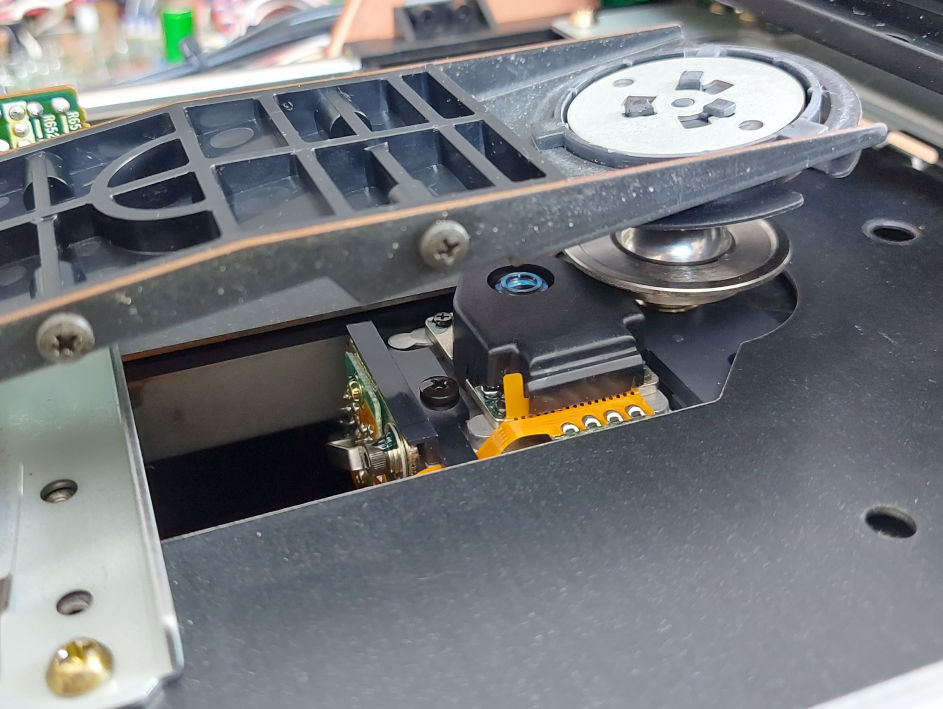
With the record tray pulled out, you can see the aluminum base plate, the pickup in the aluminum die-casting, and the rotating record tray.
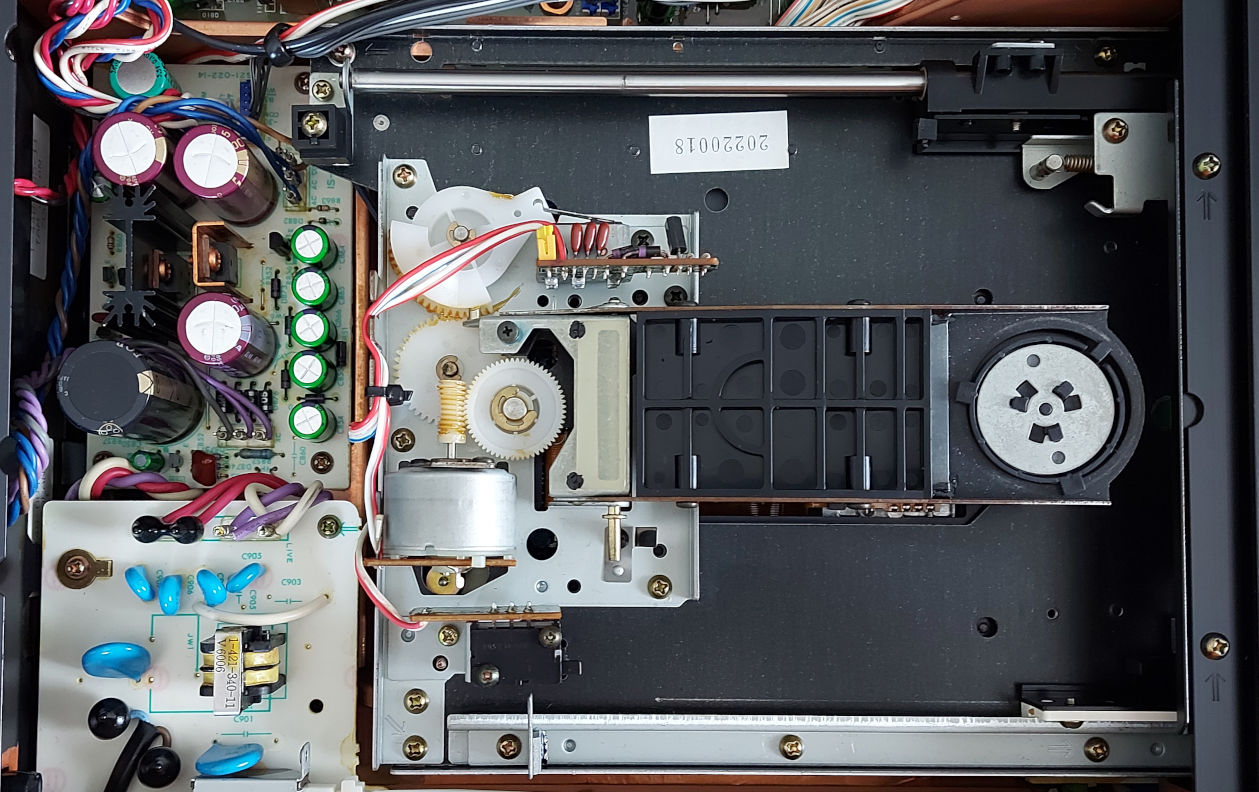
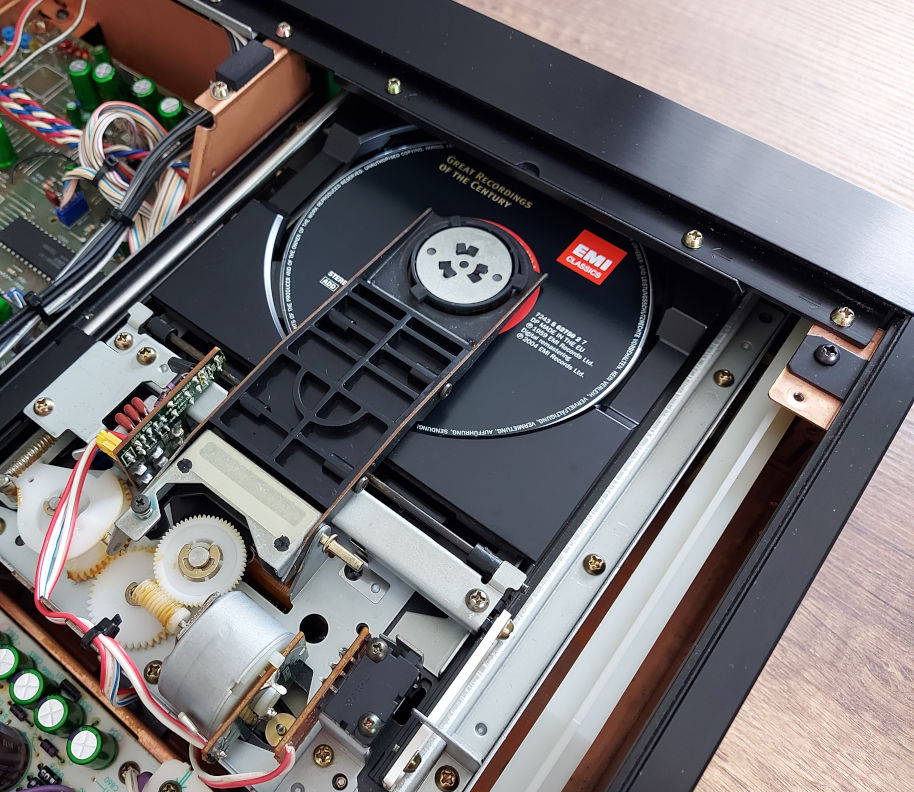
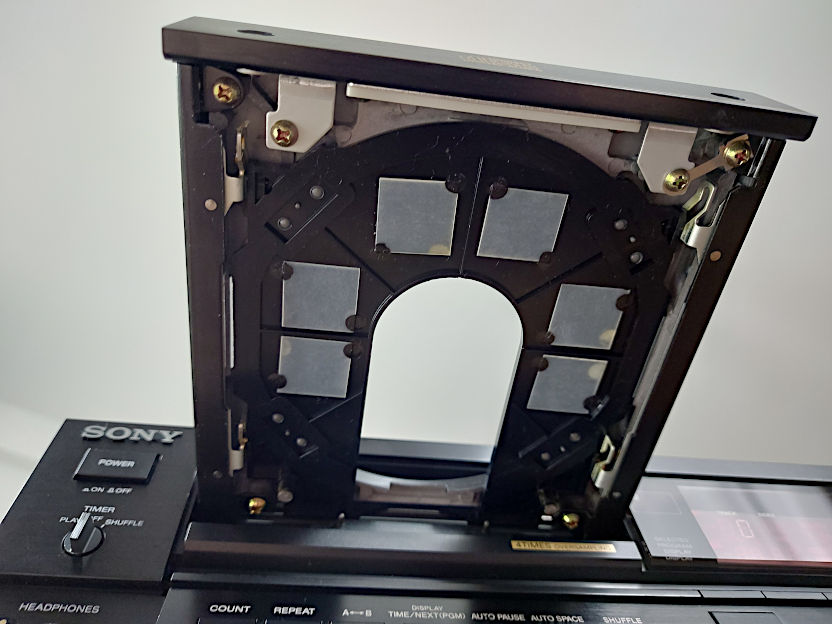
Sony developed the „Acoustic Sealed” solution for the next model, the 557ESD, which is a rubber that seals the disc tray opening, so it closes without gaps. Sony developed this based on marketing materials to prevent sound vibrations from outside from entering the player, but I think it also dampens the quiet chirping of the disc motor. This is not yet available on the 555ESD, if I open the top, I can see into the player in a very thin strip on both sides of the disc tray, and when playing, if you listen closely, you can hear a quiet chirping sound. This, as well as the plastic disc tray, is a small disadvantage compared to later players.
Remote controller
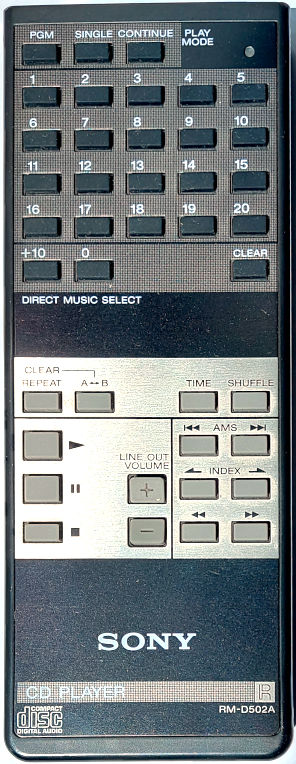
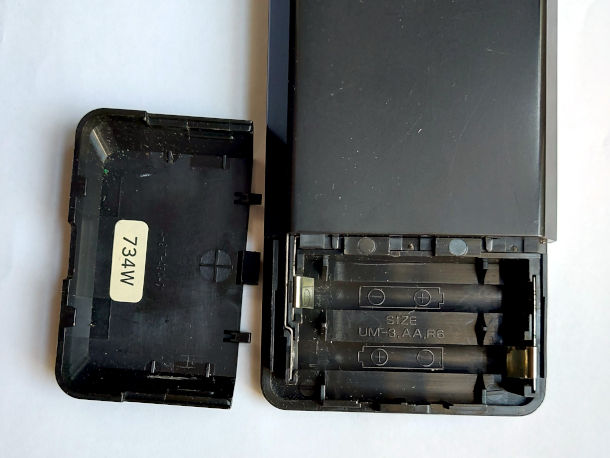
The RM-D502A remote controller is a further development of the previous ES remote controller. This type only belonged to the 555ESD. It follows the Sony design that was common at the time, its buttons (at least in new condition) give a very good quality and solid feeling when pressed. The volume control buttons are slanted. When a button is pressed, a small red LED also indicates the function. However, it has one shortcoming: we cannot operate the disc tray with it, it does not have an eject button. The player itself could handle it, because it also works with later remote controllers (except for an empty closed disc tray, which does not open with a later remote control either).
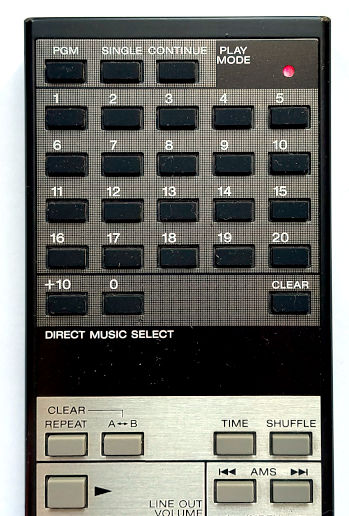
A small red LED indicator.
Interior
When you remove the cover, the player exudes a sense of order, sophistication, and quality. This may not come across as clearly in photos, but it’s very convincing in person.
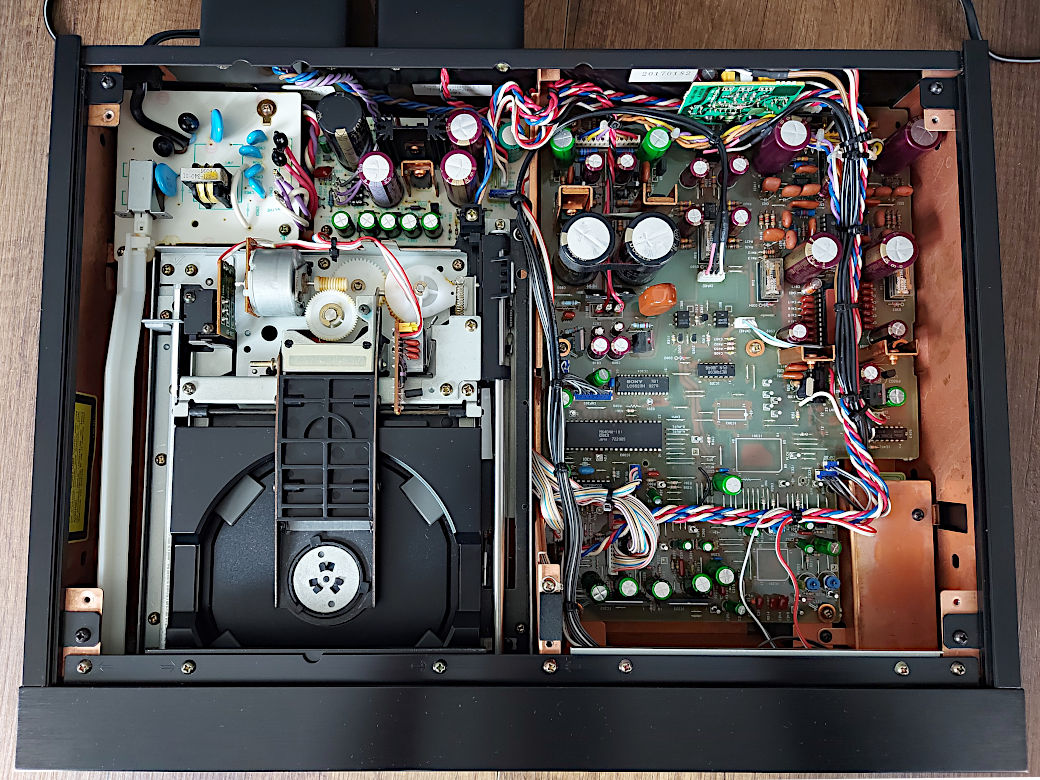
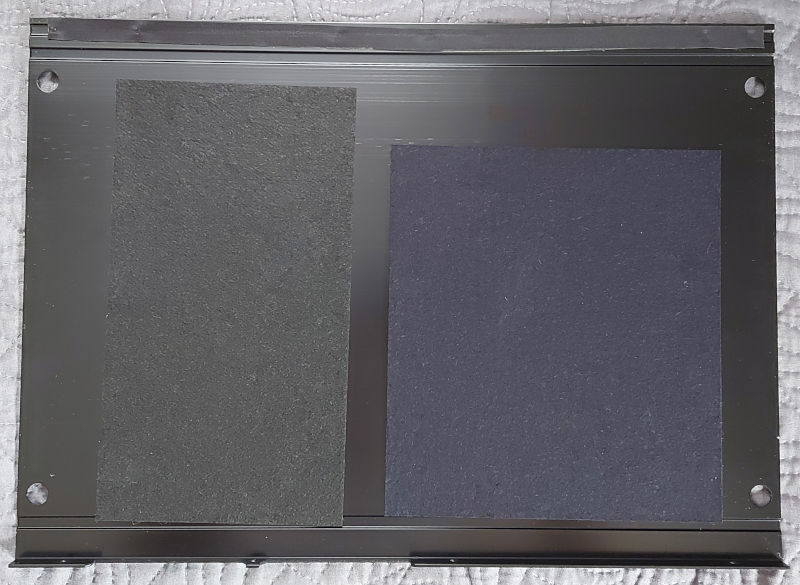
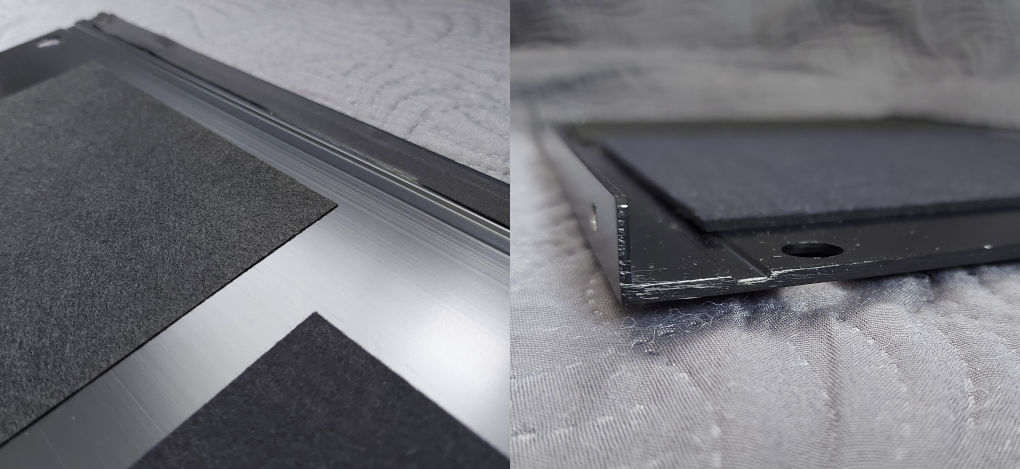
The frame of the player is made of copper-plated metal sheets, which Sony has used for many years in most of its high-end hi-fi components. Grey vibration-damping material has been glued to various parts of the frame, and two thick felts have been applied to the top plate, and a long felt strip has been applied to the front. The top plate is also insulated from the frame by a small piece of foam, which is glued to the frame. The mechanism is housed in a separate inner frame.
Mechanism
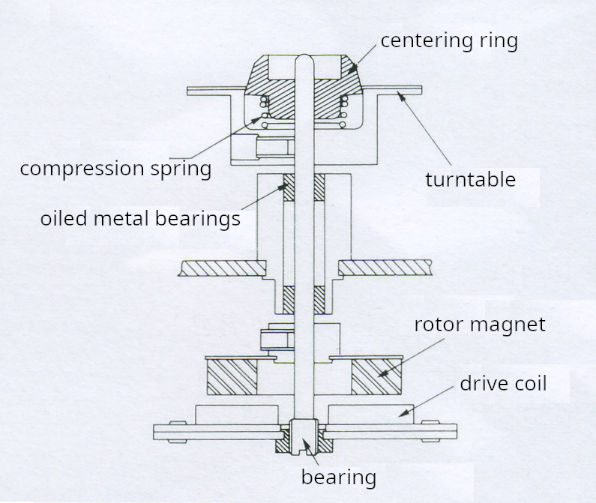
Sony designated the mechanism in several ways. The entire mechanism, including the tray, loading motor, and rotation motor, was designated CDM4A-IE. Within this, the disc motor, linear reading motor, pickup, and associated assemblies were the base unit, in this case the BU-1E.
The origin of the mechanism dates back to the CDP-502ES player, released two years earlier, in November 1984. The CDP-502ES was the pinnacle of the second generation of Sony players, which contained many important innovations. It featured 2x oversampling, as well as the BU-1 linear motor, which enabled playback without moving parts (gears) and lightning-fast track switching. The predecessor of the 555ESD remote control (RM-D502) also appeared with this unit. The 502ES (and its counterpart, the CDP-552ESD with digital output) were a very important milestone and can essentially be considered the predecessors of the CDP-555ESD.

Sony developed the BU-1 mechanism in two steps: the BU-1C and the BU-1E were released. The BU-1C was included in the 555ESD’s immediate predecessors, and the BU-1E in the 555ESD. There is not much difference between the two, the lens of the C version is still made of glass, and that of the E version is made of plastic, but otherwise the two mechanisms are completely interchangeable. The BU-1E (and C) are essentially the king of Sony’s linear motor mechanisms (you can find detailed photos of the BU-1C here ). The frame is made of a material called cerasin (or was coated with it, the Japanese brochure is not clear. In the case of the BU-1, it was an aluminum plate). The pickup is a „sled” and a piece of aluminum casting that moves on the magnetic rail. The optics, laser and coils themselves are mounted on this. The turntable motor is also a top-end BSL motor. Sony made many good linear motor drives later, but the original, which still shows the technology in the clearest and least cost-cutting way, is the BU-1E. Lightning fast, durable and solid. True high-end (even more so now, because Sony stopped producing linear motor drives in the late 90s, and the quality of CD drives went into a steep decline and has now reached its lowest point).
Sony also analyzes the magnetic disc chuck and the solution for holding the disc in detail in its contemporary catalog (translated from Japanese using Google Translate): „The chucking mechanism must hold the disc flat while maintaining sufficient precision against eccentricity. Soul Sony has paid meticulous attention to this point, employing a precise tapered chucking method to absorb the 100μ eccentricity of the disc’s center hole dimension (15mm + 0.1 – 0, specified). This keeps the center hole eccentricity within a negligible range. The Soul chucking arm also employs a double-layer structure of resin and metal to significantly suppress vibration. Furthermore, the underside of the arm is flattened to prevent air vortices generated during rotation from causing the disc to wobble—a kind of aerodynamic measure (CDP-555ESD, 333ESD).„
Electronics
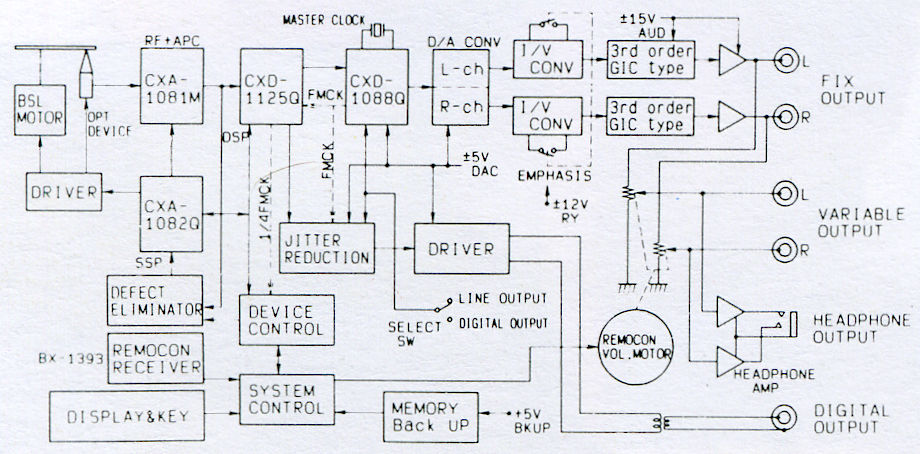
Block diagram of the CDP-555ESD from the October 1986 Japanese catalog
Of course, every single component in the player is of the highest quality available. The main PCB is a light green epoxy resin found only in Sony’s top-of-the-line products. The digital and analog circuits are all on a single PCB, with the servo and digital signal processing ICs at the bottom of the PCB, and the DAC, control system and analog circuits at the top:
- Sony CXD1088Q: digital filter
- Sony CXD1125Q: digital signal processor
- Sony CXA1082Q: servo
- Philips TDA 1541: DAC
- OKI MSM6404A: 4-bit microcontroller with 4000 bytes of ROM and 128 bytes (256 words) of RAM.
- Sony LC6523H: microcontroller
- Sanyo LC3516AML: 2 kbyte RAM
The motorized blue ALPS volume control is located in a separate small covered, shielded cage and even after 40 years it works perfectly, no creaking, no contact defects. The internal picture is basically determined by the ELNA Duorex wine red and Nichicon MUSE green capacitors. Next to them are three large ELNA For Audio capacitors, two of them on the main PCB, for the analog circuits. These two capacitors are connected by some kind of „headband”, which was probably used by Sony engineers for vibration damping. The digital part and the display power supply are located on a separate PCB, behind the mechanics.
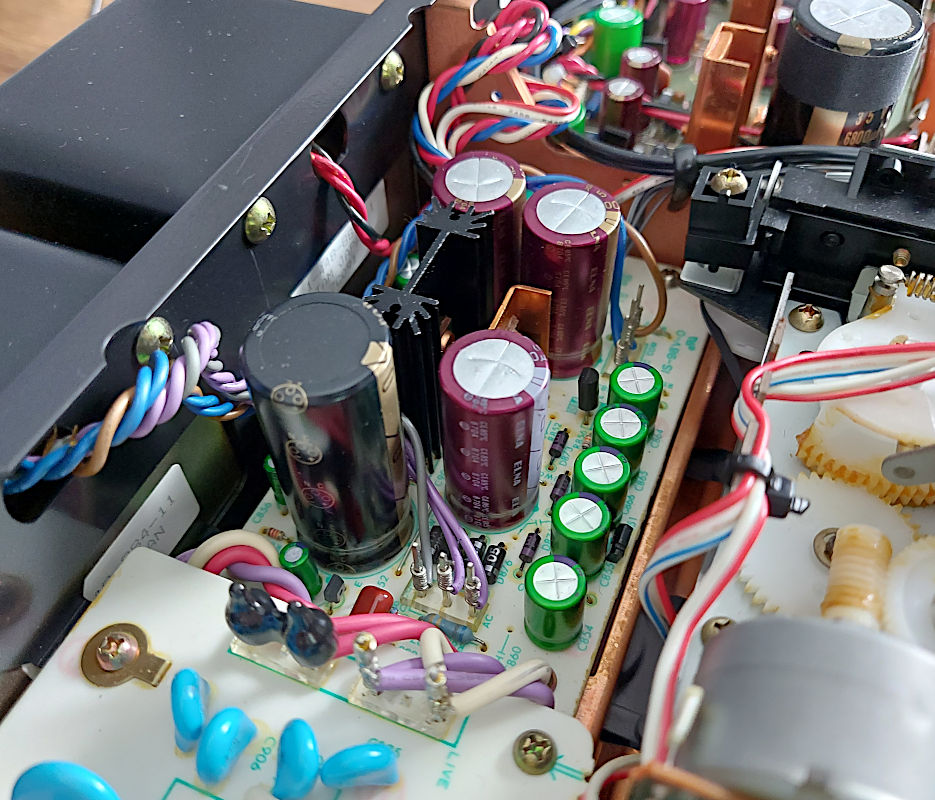
Power supply for the digital part and display
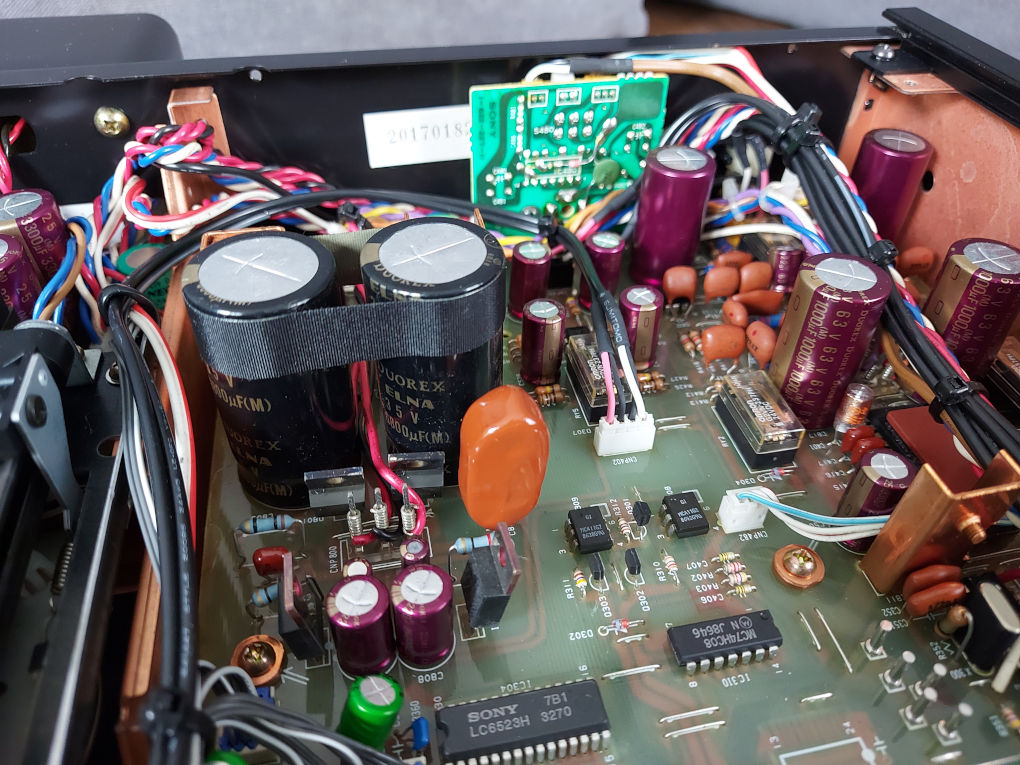
The analog part and the DAC power supply, on the right the DAC and the analog part.
The player receives its clock from a single main clock oscillator, which is 16.9 MHz, which is used by the signal processing and servo circuits and the Philips TDA 1541 DAC. Thanks to the brand new 4x oversampling, the DAC works from a 176.4 kHz 16-bit PCM source. Although these numbers don’t attract much attention today, if we consider that in 1986 the common home computer Commodore 64 was 1 MHz, and the epoch-making 16 MHz 386 processor had been released a year earlier and cost astronomical amounts at the time, a CD player operating at 16 MHz and converting 176.4 kHz 16-bit PCM was ultra high-end. (The 12 MHz 286 processor was released in August 1985 for $260, which would be $810 today. The Philips TDA 1540 also worked at 176.4 kHz in the very first Philips CD player, but with 14-bit data.)
Sony first introduced its error correction solution called S-SERVO with this generation, which was later improved in several stages. Let’s look again at the Japanese catalog of the time: „A groundbreaking predictive control system, „S-Servo,” has been developed and installed to enhance tracking ability.
This system features a newly developed IC that predicts and detects signal dropouts caused by disc contamination, etc. When this IC detects a fault on the disc occurring at the same frequency as the disc’s rotation cycle, it immediately predicts the timing of the next occurrence based on its periodicity. It appropriately controls the servo amount of both the tracking and focus servo circuits, minimizing the occurrence of errors. Its prediction time accuracy is highly precise, at 8,000 times per second, and it supports CLV (Constant Linear Velocity), ensuring stable and highly accurate fault response at any location on the disc, regardless of the inner or outer circumference, even with different rotation cycles. Unlike conventional methods that switched the servo loop gain after a dropout occurred, this system can switch immediately before a dropout occurs, resulting in a more robust and stable tracking capability against disc faults.
The second feature of „S-Servo”: It remains a servo system that is faithful to the original sound reproduction.
„S-Servo” improves tracking capability while simultaneously enhancing the sound quality of the CD player itself. Currently, the most power-consuming and rapidly fluctuating component of a CD player is the tracking and focus servo system. This can generate „dirty control currents,” affecting the analog circuitry and potentially degrading the music signal. The servo system itself, which is essential for a CD player’s functionality, was actually one of the factors that degraded the sound. However, predictive control significantly reduces the correction and interpolation caused by errors, minimizing servo current fluctuations, reducing negative impacts on the analog circuitry, and enabling more faithful reproduction of the original sound. (CDP-555ESD, 333ESD, 222ES, 510, 330)„
As I mentioned, the DAC IC is the now legendary Philips TDA 1541, the original one, not the A version (like in the CDP-710). However, this is only reported in the factory service manual, because in the player, Sony engineers glued some kind of red chip on top of the IC. What was the purpose of this, we do not know, but we can see this solution in several players of the time, and even in the DAS-703. (There are photos on the net when someone removed this glued small chip from the top of the IC.)
Since this DAC is stereo, we only find one DAC IC in the player. Next to it are the high-quality film capacitors.
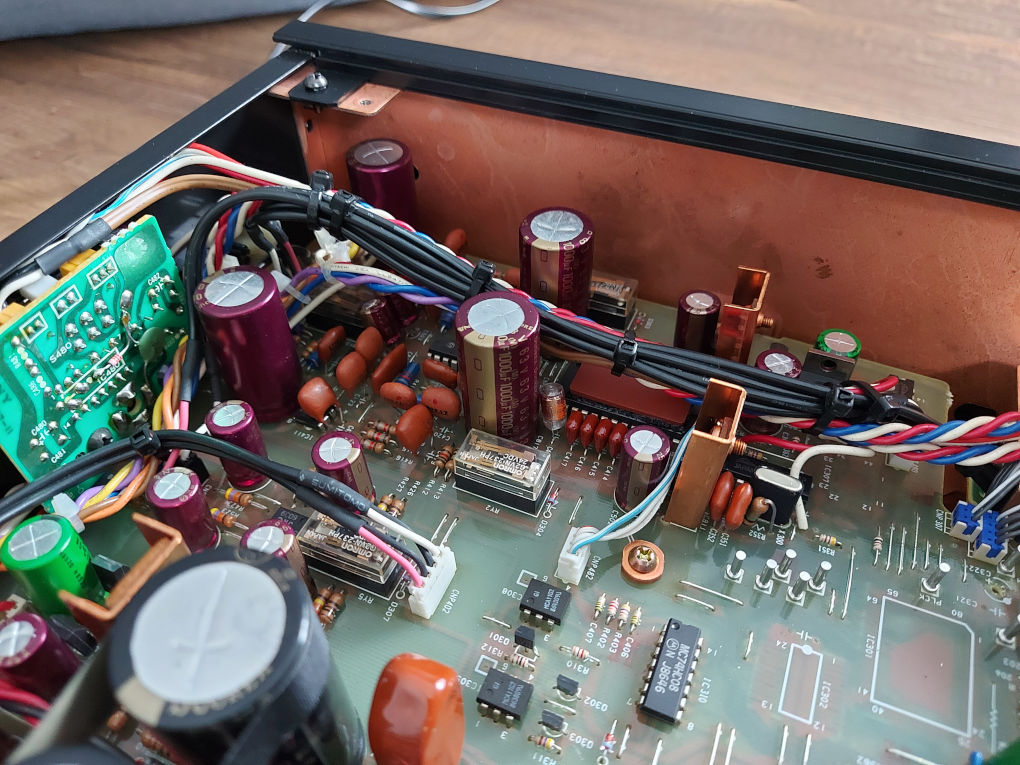
DAC and analog section
The output is first fed to a Mitsubishi M5240P dual operational amplifier, which also implements de-emphasis (if necessary), then a JRC 5532DD (3rd-order GIC low-pass filter) and a TI NE5534P op-amp per channel. Both channels also have separate, independent voltage regulators. Internal LC-OFC cables for power supply, headphone output and digital information are made by Hitachi. The analog signal is directly fed to gold-plated RCA connectors soldered to the PCB. Except of course for the volume-controlled output, which first goes through the already mentioned ALPS potentiometer and . Of course, a front-panel headphone output is also available.
The player also has four Omron g2vn-237pH relays. Two of them switch the analog de-emphasis correction of the two channels. These switch an RC network directly between the I/V converter after the TDA1541 DAC and the analog filter stage.
A two-pole relay mutes the two line outputs, so there is no loud pop when switching on and off. This can mute both the fixed and variable outputs during search or faulty playback. An additional relay does the same on the headphone output.
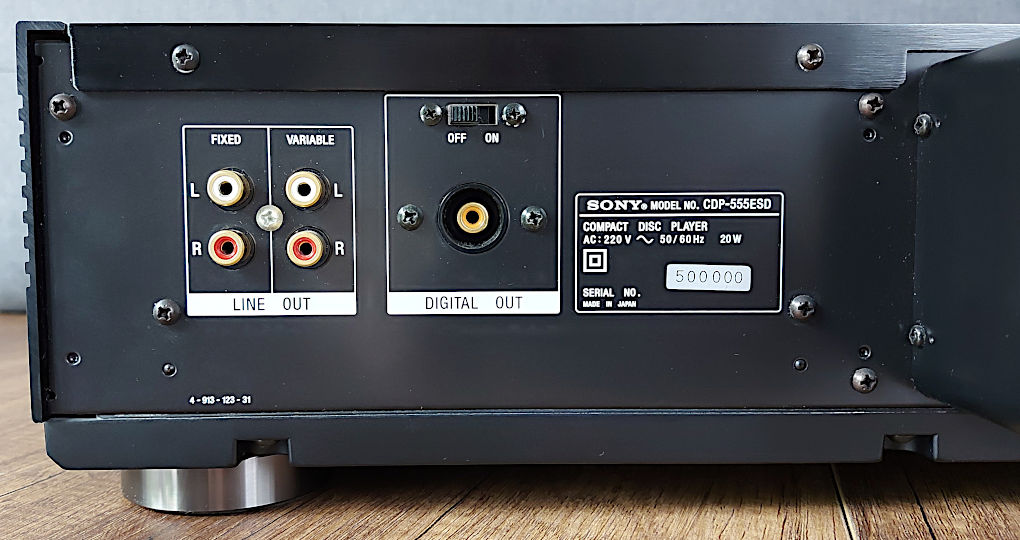
The digital output is placed on a separate small PCB on the back. If we turn it on, the analog outputs are muted. At that time, optical digital transmission did not yet exist, so we get a standard coaxial output. Sony’s contemporary catalog advertises that the sound quality can be further improved with the DAS-703ES external DAC, which is even more expensive, costing 250,000 yen (it was released a year earlier, in November 1985). Unfortunately, I don’t have one (it’s even rarer than the white raven), but since it still uses the previous 2x oversampling, it’s not certain that it would improve the sound. Of course, its construction is also non plus ultra.
Using the player
In this chapter, I will take into account the aspects that are important to me, I will not examine the services that I do not use.
Of course, the player supports all the services that are important and necessary by default. IN:DEX display, de-emphasis, track and disc time remaining. The music calendar is also useful, although not essential. It is good because you can essentially see at a glance how many tracks are left on the disc if it consists of less than 20. The operation of the disc tray and the reading and track access are of course lightning fast. With later players, in the event of prolonged use, you can feel that the CDs taken out of the player get a little warm, but the 555ESD is the coolest ES player I have ever encountered. I do not use the digital output, these high-end machines still hold their own today, there is no need to use a separate DAC. In terms of measurements, Sony’s machines usually perform excellently, the Sony CD player engineers really knew their stuff (at least back then). There are no measurements available for the 555ESD, it is probably decent due to the use of the TDA 1541, but it is nowhere near a world champion in this respect.
I can only mention two negatives. The brightness of the display on my copy is very bright, so the LCD is probably in excellent condition, but it would have been nice if the display could be turned off. This was already done on later players, but not here, which is not the most advantageous when listening in the dark. But of course it is bearable. The sealed disc tray introduced with the CDP-557ESD would have been useful here too, unfortunately the engineers did not think of this when designing the 555ESD, so the motor sound is filtered out and a faint chirp can be heard from close up during playback. In all later ES top-of-the-line players, this has been solved with a closed tray opening. Fortunately, there are no problems with the transformers, they are completely noiseless, although when you lean close, you can hear a very faint humming sound from the player.
Overall: obviously this player is not perfect and Sony has improved many things in the following generations, but overall every element radiates careful design, attention, sophistication and top quality.
Versions
This player was released worldwide, so there are several versions of it. I can only conclude from the copies I have seen on various auction sites and other places about the differences in the copies that were sold in each region, so this is not evidence, just experience. Based on the examination of the various types of the CDP-X707ES, the first digit of the serial number can clearly identify the region, because these digits are also there in the given region, even though it is a 6-year later model.
Basically, there are 4 types of CDP-555ESD, the serial number is always 6 digits:
- Japanese version: the serial number is between 200000-220000. Model No. „CDP – 555 ESD”, 100V 16W 50/60 Hz
- AEP version: the serial number is between 500000-502000. Model No. „CDP-555ESD”, 220V 20W 50/60 Hz
- UK/FR version: serial number between 600000-601000. Model No. „CDP-555ESD” 240V 20W 50/60 Hz
- USA version: serial number between 800000-801000. Model No. „CDP-705ESD” 120V 20W 60 Hz
The different models can be clearly distinguished by their back cover (the photos below are from auction sites), in the case of the AEP version, an additional feature is that the ones with higher serial numbers also had a plus label on the back cover. Unfortunately, there is no public information available about the meaning of Sony’s serial numbers at that time, most likely the higher number within each version means later production, but this is also just an assumption.
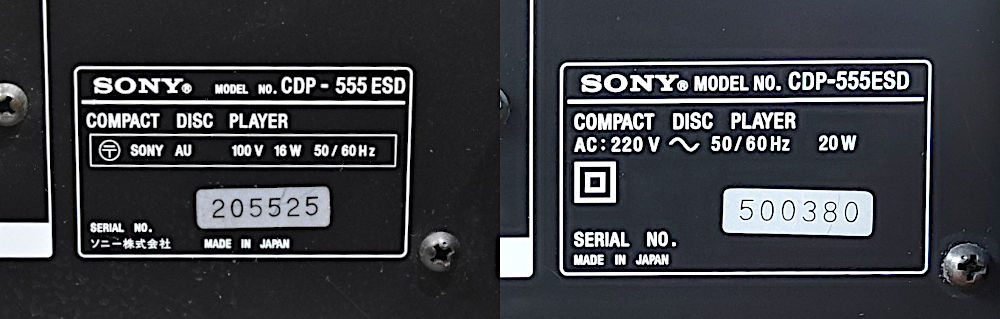
On the left is the Japanese model serial number, on the right is the AEP model serial number. The double square indicates protection class II, meaning the device is double or reinforced insulated. It does not require protective earthing.
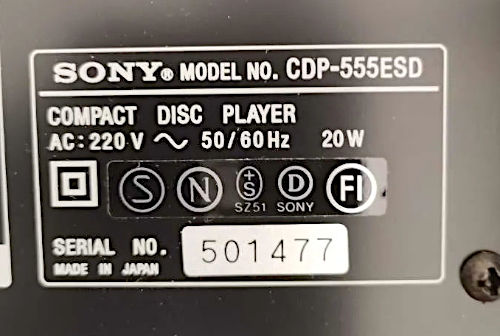
Serial number of the second (perhaps later) version of the AEP model. The extra sticker may have been added at some point at serial number 500400.
The meaning of the new pictograms, from left:
- S: the Swedish SEMKO safety certification mark
- N: the Norwegian NEMKO certification
- +S: the Swiss electrical safety approval. The SZ51 underneath is probably the certificate or permit identifier
- D: the Danish DEMKO certification.
- FI: the Finnish FIMKO certification.
The four Scandinavian symbols show that the device has been tested according to the electrical safety regulations of the given countries. This means that it can be assumed that these models with higher serial numbers have already been distributed in these countries, while the earlier ones have not yet. Perhaps the testing process in the given countries took longer, or they first started distributing in West Germany, the largest European market, and only later in other countries.
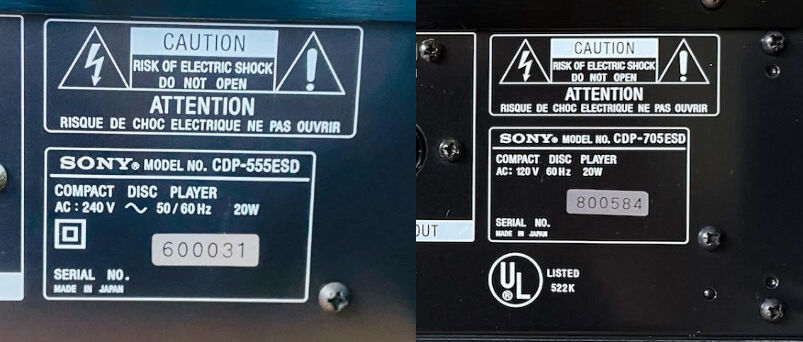
English and French versions on the left, American on the right.
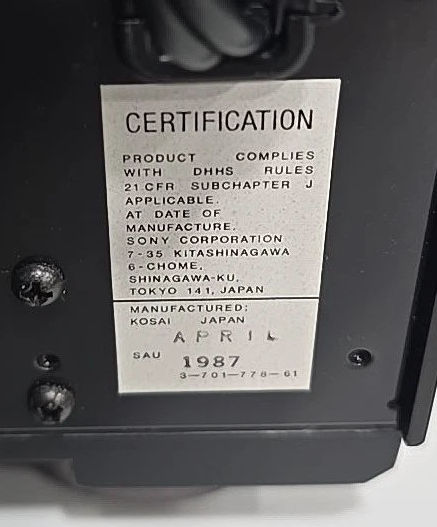
American copies still have an extra sticker on the right side under the power cord. I’ve only seen two copies where this was visible, but both had a manufacturing date of April 1987.
Although I’m not an electronics expert, according to the service manual, the internal structure (except for the different power connector) is identical for the AEP/UK versions. However, looking at the power supply, there is a clear difference between the Japanese/US and AEP/UK versions:
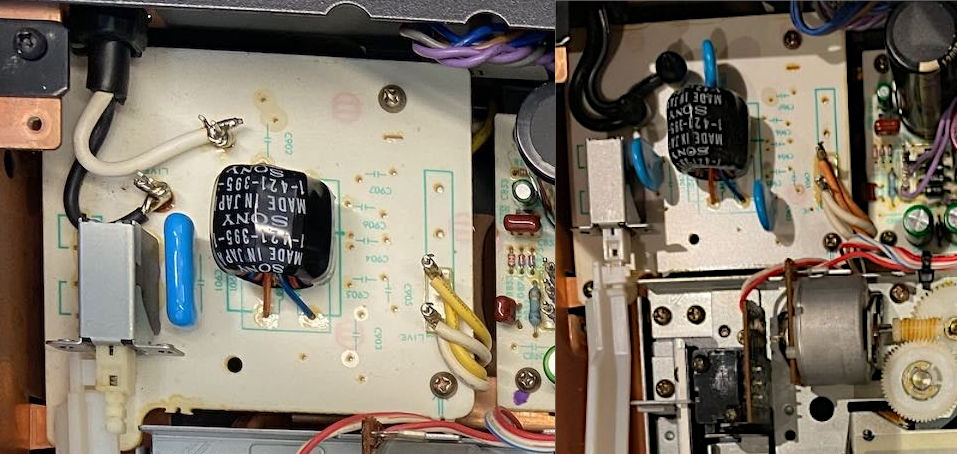
On the left is the Japanese version’s power supply PCB, on the right is the American version’s.
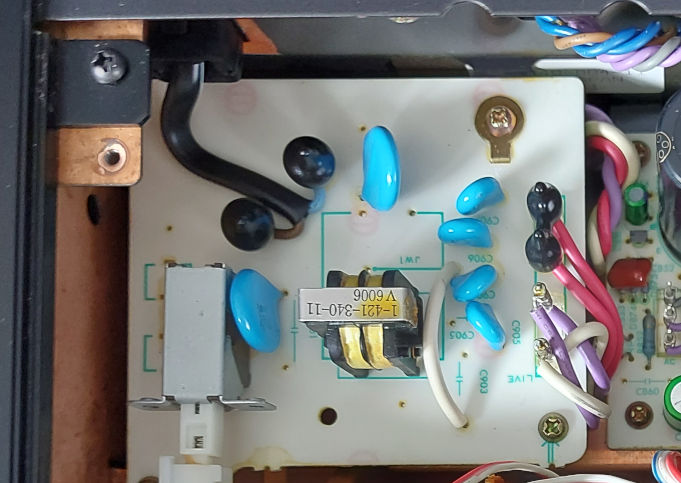
AEP version power supply PCB.
In addition to the back cover, there are also distinguishing features on the front cover. The US version’s CDP-705ESD inscription is clearly visible. In the case of the Japanese version, it is striking that the yellow „4 TIMES OVERSAMPLING” inscription on the front of the disc tray, which is present on other versions, is missing. This clearly distinguishes the Japanese version from all others. By the way, if we look at the photo in the original October 1986 catalog, instead of the DUAL D/A CONVERTER SYSTEM/DIGITAL OUTPUT inscription, it says something else: „DIRECT MUSIC SEARCH/DIGITAL OUTPUT”. The catalog photo of the inside of the player, although quite small, is also seemingly different from the reality. Based on this, it is possible that a prototype CDP-555ESD was used for the photos taken for the catalog, and some things were changed in the final version. In the April 1987 catalog, the photo of the inside actually shows the 555ESD.
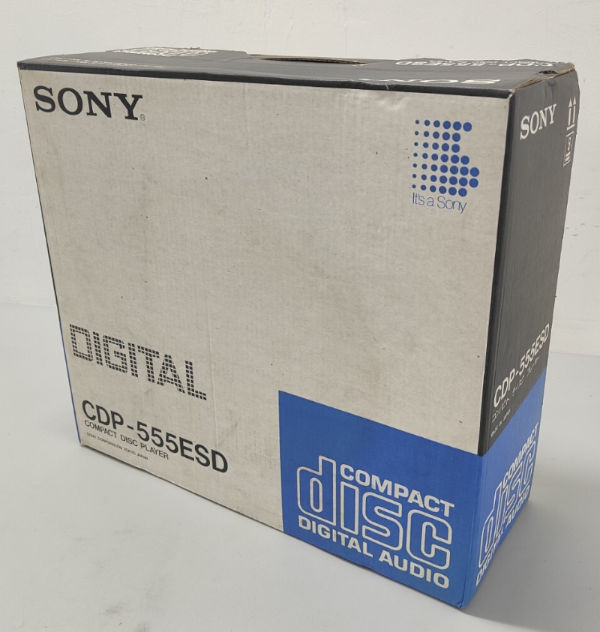
The original box of the Japanese version, but presumably the boxes intended for other markets did not differ from this, except for the Japanese inscriptions.
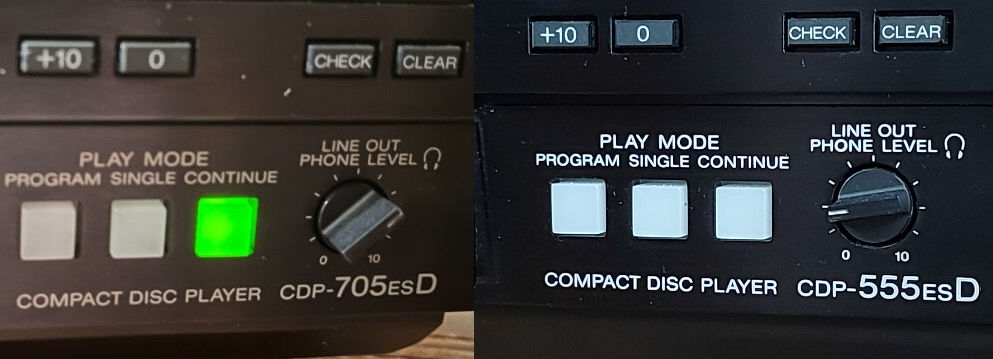
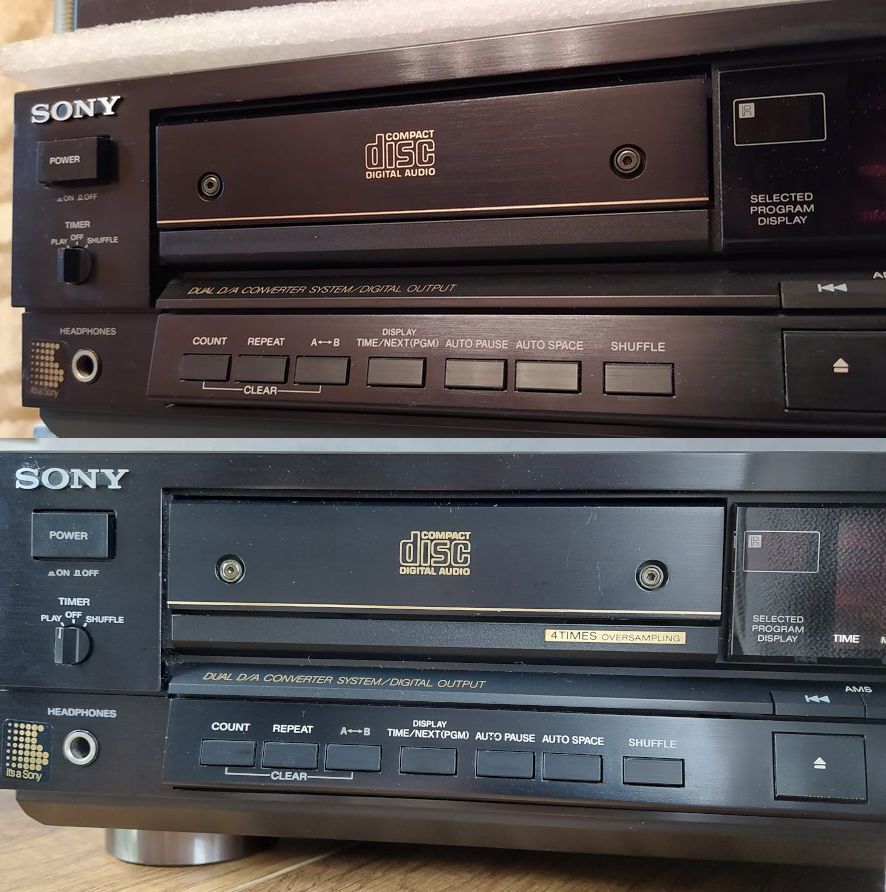
The disc tray for the Japanese version is on top, and for all other versions is on the bottom.
Technical specifications
| Japanese model | CDP-555ESD |
|---|---|
| USA/Canada model | CDP-705ESD |
| Japanese release | 1986.10 |
| International release | 1987 (?) |
| Distribution | 1986-19871 |
| Frequency response | 2-20000Hz +-0,3dB |
| Harmonic distortion | 0,0025% |
| Dynamic range | >97dB |
| Signal-to-noise ratio | >106dB |
| Channel separation | >100dB |
| DAC | |
| DAC nickname | UNILINEAR CONVERTER SYSTEM |
| Digital filter IC | CXD1088Q |
| DAC IC | TDA1541 |
| DAC clock | 176,4kHz |
| Oversampling | 4x |
| Low-pass filter | 3rd order GIC |
| Mechanism | |
| Mechanism type | CDM4A-IE |
| Base unit | BU-1E |
| Linear drive | x |
| BSL motor | x |
| Base unit material | cerasin |
| Chassis material | gibraltar |
| Servo | S-SERVO |
| Disc tray | plastic/metal |
| Outputs | |
| Line out, unbalanced | 2V 50 kOhm (1 pair RCA) |
| Variable line out, unbalanced | 0-2Vrms 50kOhm (1 pair RCA) |
| Digital coax output | 0,5V/75ohm |
| Phone jack | 28mW (32Ohm) 6,3mm |
| Remote controller type | RM-D502A |
| Power consumption | 16W (Japanese version) 20W |
| Power transformer | 2x35VA (digit/analog) |
| Dimensions | |
| Width | 430mm |
| Height | 125mm |
| Depth | 320mm (385mm with transformers) |
| Weight | 14,1kg |
| Original price | 150000 yen; 1000 GBP; 1500 USD; 3000 DM |
Róbert Sipos (2026)
Automatically translated with corrections