
Part 3 – coming soon
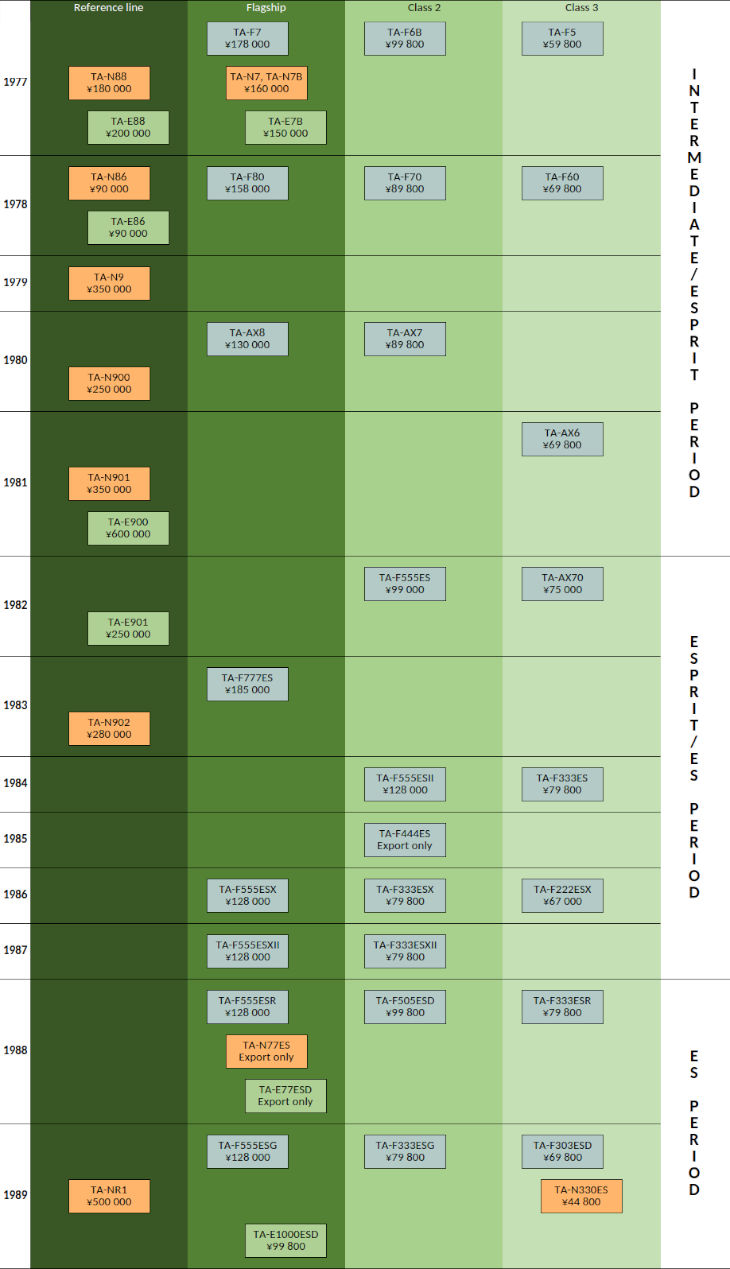
The ESPRIT family
In November, 1977, a new family of amplifiers was also released. At first, these did not yet have a new category name. This new category only included preamplifiers and power amplifiers. These amplifiers had a radically different appearance and an uncompromising design. Every small detail was subordinated to sound quality. The new philosophy is well summarized by the following inscription on the back of the new preamplifier:
„This preamplifier contains completely independent twin mono amplifiers. The chassis design and panel layout exactly follow the audio signal paths in simple and straight sequence. All major components, developed for use exclusively in this model are based upon strict specifications. A marvelous and new experience in sound reproduction is thus assured.”
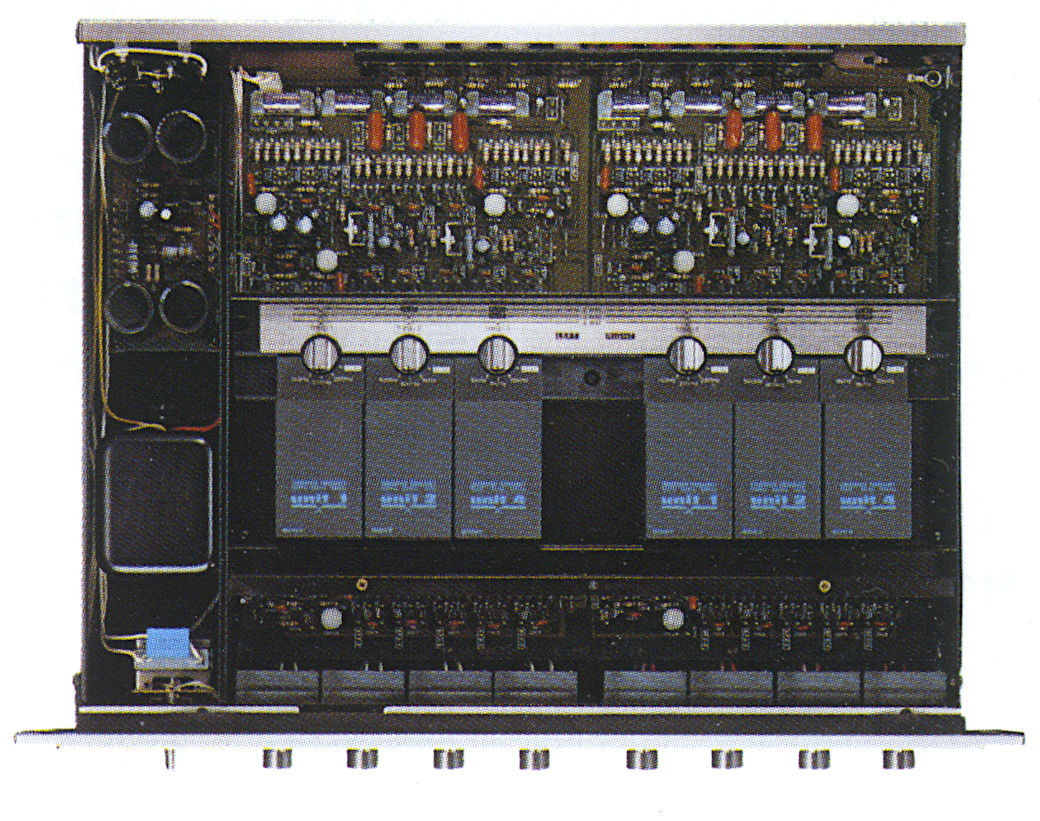
The panel design followed the shortest possible signal path, so the inputs and outputs were also unusually placed upwards on the side of the preamplifier. All new amplifiers were rack mountable. The components of this amplifier category were made to the highest possible quality standards. Of course these preamplifiers don’t include bass/treble tone controls.
These amplifiers became Sony’s new reference amplifiers and are considered to be among the best amplifiers ever made by anybody.
Around 1980 and 1981, the newer models appeared in the new catalogs under the name „ESPRIT”. Although the first models were not yet called ESPRIT, this whole amplifier category can be called ESPRIT. These amplifiers were distributed worldwide by Sony. This category existed between 1977-1986. I have to mention that in this category, Sony also produced tuner, equalizer, cassette deck and even speakers besides pre- and power amplifiers. I will not discuss these in this article however.
In 1987 the ESPRIT family was discontinued and the new „R” family of Sony reference models appeared 2 years later.
In November, 1977, a preamplifier and a power amplifier were released: TA-E88 and TA-N88 (black version E88B and N88B). The TA-N88 used V-FETs and it was unusually a class D amplifier. It was the one and only class D high end amplifier Sony ever made. Its base plate was diecast aluminium.
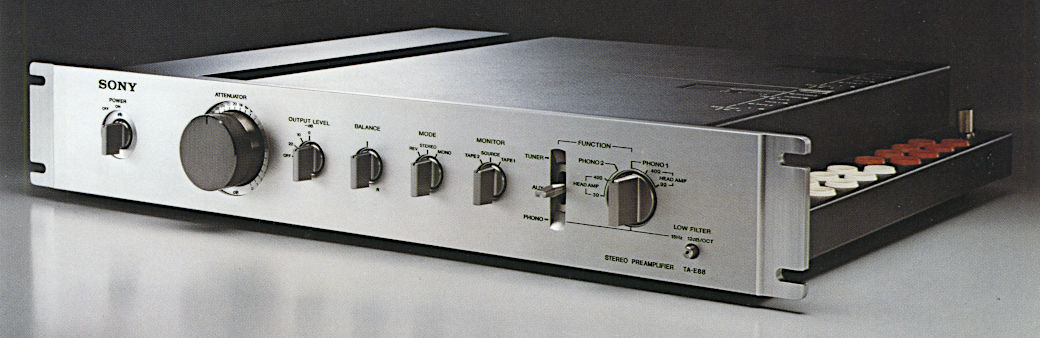
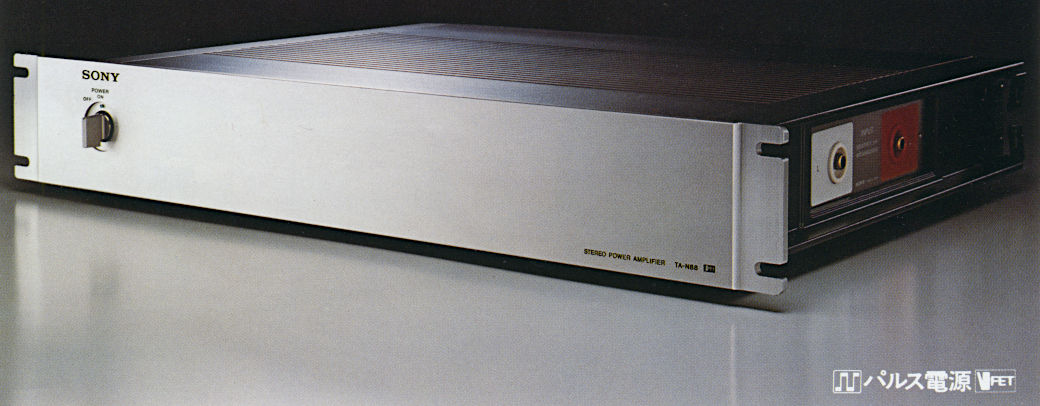
The TA-E88 and TA-N88 were available worldwide for a short time in 1978. From 1979, only TA-E88B and TA-N88B were sold overseas. These amplifiers were still being sold in Europe in 1984. The „B” versions were not sold in Japan.
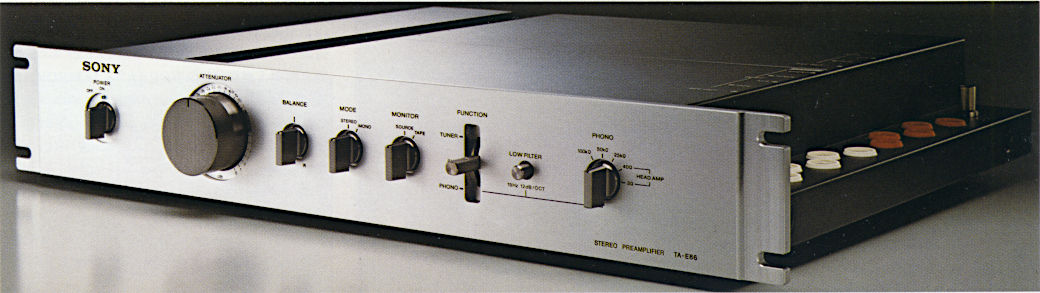
TA-N88 discontinued in 1979 but the successor model TA-N86 was released already in 1978. Probably there were problems with class D N88. N86 was class AB amplifier with switch for class A / class B operation. It’s price was half of the N88 and its circuitry was a little bit less strict specification. It is distributed until 1986 in Japan so it was one of the longest produced Sony amplifier in Japan.
In Europe it is distributed until 1980 (only the B version distributed worldwide and the silver version in Japan).
TA-E88 discontinued in 1981 but the successor model TA-E86 was released already in 1978. It’s price was less than half of the N88 and its circuitry was a little bit less strict specification. It is distributed until 1982 in Japan and 1980 in Europe (only the B version distributed worldwide and the silver version in Japan). It also did not include tone controls, but it did have a 6 dB bass boost on output 2.
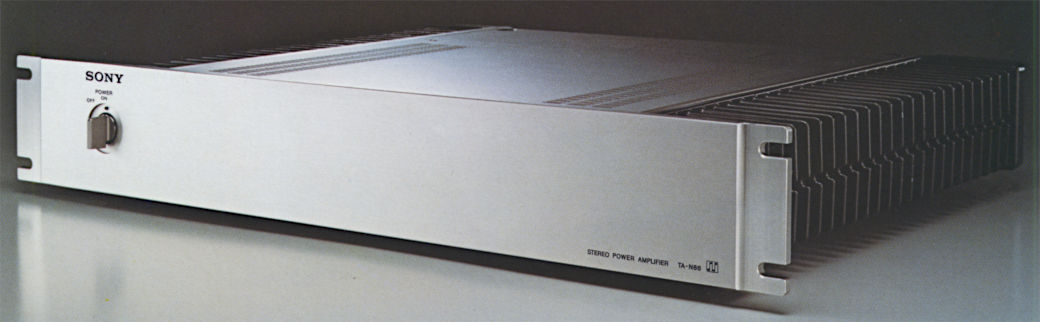
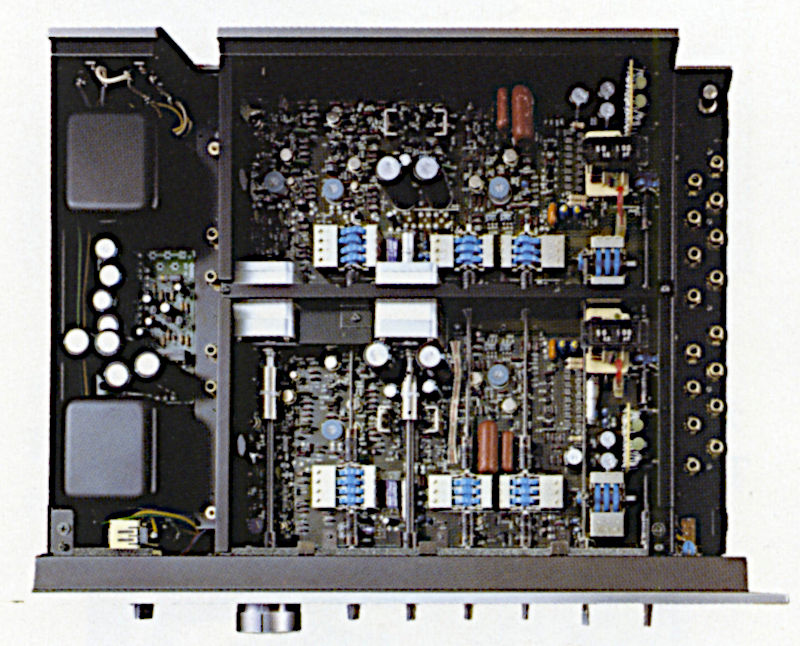
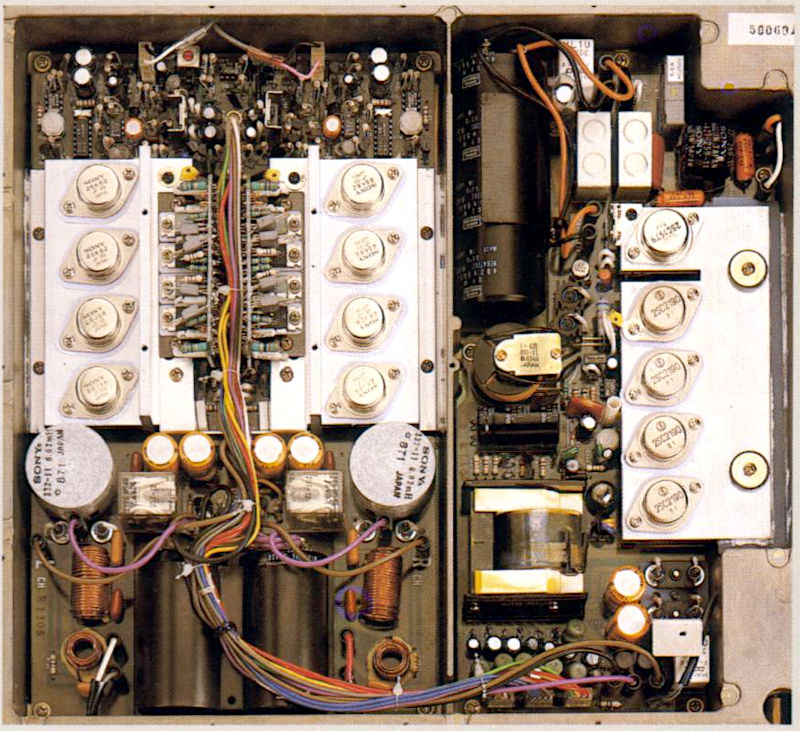
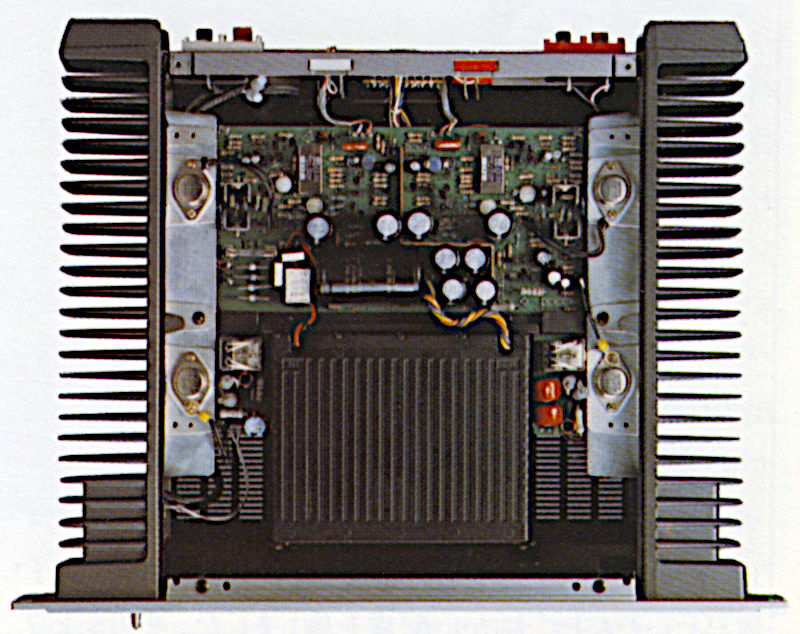
TA-N86 had outer diecast heatsink. Sony provided removable rubber band for the heatsink in order to avoid resonance from the fins. You can see the center dent on the heatsink for the rubber band.
TA-N88 and TA-N86 used switching power supply.
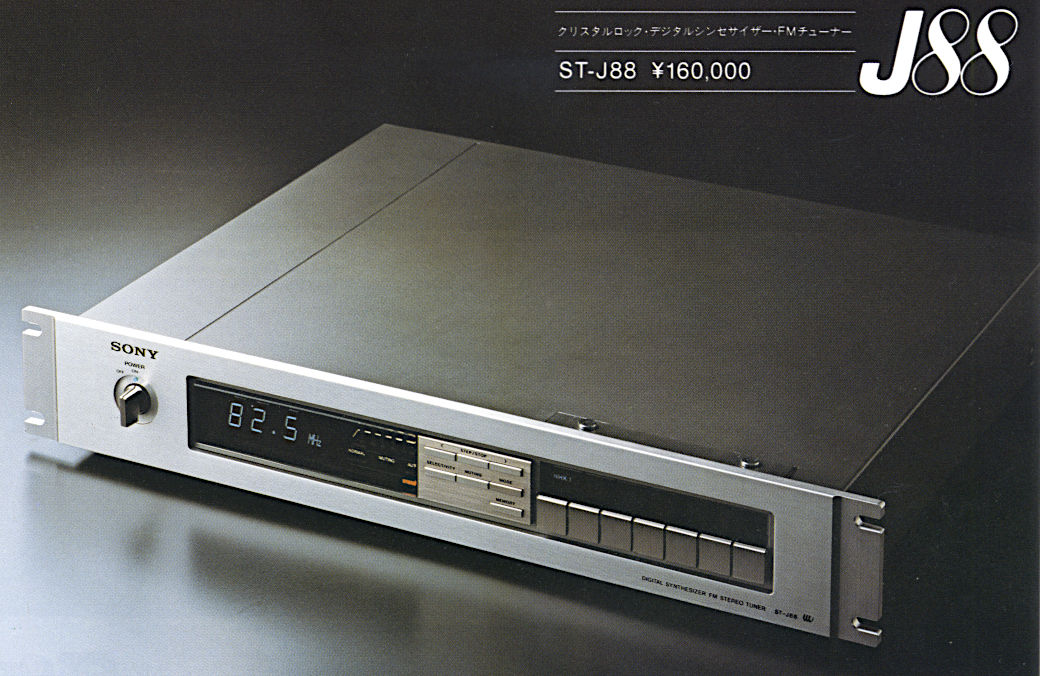
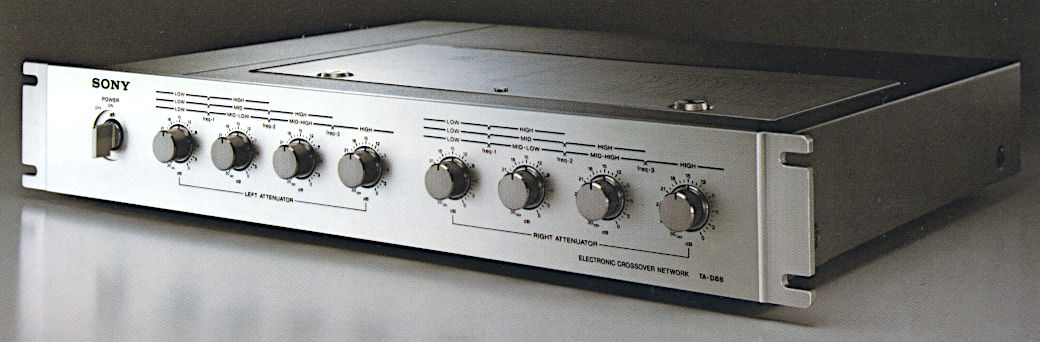
The ESPRIT name appeared in catalogs in 1980. Earliest ESPRIT catalogs contained the models TA-N88/N86 and TA-E88/E86 (and the equalizer, cassette player, tuner of course). However, new models only appeared in November, 1981, and these already included the ESPRIT inscription in their names.
The new preamplifier was the TA-E900, new power amplifier was the TA-N900. However, in the meantime a new mono power amplifier also released in 1979, it was the TA-N9. It was probably only released in Japan, however interestingly it can be seen in a 1980 German catalog too. This was by far the most expensive amplifier Sony has released up to that point. It has a different look than the other ESPRIT models. It was a switchable class A / class B MOS-FET amplifier and used switching power supply.
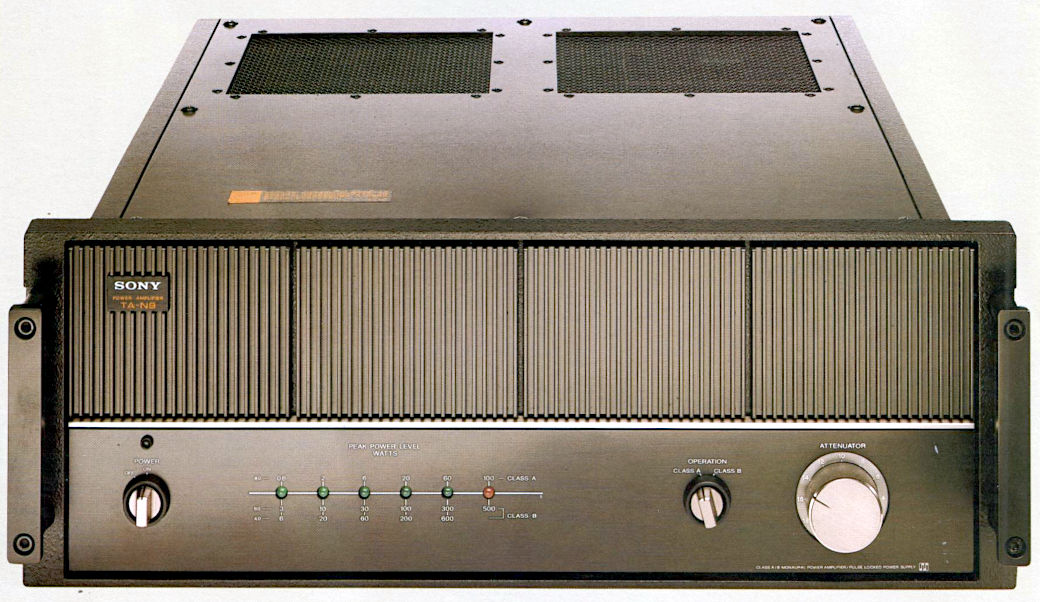
The TA-N9 was produced in very limited numbers. It also used the heat pipe cooling system, and also had a fan. (This amplifier was capable of delivering 450 W at 8 Ohms in class B mode and 80 W in class A mode.) The components of the amplifier were made to the highest possible standards in every respect, even the cooling fan used a BSL motor! (Later, Sony used this very durable and low-noise but very expensive solution for disc-spinning motors in high-end and top-of-the-range CD players.)
It was incredibly expensive, since a stereo system required two of them, which at that time cost 700 000 yen and the two amplifiers weighed a total of 36 kilograms. And you needed a very good preamplifier too. Adjusted for inflation, a stereo pair was the most expensive power amplifier Sony ever produced. (In 1975 a low category TA-1630 integrated stereo amplifier costed 29 800 yen and could produce 2 x 27 W)
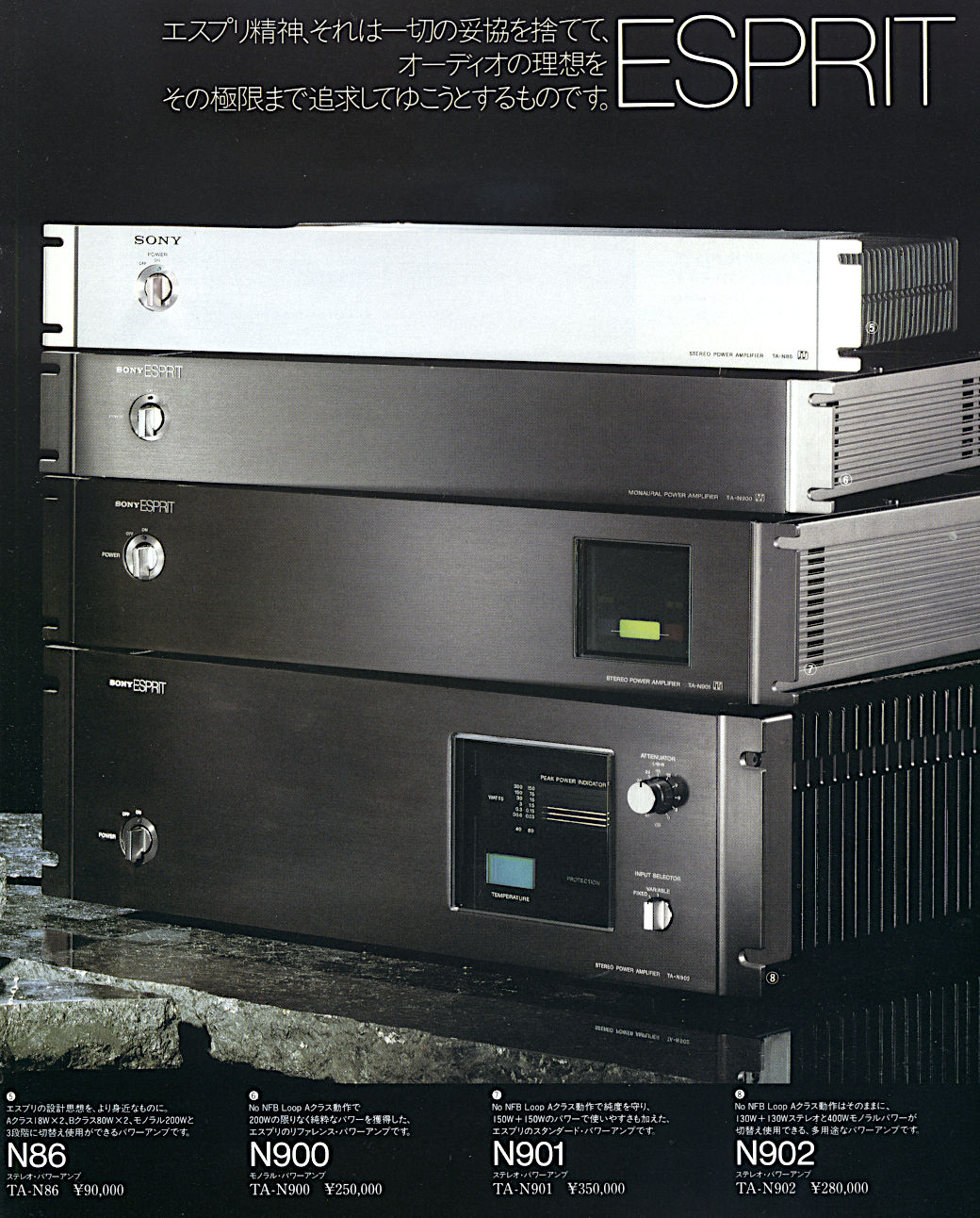
In 1981, the first amplifiers that had ESPRIT in their name were released. These were the TA-N900 power amplifier and the TA-E900 preamplifier.
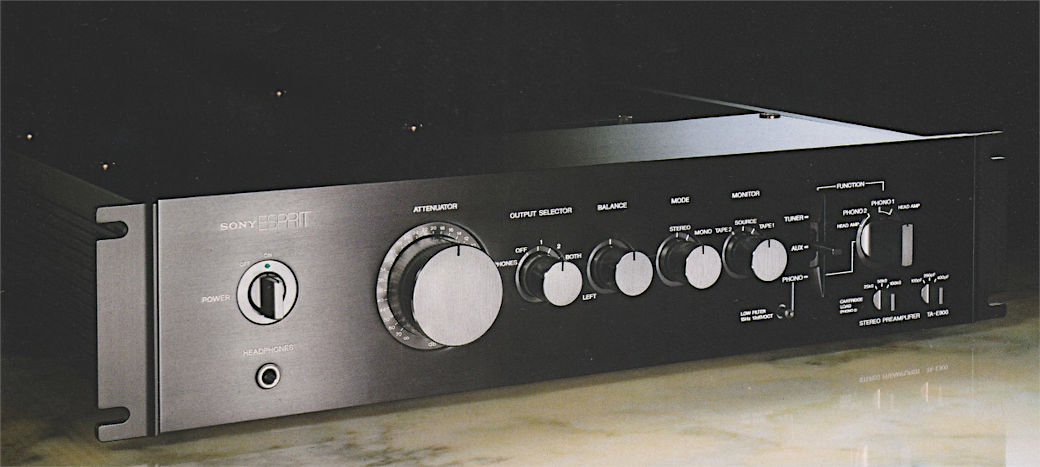
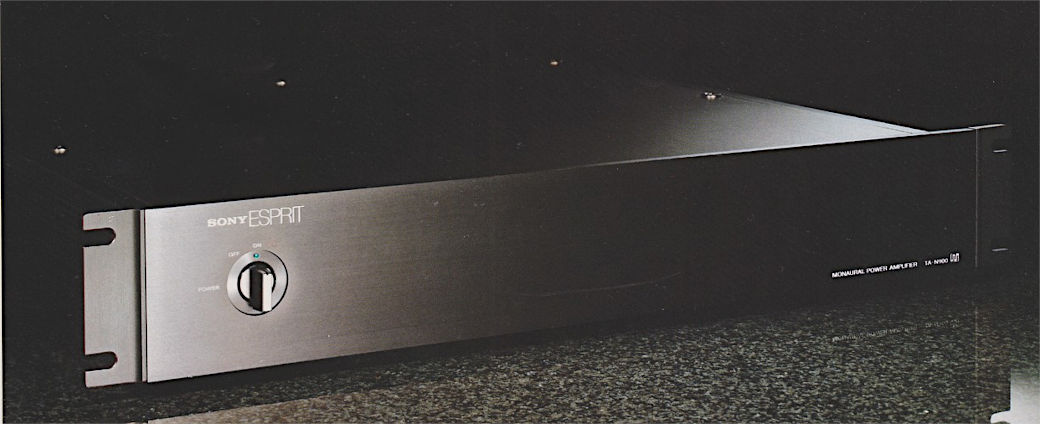
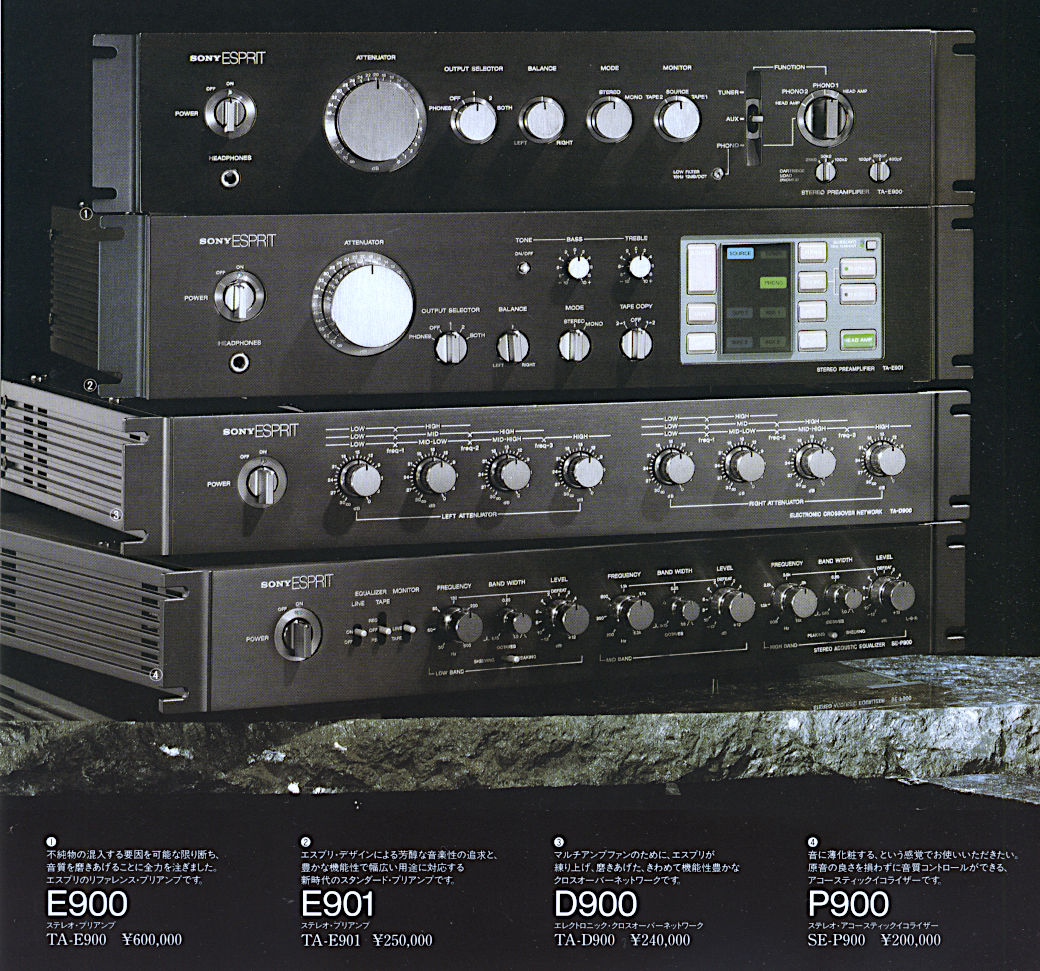
The TA-E900 was the successor to the TA-E88, setting the bar even higher. Fully dual-mono design, shortest possible signal paths (inputs/outputs were still accessible from the top of the amplifier). Aluminum/zinc die-cast case, selected components much of wich were manufactured specifically for this model. Even the diode legs were made of pure copper. Its price was 600000 yen. It was by far the most expensive Sony preamplifier until the 90’s.
The TA-N900 was the successor to the TA-N9. It was a mono power amplifier with switching mode power supply. It used diecast heatsinks, heat-pipe system and BSL motor powered cooling fan.
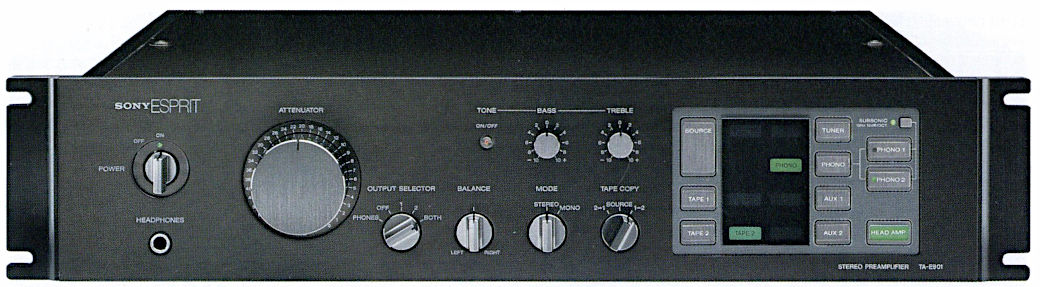
TA-E900 was developed further and in 1982 Sony released the ESPRIT TA-E901. It was the last ESPRIT preamplifier. Its specification was less strict, it abandoned the philosophy of the shortest possible signal path so inputs/outputs were on the backside as usual. It had tone controls too. It had a new feature, called function display.
Sony introduced two more ESPRIT power amplifiers after the TA-N900. The TA-N901 in 1981 and the TA-N902 in 1983. These were the last power amplifiers in the ESPRIT series. Both were stereo Class A amplifiers. Both had the new function display feature. TA-N902 had variable input and it was capable bridged mono operation. It was not similar to the TA-N901, nor the original TA-N900. It has two big transformers instead of switching power supply.
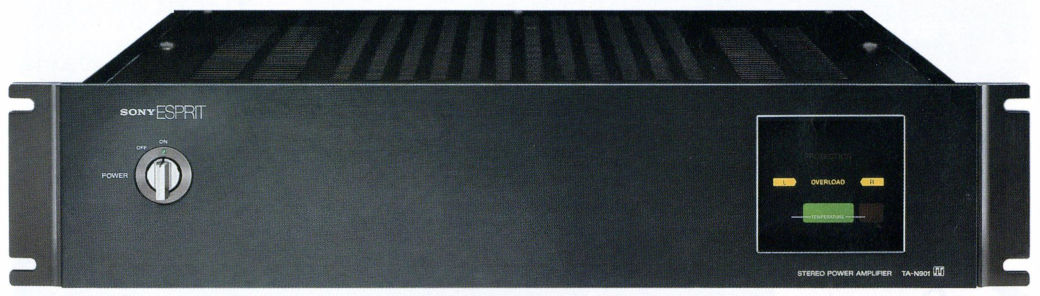
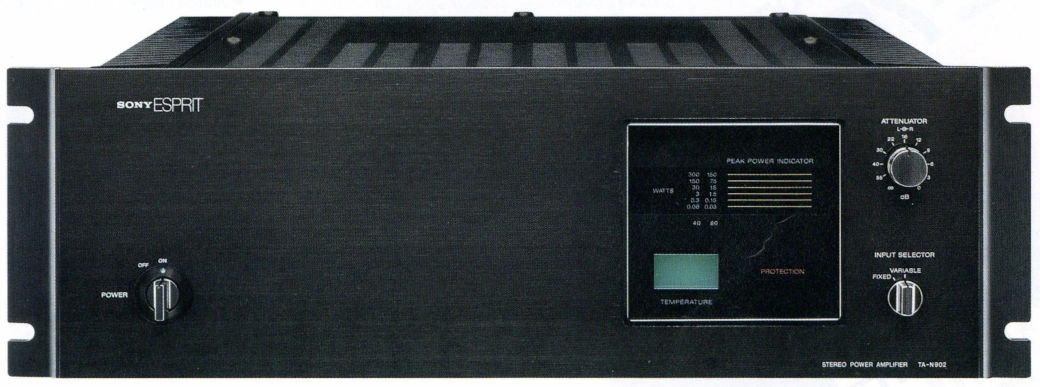
ESPRIT models had optional wooden frame too. It was not just wooden but it was reinforced with artificial marble. Additionally Sony released an ESPRIT resonance damper foot and an ESPRIT speaker cable too. Dedicated high-fidelity speaker cables in 1982 weren’t so common like today so Sony was pioneer in this category too.
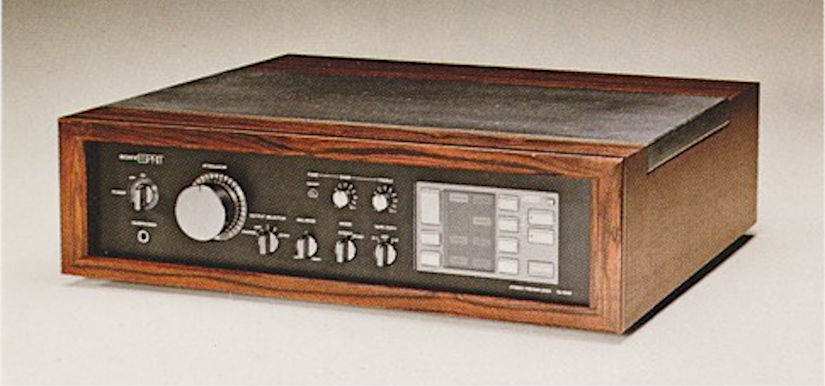
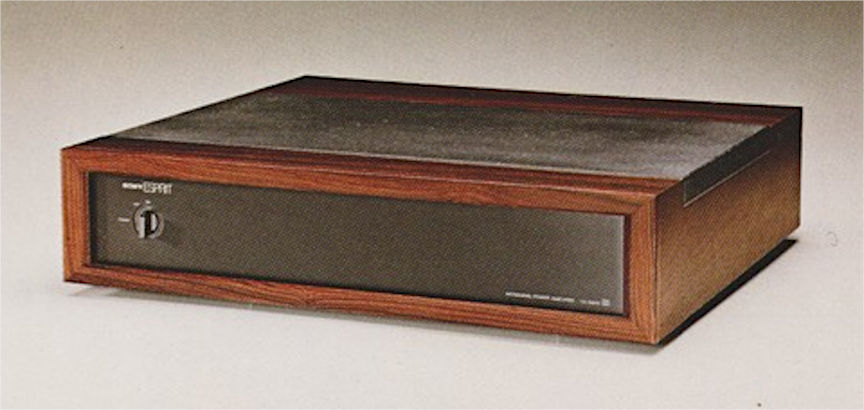
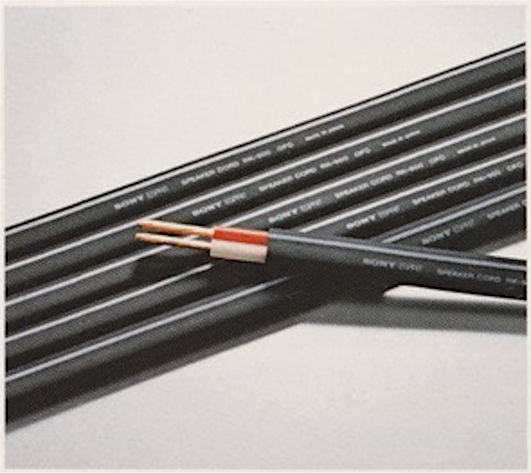
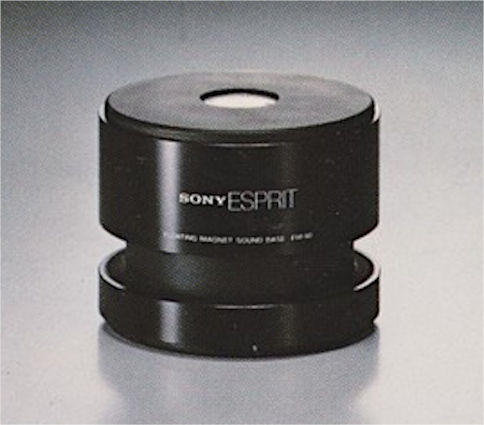
In 1988 all ESPRIT models were disappeared from the catalogs and ESPRIT name no longer used (a Japanese December 1987 catalog still included the TA-E901 and the TA-N902). An era has ended. New „R” series released as new reference. The CDP-R1 CD player was the first legend in this category in the end of 1987. First power amplifier was released in this new category in 1989.
ESPRIT preamplifier specifications:
| Japanese model | TA-E88 | TA-E86 | ESPRIT TA-E900 | ESPRIT TA-E901 |
|---|---|---|---|---|
| USA/Canada model (if different) | TA-E88B | TA-E86B | ||
| European model (if different) | TA-E88B | TA-E86B | ||
| Japanese release | 1977 | 1978 | 1981. November | 1982. March |
| Distribution | 1977-1981 (1984 overseas) | 1978-1982 | 1981-1986 | 1982-1987 |
| Amplifier section | ||||
| Harmonic distortion at rated output | <0.002% | <0.003% | <0.005% | <0.008% |
| Intermodulation distortion at rated output | <0.003% | <0.005% | <0.008% | |
| Residual noise | <6 µV | 12 µV | 12 µV | |
| Frequency response on inputs other than phono +0/-1 dB | DC – 500 kHz | 5 Hz – 500 kHz | DC – 300 kHz | 5 Hz – 200 kHz |
| Inputs | ||||
| Phono 1 | 1 stereo | 1 stereo | 1 stereo | 1 stereo |
| 10 kΩ – 100 kΩ (switchable) 100 pF – 500 pF (switchable) | 2.5 mV 25/50/100 Ω Head amp mode: 0.125 mV 25/100 Ω | 2.5 mV 50 kΩ Head amp mode: 0.2 mV 4 Ω | 2.5 mV 50 kΩ Head amp mode: 0.125 V 200 Ω |
|
| 87 dB Head amp mode: 78 dB | 80 dB Head amp mode: 70 dB | 80 dB Head amp mode: 72 dB |
||
| Phono 2 | 1 stereo | - | 1 stereo | 1 stereo |
| - | 2.5 mV 25/50/100 kΩ Head amp mode: 0.2 mV 4 Ω | 0.125 mV 200 Ω | ||
| - | 80 dB Head amp mode: 70 dB | 70 dB | ||
| RCA other (aux, tuner, tape etc.) | 4 stereo | 3 stereo | 4 stereo | 5 stereo |
| 150 mV 50 kΩ | 150 mV 50 kΩ | 150 mV 50 kΩ | 150 mV 50 kΩ | |
| 105 dB | 115 dB | 88 dB | ||
| Outputs | ||||
| Rec out (RCA) | 2 stereo | 1 stereo | 2 stereo | 2 stereo |
| 150 mV 1 kΩ | 150 mV 10 kΩ | 150 mV 100 Ω | 150 mV 1 kΩ | |
| Amplifier out | 2 stereo | 2 stereo | 2 stereo | 2 stereo |
| 1.5 V 100 Ω | 1.5 V 100 Ω | 1.5 V 100 Ω | 1.5 V 100 Ω | |
| Headphone out | - | - | x | 670 mW 10 Ω |
| Functions | ||||
| Bass tone control | - | - (bass boost on output 2: +6 dB at 120 Hz) | - | 60 Hz +-10 dB |
| Treble tone control | - | - | - | 25 kHz +-10 dB |
| Low filter1 | 15 Hz (switchable) | 15 Hz (switchable) | switchable only on phono inputs below 15 Hz | switchable only on phono inputs below 15 Hz |
| Balance | x | - | x | x |
| Muting switch | x | - | x (output off switch) | x (output off switch) |
| Stereo switch | x | - | x | x |
| Construction | ||||
| Transformator count | 2 (dual mono) | 1 | 2 (dual mono) | 1 |
| Power consumption | 22W | 15W | 27W | 27W |
| Construction | frame is diecast aluminium/zinc | aluminium frame/bars; resin concrete | ||
| Optional wooden frame | TAC-91 rosewood and artificial marble (30000 yen) | TAC-91 rosewood and artificial marble (30000 yen) | ||
| Dimensions | ||||
| Width | 480 mm | 480 mm | 480 mm | 480 mm |
| Height | 80 mm | 80 mm | 105 mm | 105 mm |
| Depth | 370 mm | 366 mm | 455 mm | 465 mm |
| Weight | 9.4 kg | 8.2 kg | 13 kg | 12.5 kg |
| Color | TA-E88: silver TA-E88B: grey | TA-E86: silver TA-E86B: grey | ||
| Original price | 200000 yen | 90000 yen | 600000 yen | 250000 yen |
| Calculated price in 2025 | 356000 yen | 154000 yen | 875000 yen | 356000 yen |
ESPRIT power amplifier specifications:
| Japanese model | TA-N88 | TA-N86 | TA-N9 | ESPRIT TA-N900 | ESPRIT TA-N901 | ESPRIT TA-N902 |
|---|---|---|---|---|---|---|
| USA/Canada model (if different) | TA-N86B | not released | ||||
| European model (if different) | TA-N86B | TA-N9 | ||||
| Japanese release | 1977 | 1978 | 1979 | 1980 | 1981. November | 1983 |
| Distribution | 1977-1980 | 1978-1986 | 1979-1981 | 1980-1984 | 1981-1986 | 1983-1987 |
| Amplifier section | ||||||
| Circuit type | V-FET | No NFB loop, pure-complementary SEPP output in class A operation | No NFB loop, pure-complementary SEPP output in class A operation | No NFB loop, pure-complementary SEPP output in class A operation | ||
| Power transistors | 2 x 2SK82, 2 x 2SJ28 | 5 x 2SK173, 5 x 2SJ54 | MOSFET: 4 x 2SK173, 4 x 2SJ54 | |||
| Stereo/Mono | stereo | stereo/bridged mono | mono | mono | stereo | stereo/bridged mono |
| RMS output 8 Ohm 20 Hz - 20 kHz | 2 x 160 W | 2 x 18 W (class A) 2 x 80 W (class B) | 80 W (class A) 450 W (class B) | 200 W | 2 x 150 W | 2 x 130 W |
| RMS output 4 Ohm 20 Hz - 20 kHz | - | 2 x 90 W (class B) | 450 W | 200 W | 2 x 130 W | 2 x 200 W |
| Bridged mono output (8 Ohm 20Hz-20kHz) | - | 180 W | - | - | - | 400 W |
| Power bandwith (8 Ohm) | 5 Hz - 45 kHz (class B) 5 Hz - 60 kHz (class A) 5 Hz – 30 kHz (bridged mono) | 30 Hz – 50 kHz (class A) 20 Hz – 30 kHz (class B) | 5 Hz – 70 kHz | 5 Hz – 80 kHz | 5 Hz – 80 kHz | |
| Frequency response (test mode, +0/-1 dB)1 | 5 Hz – 40 kHz (+0.5/-1 dB) | DC – 200 kHz | DC – 300 kHz | DC – 100 kHz (+0/-3 dB) | DC – 100 kHz +0/-3 dB | DC – 100 kHz +0/-3 dB |
| Frequency response (normal mode, +0/-1 dB)1 | - | 7 Hz – 200 kHz | 3 Hz – 300 kHz | 5 Hz – 100 kHz (+0/-3 dB) | 5 Hz – 100 kHz +0/-3 dB | 5 Hz – 100 kHz +0/-3 dB |
| Damping factor (1kHz, 8 Ohm) | 20 | 70 | 300 | 50 | 50 | 50 |
| Harmonic distortion at rated output | <0.5% | 0.007% (class A, B) 0.015% (mono) | 0.007% (class B 8 Ω) 0.014% (class B 4 Ω) 0.005% (class A 8 Ω) | <0.05% (8 Ω) <0.1% (4 Ω) | <0.1% (8 Ω) <0.2% (4 Ω) | <0.1% (8 Ω) <0.2% (4 Ω, mono 8 Ω) |
| Harmonic distortion at 1 W output | 0.001% (class A) 0.003% (class B) 0.008% (mono) | |||||
| Intermodulation distortion at rated output | <0.1% | 0.004% (class A, B) 0.005% (mono) | 0.05% (8 Ω) 0.1% (4 Ω) | <0.1% (8 Ω) <0.2% (4 Ω) | <0.1% (8 Ω) <0.2% (4 Ω, mono 8 Ω) |
|
| Intermodulation distortion at 1 W output | 0.002% (class A) 0.003% (class B) 0.004% (mono) | 0.003% (8 Ω 10W) 0.006% (4 Ω 10W) | ||||
| Signal to noise ratio | >110 dB | >120dB | >120dB (class A) >125dB (class B) | 120 dB (8 Ω, A weight) | >120 dB (8 Ω, A weight) | >120 dB (8 Ω) |
| Residual noise (8 ohm) | <100 µV | 25 µV | 22 µV | <20 µV | <30 µV | <30 µV |
| Inputs, speaker out | ||||||
| Variable RCA | - | - | x | - | - | x |
| Fixed RCA | 1 stereo | 1 stereo (direct/coupled) | 1 stereo (direct/coupled) | 1 stereo (direct/coupled) | 1 stereo (direct/coupled) | 2 stereo (fixed direct/coupled and variable) |
| 1.4 V 50 kΩ | 50 kΩ | 1,1 V 50 kΩ (class A) 1,8 V 50 kΩ (class B 4 Ω) 2.5 V 50 kΩ (class B 8 Ω) | 1.7 V 50 kΩ | 1.4 V 50 kΩ | 1.3 V 50 kΩ | |
| Speaker out | stereo | mono | stereo | stereo | ||
| 8 – 16 Ω | 4 – 16 Ω (class B) 8 - 16 Ω (class A) | 4 - 16 Ω (class B) 8 - 16 Ω (class A) | 2 – 16 Ω (switchable) | 4 – 16 Ω (switchable) | 4 – 16 Ω (stereo) 8 – 16 Ω (mono) |
|
| Other functions | ||||||
| Low filter | - | on coupled input | on coupled input | on coupled input | on coupled input | on coupled input |
| Protection circuit | x | x | x | x | x | x |
| Internal Temperature indicator | - | - | - | - | x | x |
| Optical peak or overload meter | - | - | - | - | x | x |
| Construction | ||||||
| Transformator count | 0 (switching PS) | 0 (switching PS) | 1 (switching PS) | 0 (switching PS) | 0 (switching PS) | 2 |
| Capacitors in the power supply | 44000 µF | 44000 µF | ||||
| Power consumption | 135 W (US model) 550 W (EU model) | 210 W (US model) 450 W (EU model) | 450 W | 200 W 270 W (EU model) 175 W (US model) | 140 W (EU model) 410 W (UK model) | 320W |
| Heat sink | outer heat sink | Heat pipe system, heat sink, BSL motor powered fan | Heat pipe system, heat sink, BSL motor powered fan | heat sink | heat sink with applicable anti-vibration belt | |
| Construction | case is diecast aluminium | aluminium case with plastic top plate | ||||
| Optional wooden cabinet | TAC-90 wooden cabinet with artificial marble (30000 yen) | |||||
| Dimensions | ||||||
| Width | 450 mm | 480 mm | 480 mm | 480 mm | 480 mm | 480 mm |
| Height | 80 mm | 80 mm | 185 mm | 80 mm | 105 mm | 155 mm |
| Depth | 360 mm | 380 mm | 500 mm | 445 mm | 485 mm | 485 mm |
| Weight | 11 kg | 8 kg | 18 kg | 10.5 kg | 12.5kg | 28 kg |
| Color | TA-N86: silver TA-N86B: black | |||||
| Original price | 180000 yen | 90000 yen | 350000 yen | 250000 yen | 350000 yen | 280000 yen |
| Calculated price in 2025 | 322000 yen | 155000 yen | 580000 yen | 366000 yen | 513000 yen | 392000 yen |
Revival of the ES series

At the end of 1982, Sony again changed the outer design and numbering system of its integrated amplifiers. Since the reference category was now called ESPRIT, the ES designation reappeared in the flagship category. The ESPRIT category only had preamplifiers and power amplifiers, while the flagship ES category initially only had integrated amplifiers. The ES designation, numbering system and the outer design of the amplifiers basically remained the same with minor changes until the end of the 90s.
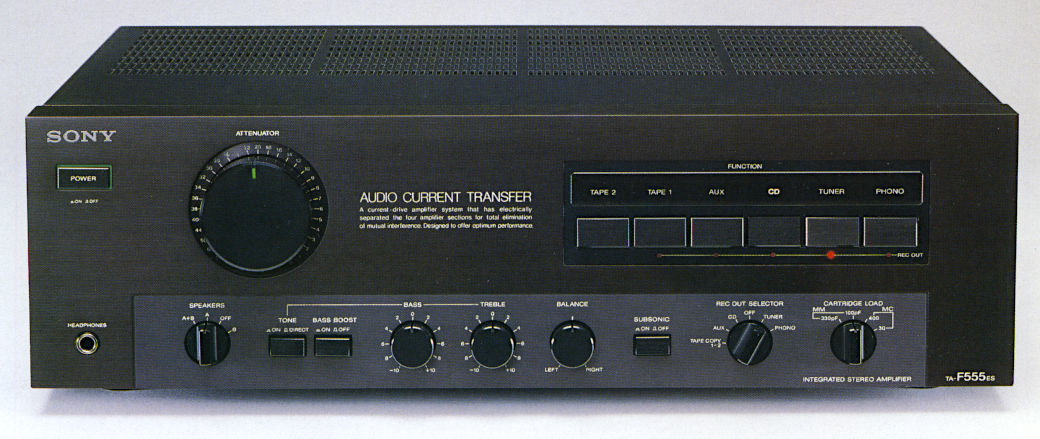
The amplifiers were class AB, using Audio Current Transfer and Legato Linear technology. The heat pipe system and the switch mode power supply were banished. The tape head, ext. adapt, microphone and DIN connectors were also gone.
The first ES amplifier was the TA-F555ES, released in October 1982. A year later, in November 1983, the high-end TA-F777ES was released, but it was only sold in Japan. It was very big and very heavy, 19 kg amplifier with one big transformer. Sony sold these first two ES amplifiers for a fairly short time: the TA-F555ES disappeared from catalogs in May 1984, and the TA-F777ES disappeared from catalogs during 1985. (The F555ES was sold overseas until 1985.)
In the new numbering system, TA-F again stands for integrated amplifier, and 3 digits are the type. The higher the number, the higher the category the type belongs to.
Two lower-end models were later released: the TA-F333ES in 1984 and the TA-F444ES in 1985, but the latter was not sold in Japan. However, I have a scan of a Japanese but English-language catalogue which contains TA-F444ES (its price in Yen). Some of the TA-F444ES had adjustable voltage setting for 220V/240V/120V. Probably these were sold for foreigners in Japan. Most of the TA-F444ES had fixed voltage transformer. Some of them were 120V version with 6-16 Ohm speaker out, some of them were 220V version with 4-16 Ohm speaker out.
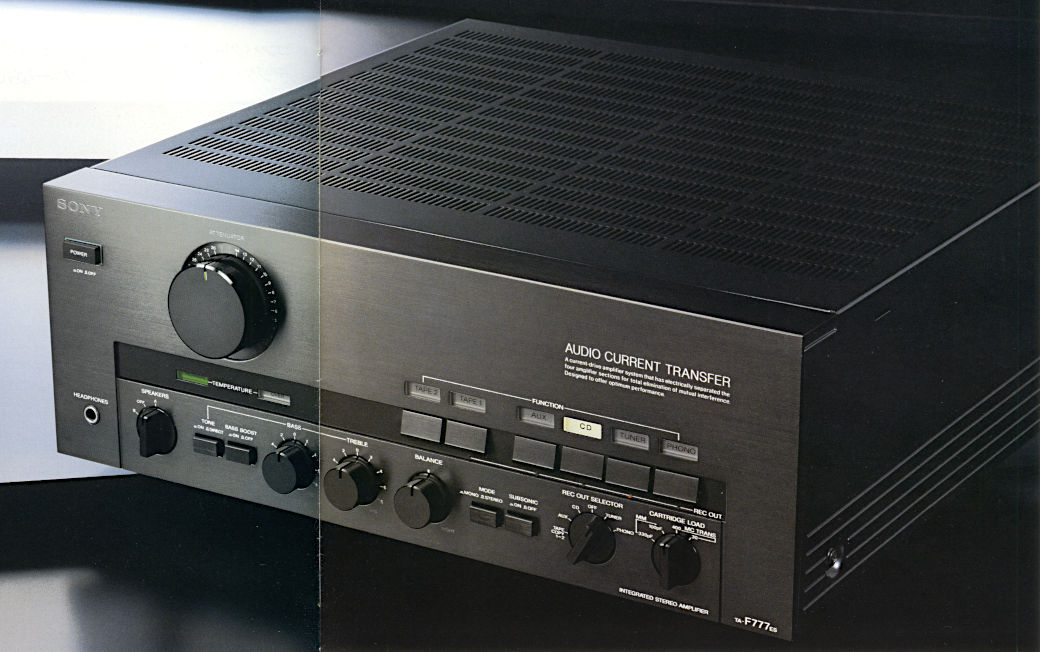
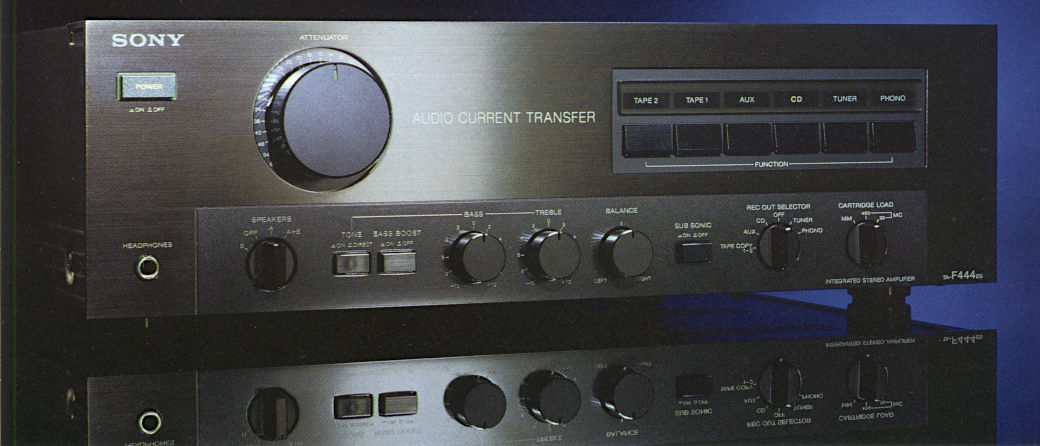
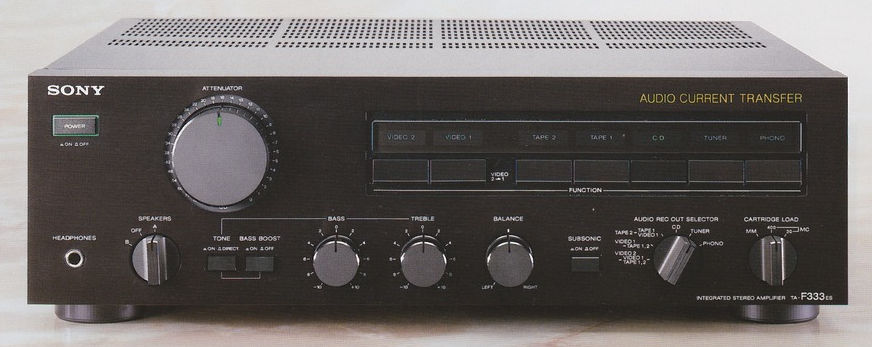
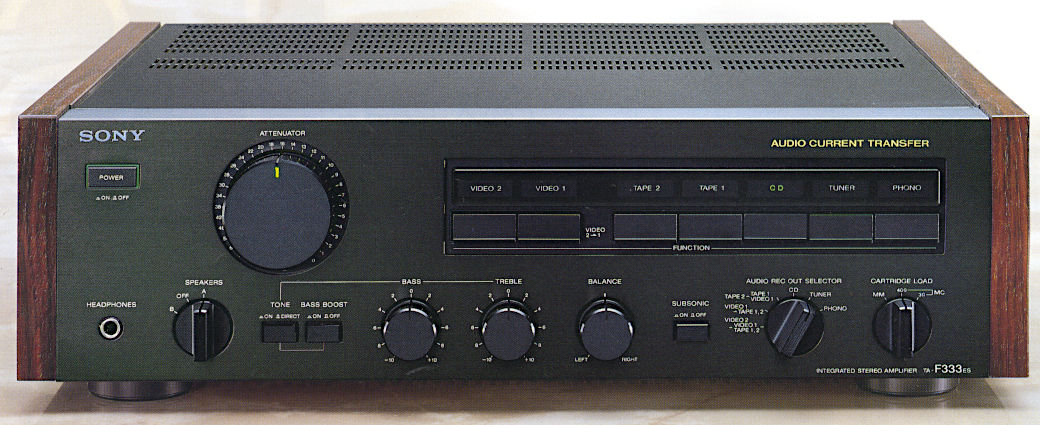
All new ES amplifiers were released without wooden side panels, but the TA-F333ES had optional wooden frame option and it was fitted with wooden side panels in 1985.
Interestingly TA-F333ES were released as TA-F444ESII overseas.
Also, in October, 1984 TA-F555ESII was released (it had wooden side panels). TA-F333ES (F444ESII) and TA-F555ESII (and the later TA-F222ESX) were the only Sony ES integrated amplifiers with AV (audio/video) inputs/outputs. In 1984 a new ES logo appeared in the Japanese catalogues and brochures too.
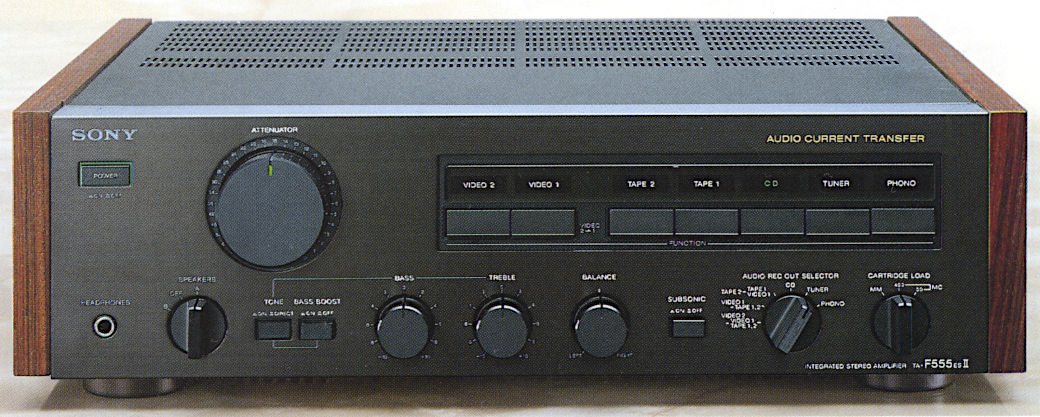
| Japanese model | TA-F555ES | TA-F777ES | not released | TA-F555ESII | TA-F333ES |
|---|---|---|---|---|---|
| USA/Canada model (if different) | not released | TA-F444ES | TA-F444ESII | ||
| European model (if different) | not released | TA-F444ES | TA-F444ESII | ||
| Japanese release | 1982. October | 1983. November | 1984 | 1984. October | 1984. October |
| Distribution | 1982-1984 (1985 overseas) | 1983-1985 | 1984-1987 (overseas) | 1984-1986 (1987 overseas) | 1984-1986 |
| Amplifier section | |||||
| Circuit type | Audio Current Transfer Legato Linear | Audio Current Transfer Legato linear | Audio Current Transfer Legato linear Pure-complementary, triple-Darlington OCL SEPP with all stages direct coupled | Audio Current Transfer Legato linear Quasy-complementary SEPP OTL OCL with all stages direct coupled | Audio Current Transfer Super Legato Linear |
| Power transistors | |||||
| RMS output 8 Ohm 20 Hz - 20 kHz | 2 x 100 W | 2 x 125W | 2 x 80 W | 2 x 120 W | 2 x 100 W 2 x 90 W (EU model) |
| RMS output 4 Ohm 20Hz-20kHz | 2 x 100 W | 2 x 180W | 2 x 110 W 2 x 100 W (US/Canadian model) | 2 x 140 W | |
| Power bandwith (8 Ohm) | 5 Hz – 100 kHz | 5 Hz – 80 kHz | 10 Hz – 100 kHz | 10 Hz – 100 kHz | |
| Frequency response (+0/-1 dB) | 2 Hz – 200 kHz | 5 Hz – 200 kHz +0/-3dB | 5 Hz – 200 kHz +0/-3dB | ||
| Damping factor ( 1kHz, 8 Ohm) | 125 | 150 | 125 | 125 | |
| Harmonic distortion at rated output | <0.004% | 0.004% | <0.004% | ||
| Harmonic distortion at 10 W output | 0.002% | 0.002% | |||
| Intermodulation distortion at rated output | <0.004% | <0.004% | 0.004% | ||
| Signal to noise ratio | 97 dB | ||||
| Residual noise (8 ohm) | < 28 µV | < 25 µV | 28 µV | ||
| Speaker out | A – B (4-16 Ω) | A – B (4-16 Ω) | A – B (4-16 Ω) | A – B (6-16 Ω) | A – B (4-16 Ω) |
| Inputs | |||||
| Phono RCA | 1 stereo | 1 stereo | 1 stereo | 1 stereo | 1 stereo |
| Switchable: 2,5 mV 50 kΩ 130 mV 100 Ω / 30 Ω | 2.5 mV (MM) 0.17 mV (MC) Channel separation: 95 dB(MM) 80 dB(MC) | ||||
| 81 dB / 70 dB | 82 dB / 74 dB | 83 dB(MM) 73dB(MC) | 83 dB(MM) 73dB(MC) | 83 dB(MM) 71dB(MC) |
|
| RCA other (aux, tuner, tape etc.) | 5 stereo | 5 stereo | 5 stereo | 4 stereo | 4 stereo |
| 150 mV 50 kΩ | 150 mV 50 kΩ | 150 mV 50 kΩ | |||
| 100 dB | 100 dB | ||||
| 97 dB | 102dB | 102dB | |||
| Video in (video signal) | - | - | - | 2 | 2 |
| Video in (audio signal) | - | - | - | 2 stereo | 2 stereo |
| - | - | - | 150 mV 50 kΩ | ||
| - | - | - | 102dB | ||
| - | - | - | 100 dB | ||
| Outputs | |||||
| Rec out | 2 stereo | 2 stereo | 2 stereo | 2 stereo | 2 stereo |
| 150 mV 1 kΩ | 150 mV 1 kΩ | 150 mV 1 kΩ | |||
| Headphone out | x | x | x | x | x |
| Video out (video signal) | - | - | - | 1 / 1 monitor | 1 / 1 monitor |
| Video out (audio signal) | - | - | - | 1 stereo | 1 stereo |
| - | - | - | 150 mV 1 kΩ | ||
| Functions | |||||
| Bass tone control1 | 60 Hz ±8 dB 50 Hz | x | 60 Hz ±8 dB 50 Hz | 60 Hz ±8 dB 50 Hz | x |
| Bass boost | +4 dB | x | +4 dB | +4 dB | - |
| Treble tone control1 | 25 kHz ±8 dB | x | 25 kHz ±8 dB | 25 kHz ±8 dB | x |
| Low filter | 15 Hz | x | 15 Hz | 15 Hz | x |
| Balance | x | x | x | x | x |
| Stereo switch | - | stereo/mono | - | - | - |
| Internal temperature indicator | - | x | - | - | - |
| Construction | |||||
| Transformator count | 1 | 1 | 1 | 1 | |
| Capacitors in the power supply | 44000 µF | 45000 µF | |||
| Power consumption | 193 W 240 W (EU model) | 300 W | 260 W (US model) 195 W (EU model) 210 W (UK model) | 290 W (US model) 310 W (EU model) | 248 W |
| Heat sink | heat sink | heat sink | heat sink | ||
| Construction | copper-plated chassis with wooden side panel | copper-plated chassis | |||
| Optional wooden frame | - | - | - | - | TAC-125 (4400 yen) |
| Dimensions | |||||
| Width | 430 mm | 430 mm | 430 mm | 430 mm | 430 mm |
| Height | 130 mm | 155 mm | 130 mm | 135 mm | 135 mm |
| Depth | 367 mm | 450 mm | 430 mm | 425 mm | 425 mm |
| Weight | 13 kg | 19 kg | 13.5 kg | 15.1 kg | 13.5 kg |
| Original price | 99000 yen | 185000 yen | 92000 yen | 128000 yen | 79800 yen |
| Calculated price in 2025 | 141000 yen | 259000 yen | 125000 yen | 174000 yen | 109000 yen |
1: all tone controls and filters can be turned off
Golden era of ES amplifiers
The golden age of the Sony ES amplifier family began in the second half of the 80s. A lot of ES amplifiers were released and the names of the amplifiers became incredibly confusing. The situation was further complicated by the fact that amplifiers for the Japanese domestic market often had different model numbers than the models intended for export. Moreover, it happened that the same amplifier not only had a different model number but also had slightly different inputs. There were amplifiers that were only distributed in the Japanese domestic market, other amplifiers were only manufactured for export. It was very difficult to bring order to this chaos.
The table below summarizes all Sony ES amplifiers released up to the early 2000s. Each row lists the model numbers for a specific amplifier across different markets. These are the results of my own research; while they may not be entirely accurate, I have not yet found a better summary. Where a cell is empty, that specific model was not sold in that market.
| Type | Japanese model | AEP model | USA/Canada model | UK model | General export model |
|---|---|---|---|---|---|
| Integrated | TA-F555ES | TA-F555ES | TA-F555ES | ||
| Integrated | TA-F777ES | ||||
| Integrated | TA-F444ES | TA-F444ES | TA-F444ES | TA-F444ES | |
| Integrated | TA-F555ESII | TA-F555ESII | TA-F555ESII1 | ||
| Integrated | TA-F333ES | TA-F444ESII | TA-F444ESII | TA-F444ESII | TA-F444ESII |
| Integrated | TA-F555ESX | ||||
| Integrated | TA-F333ESX | TA-F700ES | TA-F700ES | TA-F700ES | TA-F444ESX |
| Integrated | TA-F222ESX | TA-F500ES | TA-F500ES | TA-F500ES | TA-F222ESX |
| Integrated | TA-F555ESXII | TA-F800ES | |||
| Integrated | TA-F333ESXII | ||||
| Integrated | TA-F505ESD | ||||
| Integrated | TA-F303ESD | TA-F630ESD | TA-F630ESD2 | TA-F630ESD | TA-F303ESD |
| Integrated | TA-F555ESR | TA-F830ES3 | |||
| Integrated | TA-F333ESR | TA-F730ES | TA-F730ES | TA-F333ESR | |
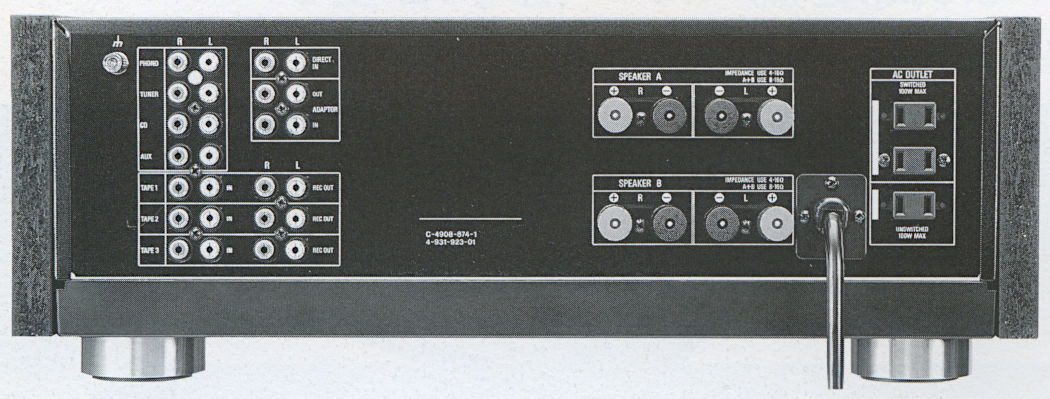
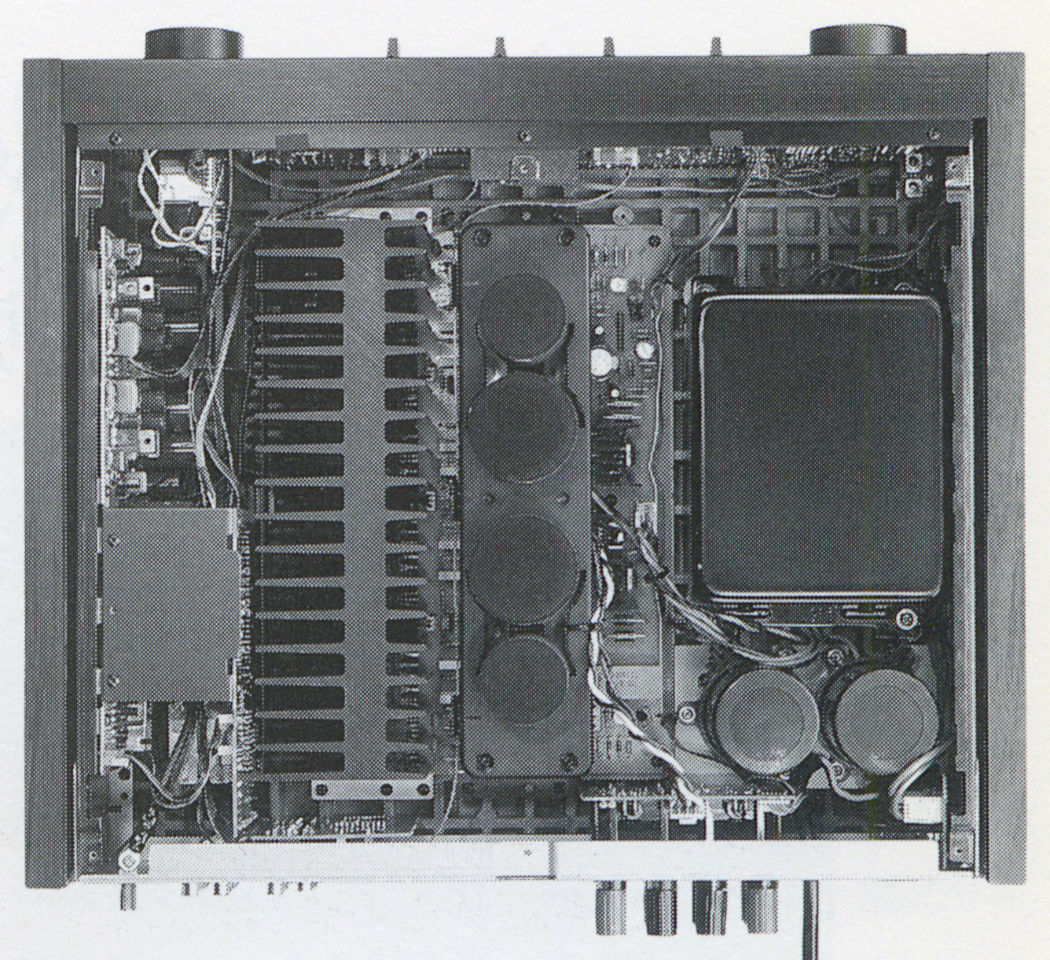
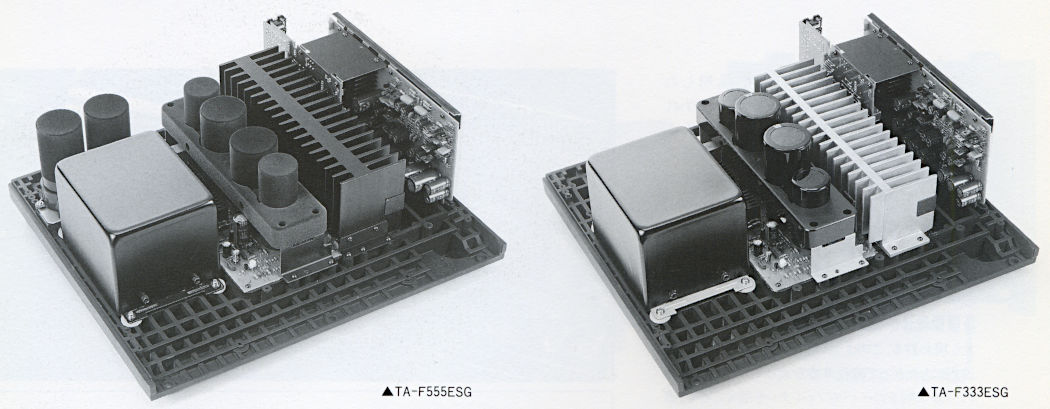
| Integrated | TA-F555ESG | ||||
| Integrated | TA-F333ESG | ||||
| Integrated | TA-F222ESR | TA-F530ES | TA-F530ES2 | TA-F530ES | TA-F222ESR |
| Integrated | TA-F555ESL | TA-F870ES | TA-F870ES | ||
| Integrated | TA-F333ESL | TA-F770ES | TA-F770ES | TA-F333ESL | |
| Integrated | TA-F555ESA | ||||
| Integrated | TA-F333ESA | ||||
| Integrated | TA-F222ESA | TA-F570ES | TA-F570ES2 | TA-F222ESA | |
| Integrated | TA-F555ESJ | TA-F808ES | TA-F808ES | ||
| Integrated | TA-F333ESJ | TA-F707ES | TA-F707ES | ||
| Integrated | TA-F222ESJ | TA-F505ES | |||
| Integrated | TA-FA7ES | TA-FA7ES | |||
| Integrated | TA-FA5ES | TA-FA5ES | |||
| Integrated | TA-FA3ES | TA-FA3ES | |||
| Integrated | TA-FA70ES | TA-FA70ES | |||
| Integrated | TA-FA50ES | TA-FA50ES | |||
| Integrated | TA-FA777ES | TA-FA777ES | |||
| Integrated | TA-FA33ES | ||||
| Integrated | TA-F222ES | ||||
| Integrated | TA-F550ES | TA-F550ES2 | TA-F550ES | ||
| Integrated | TA-F650ESD | TA-F650ESD2 | TA-F650ESD | ||
| Integrated | TA-F670ES | TA-F670ES | |||
| Integrated | TA-F590ES | TA-F590ES | |||
| Integrated | TA-F690ES | TA-F690ES | |||
| Integrated | TA-F606ES | TA-F606ES | |||
| Integrated | TA-FA30ES | TA-FA30ES | TA-FA30ES | ||
| Integrated | SONY TA-F3000 | TA-F3000ES | TA-F3000ES | TA-F3000 | |
| power | TA-N330ES | TA-N55ES | TA-N55ES | TA-N55ES | TA-N330ES |
| power | TA-N77ES | TA-N77ES | TA-N77ES | TA-N77ES | |
| power | TA-N80ES | TA-N80ES | TA-N80ES | ||
| power | TA-N90ES | TA-N90ES1 | |||
| power | TA-NR1 | TA-NR13 | TA-NR11 | ||
| power | TA-NR10 | ||||
| power | TA-N1 | TA-N1 | TA-N1 | TA-N1 | TA-N1 |
| pre | TA-E77ESD | TA-E77ESD | TA-E77ESD | TA-E77ES | |
| pre | TA-E80ES | TA-E80ES | TA-E80ES | ||
| pre | TA-E90ES | TA-E90ES1 | |||
| pre | TA-E1000ESD | TA-E1000ESD | TA-E1000ESD | TA-E1000ESD | TA-E1000ESD |
| pre | TA-E2000ESD | TA-E2000ESD | TA-E2000ESD | TA-E2000ESD | |
| pre | TA-ER1 | TA-ER13 | |||
| pre | TA-E1 | TA-E1 | TA-E1 | TA-E1 | TA-E1 |
1: released only on the USA market, not on the Canadian market. (Based on service manual)
2: released only on the Canadian market, not on the USA market. (Based on service manual)
3: released only on the German market (Based on service manual)
The ESX family
In 1984, only two new integrated amplifiers were released, and in 1985, no new ES amplifiers were released. In 1986, however, three improved models of the new ES series were released. This was the ESX family. The number 7 disappeared from the Japanese model numbers, and the top model number was 5 until the mid-1990s.
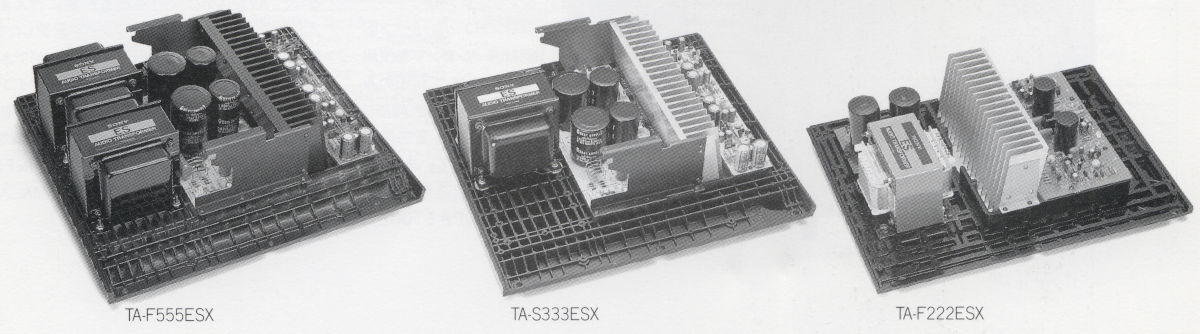
The new top model was the TA-F555ESX, which was one of the largest and heaviest integrated amplifiers Sony had ever produced. The new series was built on the so-called Gibraltar chassis. The three members of the ESX were the TA-F555ESX, TA-F333ESX and TA-F222ESX. All three had new outer design. This become the common outer design of the amplifiers until the mid-90s. The two top models had wooden side panels and all three models proudly bore the inscription „Extremely High Standard” on the front panel.
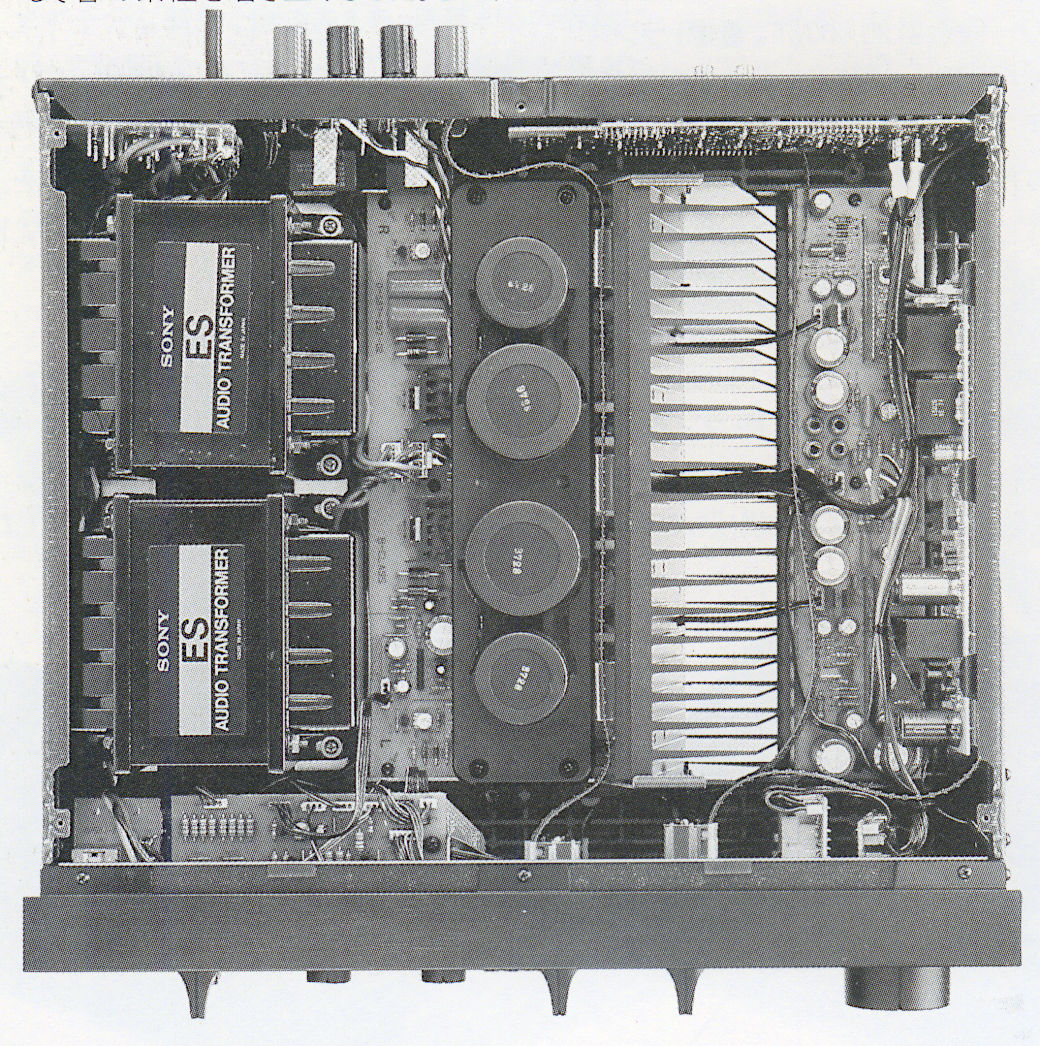
The so-called STD (Spontaneous Twin Drive) power supply was introduced in the ESX series. In the STD power supply, the rectifier circuits for the Class A stage and the power stage—which together constitute the power amplifier—are independent. Sony employed this design even in the 1990’s. The 555 model was equipped with two large transformers.
TA-F222ESX was marketed for 2 years, however the two upper models were replaced in the next year.
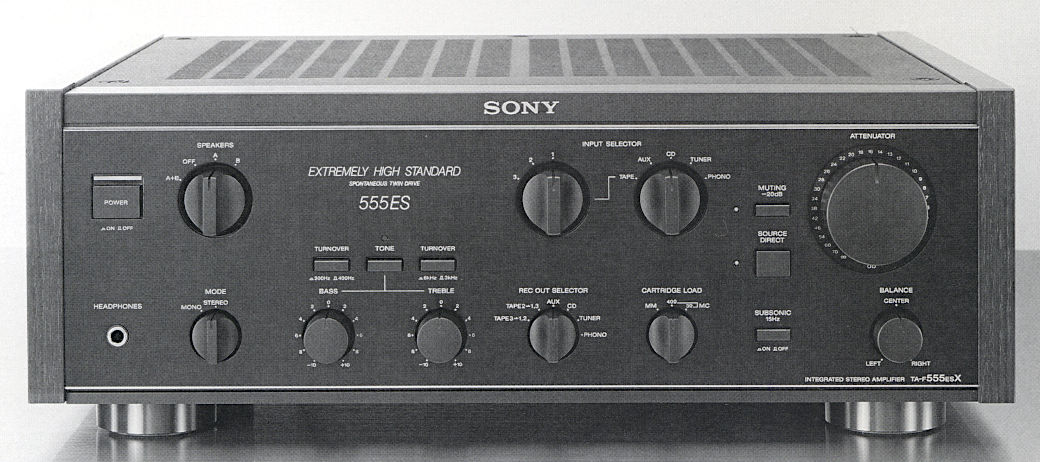
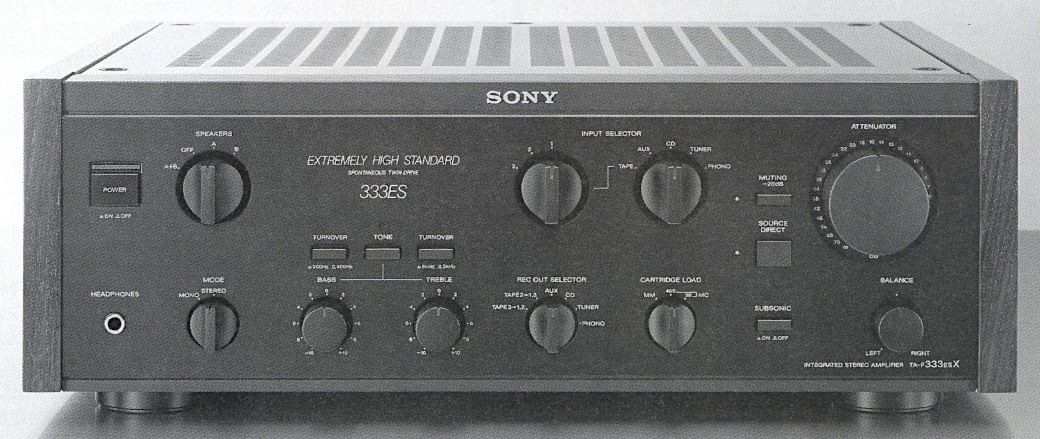
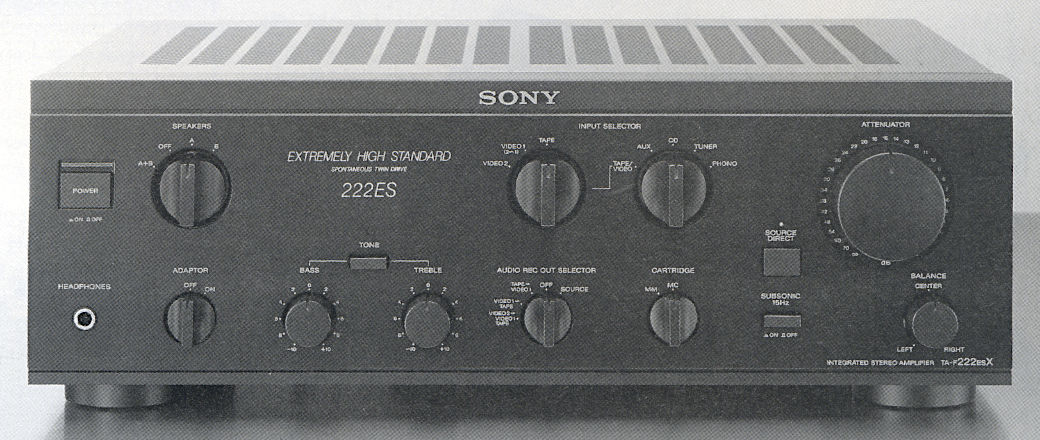
The X from the ESX designation, however, did not appear on the models intended for export (except for general export models). The export models continued to be called ES. However, their numbers became 800, 700 and 500. The TA-F333ESX was also released under two other names: TA-F700ES in Europe and North America, but there was also a „general export model” for other markets called TA-F444ESX. The general export model types usually had a voltage switch on the back. The TA-F555ESX, however, remained a Japanese domestic model only. The model numbering became a complete chaos.
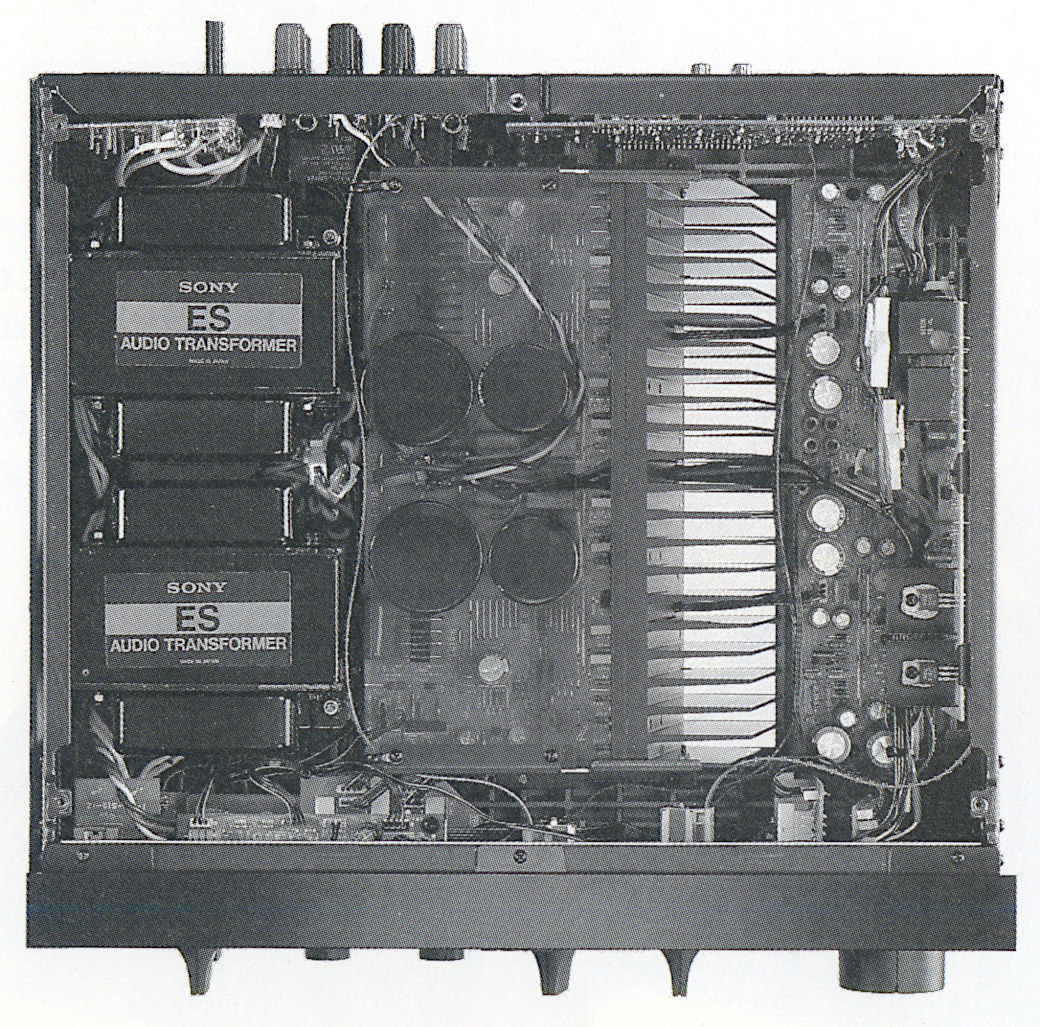
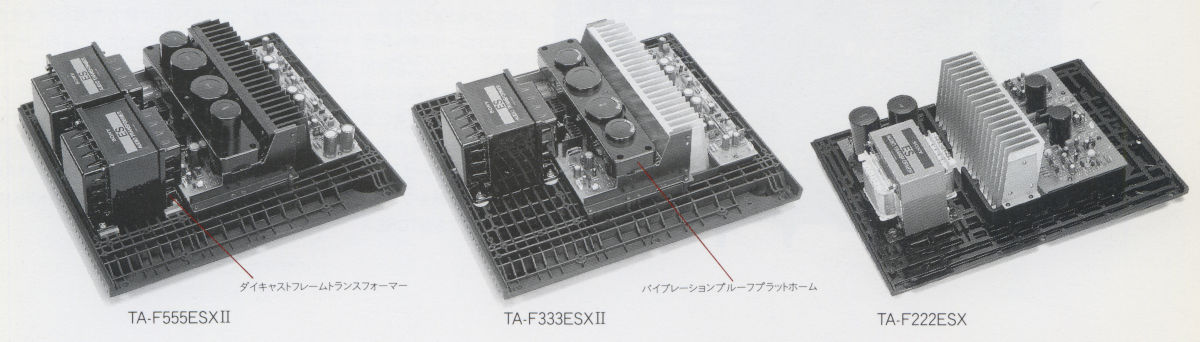
In September 1987, the ESX series received an update: the ESXII was released. The TA-F555ESXII behemoth was the heaviest integrated ES amplifier Sony ever produced. It weighed nearly 28 kg! Even the TA-F333ESXII weighed close to 20 kg. The external dimensions and power output of the amplifiers remained unchanged compared to the previous ESX series. The front panel of the TA-F555ESXII was identical to that of the earlier model (except for the model number, of course). The TA-F333ESXII differed only in the layout of the cartridge selector button.
The internal layout of the new top amplifiers however has been slightly redesigned and improved by hardening the transformer with a zinc die-cast cover and reviewing the part layout.
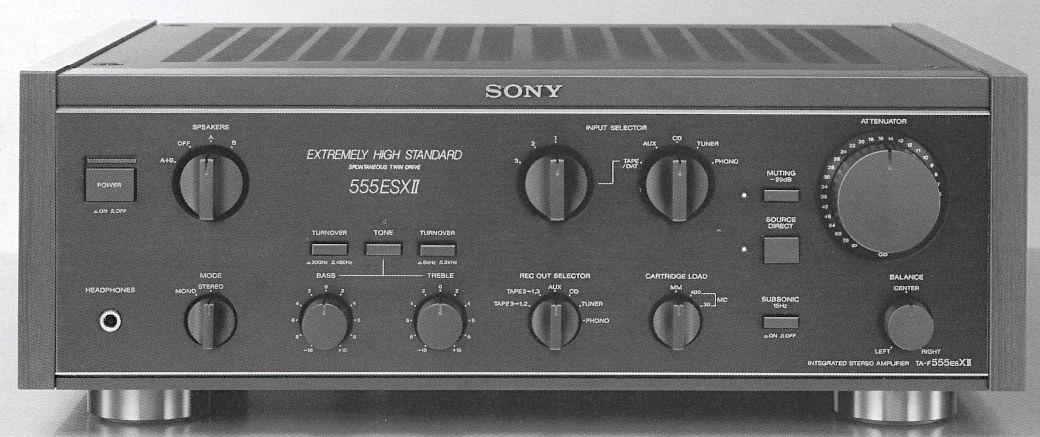
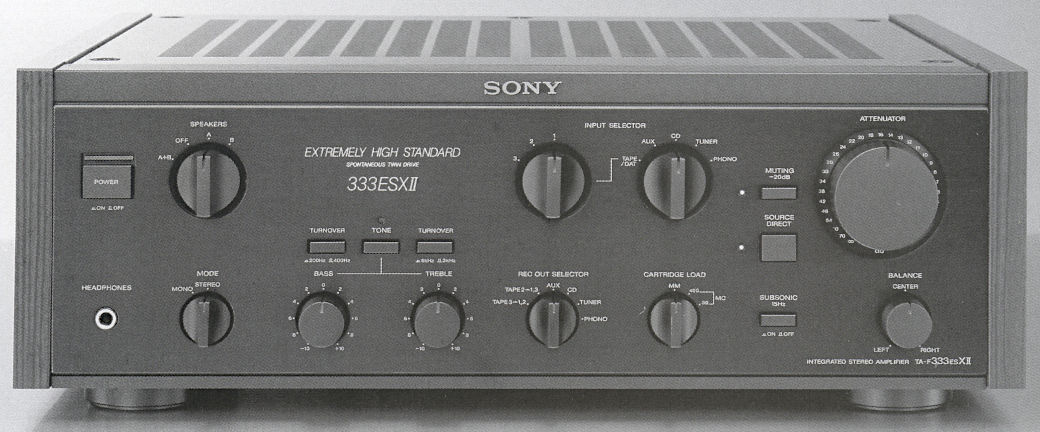
| Japanese model | TA-F555ESX | TA-F333ESX | TA-F222ESX | TA-F555ESXII | TA-F333ESXII |
|---|---|---|---|---|---|
| USA/Canada model (if different) | not released | TA-F700ES | TA-F500ES | not released | not released |
| European model (if different) | not released | TA-F700ES | TA-F500ES | TA-F800ES | not released |
| Japanese release | 1986. September | 1986. February | 1986. October | 1987. September | 1987. September |
| Distribution | 1986-1987 | 1986-1987 | 1986-1988 | 1987-1988 | 1987-1988 |
| Amplifier section | |||||
| Circuit type | Super Legato Linear | Super Legato Linear Pure complementary SEPP | Super Legato Linear Pure complementary SEPP | ||
| RMS output 8 Ohm 20 Hz - 20 kHz | 2 x 120 W | 2 x 10⁵ W 2 x 110 W (G, AEP, UK, E model) | 2 x 80 W | 2 x 120 W | 2 x 10⁵ W |
| RMS output 6 Ohm 20 Hz - 20 kHz | 2 x 125 W (G, AEP, UK, E model) 2 x 120 W (US, Canadian, North European model) | ||||
| RMS output 4 Ohm 20 Hz - 20 kHz | 2 x 180 W | 2 x 140 W 2 x 145 W (AEP, UK, E model) | 2 x 110 W | 2 x 180 W | 2 x 140 W |
| Power bandwith (8 Ohm) | 10 Hz – 100 kHz | 10 Hz – 100 kHz | 10 Hz – 80 kHz | 10 Hz – 100 kHz | 10 Hz – 100 kHz |
| Frequency response (+0/-1 dB) | 2 Hz – 200 kHz (+0 -3 dB) | 2 Hz – 200 kHz (+0 -3 dB) | 2 Hz – 200 kHz (+0 -3 dB) | ||
| Damping factor ( 1kHz, 8 Ohm) | 100 | 100 | 50 | 100 | 100 |
| Harmonic distortion at 10 W output | 0.002% | 0.002% | 0.003% | 0.002% | 0.002% |
| Intermodulation distortion at rated output | 0.004% | 0.004% 0.006% (EU model) | 0.004% | 0.004% | 0.004% |
| Signal to noise ratio | |||||
| Residual noise (8 ohm) | <115 µV | <115 µV | <115 µV | ||
| Speaker out | A – B (4-16 Ω) | A – B (4-16 Ω) | A – B (4-16 Ω) | A – B (4-16 Ω) | A – B (4-16 Ω) |
| Inputs | |||||
| Phono RCA | 1 stereo | 1 stereo | 1 stereo | 1 stereo | 1 stereo |
| 2.5 mV 50 kΩ (MM) 0.17 mV 1kΩ/100 Ω (MC) | 2.5 mV 50 kΩ (MM) 0.17 mV 1kΩ/100 Ω (MC) | 2.5 mV 50 kΩ (MM) 0.17 mV 100 Ω (MC) | 2.5 mV 50 kΩ (MM) 0.17 mV 100 Ω (MC) | 2.5 mV 50 kΩ (MM) 0.17 mV 100 Ω (MC) |
|
| signal to noise ratio | 87 dB( MM) 70 dB (MC) | 87 dB (MM) 68 dB (MC) | 86 dB (MM) 68 dB (MC) | 87 dB (MM) 70 dB (MC) | 87 dB (MM) 68 dB (MC) |
| RCA other (aux, tuner, tape etc.) | 6 stereo | 6 stereo | 4 stereo | 6 stereo | 6 stereo |
| 150 mV 50 kΩ | 150 mV 50 kΩ | 150 mV 50 kΩ | 150 mV 50 kΩ | 150 mV 50 kΩ | |
| 105 dB | 105 dB | 105 dB | 105 dB | 105 dB | |
| Adaptor in | 1 stereo | 1 stereo | 1 stereo | 1 stereo | 1 stereo |
| Video in (video signal) | - | - | 2 | - | |
| Video in (audio signal) | - | - | 2 stereo | - | |
| Outputs | |||||
| Rec out | 3 stereo | 3 stereo | 1 stereo | 3 stereo | 3 stereo |
| specification | 150 mV 1 kΩ | 150 mV 1 kΩ | 150 mV 1 kΩ | 150 mV 1 kΩ | 150 mV 1 kΩ |
| Adaptor out | 1 stereo | 1 stereo | 1 stereo | 1 stereo | 1 stereo |
| Video out (video signal) | - | - | 1 / 1 monitor | - | - |
| Video out (audio signal) | - | - | 1 stereo | - | - |
| Headphone out | 25 mW 8 Ω | 25 mW 8 Ω | 25 mW 8 Ω | 25 mW 8 Ω | 25 mW 8 Ω |
| Functions | |||||
| Bass tone control1 | 100 Hz +4 -3.5 dB (turnover freq. 200 Hz) +6 -5 dB (turnover freq. 400 Hz) | 100 Hz +4 -3.5 dB (turnover freq. 200 Hz) +6 -5 dB (turnover freq. 400 Hz) | 100 Hz ±6 dB | 100 Hz +4 -3.5 dB (turnover freq. 200 Hz) +6 -5 dB (turnover freq. 400 Hz) | 100 Hz +4 -3.5 dB (turnover freq. 200 Hz) +6 -5 dB (turnover freq. 400 Hz) |
| Treble tone control1 | 10 kHz +7 -8 dB (turnover freq. 3 kHz) +4 -5 dB (turnover freq. 6 kHz) | 10 kHz +7 -8 dB (turnover freq. 3 kHz) +4 -5 dB (turnover freq. 6 kHz) | 10 kHz ±6 dB | 10 kHz +7 -8 dB (turnover freq. 3 kHz) +4 -5 dB (turnover freq. 6 kHz) | 10 kHz +7 -8 dB (turnover freq. 3 kHz) +4 -5 dB (turnover freq. 6 kHz) |
| Low filter1 | 15 Hz | 15 Hz | 15 Hz | 15 Hz, 6 dB/oct | 15 Hz, 6 dB/oct |
| Balance | x | x | x | x | x |
| Stereo switch | x | x | - | x | x |
| Muting | x | x | - | x | x |
| Construction | |||||
| Transformator count | 2 (STD) | 1 (STD) | 1 (STD) | 2 (STD) | 1 (STD) |
| Capacitors in the power supply | 55000 µF | 38400 µF | 34000 µF | 60000 µF | 38400 µF |
| Power consumption | 315 W | 245 W 330 W (US model) 390 W (G model) 350 W (UK model) 270 W (AEP model) 390 W (E model) | 215 W 210 W (US model) 250 W (EU model) | 300 W 310 W (EU model) | 245 W |
| Heat sink | aluminium heat sink | aluminium heat sink | aluminium heat sink | aluminium heat sink | aluminium heat sink |
| Construction | Acoustically Tuned Gibraltar Chassis | Acoustically Tuned Gibraltar Chassis | Acoustically Tuned Gibraltar Chassis | Acoustically Tuned Gibraltar Chassis | Acoustically Tuned Gibraltar Chassis |
| Dimensions | |||||
| Width | 470 mm | 470 mm | 430 mm | 470 mm | 470 mm |
| Height | 166 mm | 161 mm | 148 mm | 166 mm | 161 mm |
| Depth | 436 mm | 436 mm | 373 mm | 436 mm | 436 mm |
| Weight | 26 kg | 18.6 kg 18.3 kg (overseas models) | 13.6 kg | 27.8 kg | 19.6 kg |
| Original price | 128000 yen | 79800 yen | 67000 yen | 128000 yen | 79800 yen |
| Calculated price in 2025 | 170000 yen | 106000 yen | 89000 yen | 170000 yen | 106000 yen |
| Price | 2000 DM |
1: all tone controls and filters can be turned off
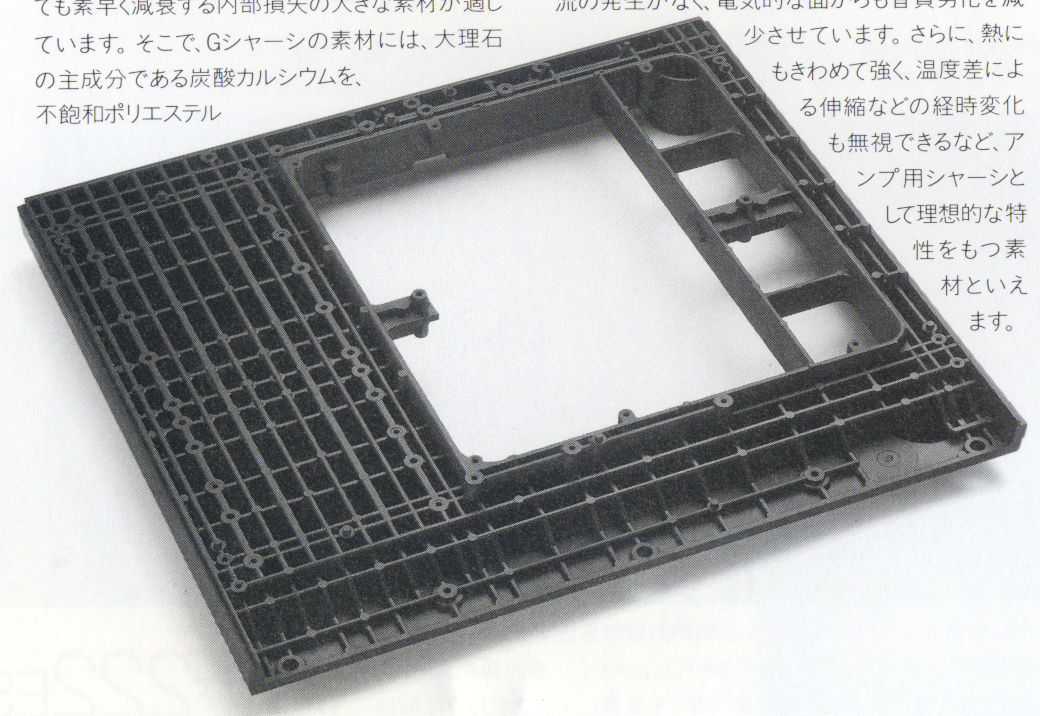
Two integrated digital
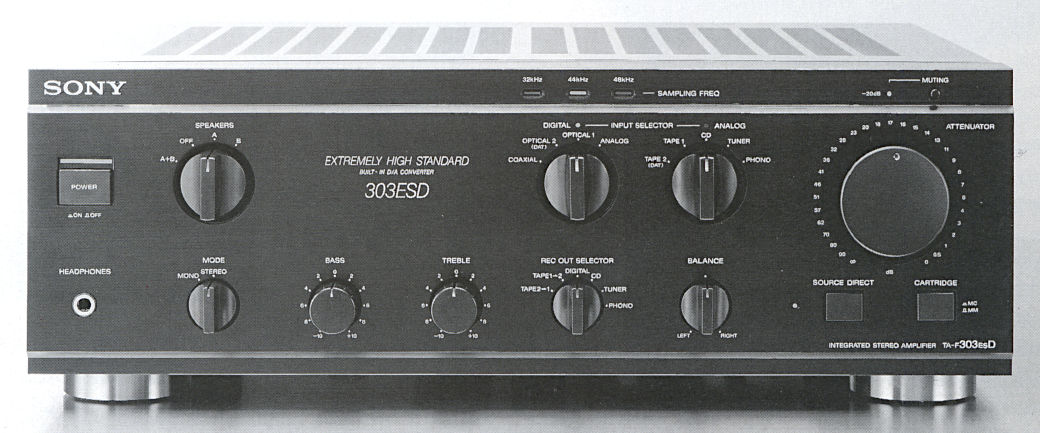
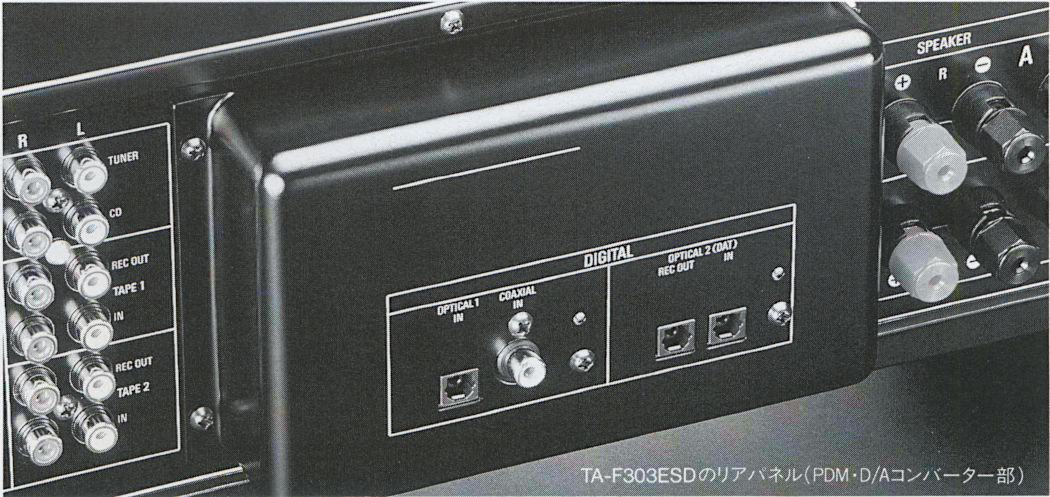
In late 1988 and early 1989, Sony released two ES integrated amplifiers featuring built-in DACs. These were the only ES integrated amplifiers Sony ever produced with a built-in DAC (this was PDM type D/A converter). The TA-F505ESD was manufactured exclusively for the Japanese domestic market, while the TA-F303ESD was sold worldwide under model names TA-F630ESD and TA-F303ESD.
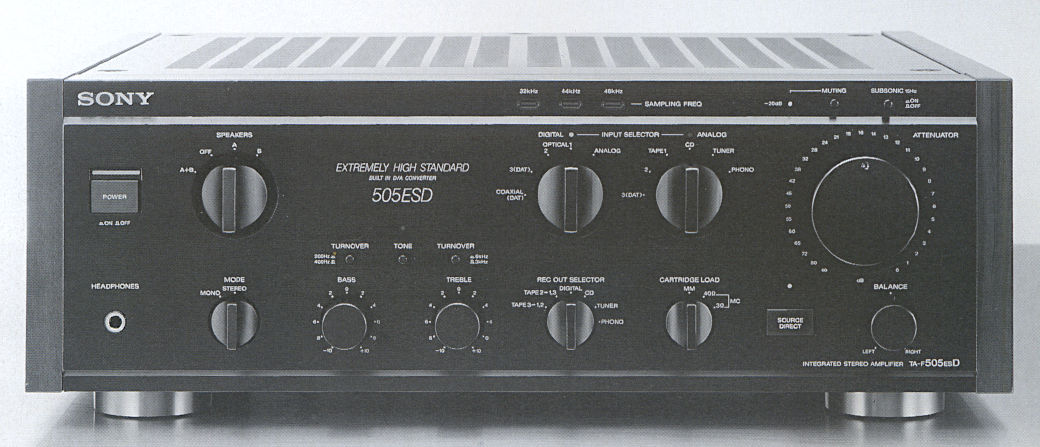
| Japanese model | TA-F505ESD | TA-F303ESD |
|---|---|---|
| USA/Canada model (if different) | not released | TA-F630ESD |
| European model (if different) | not released | TA-F630ESD |
| Japanese release | 1988. October | 1989. January |
| Distribution | 1988-1990 | 1989 (1989-1991 overseas) |
| Amplifier section | ||
| Circuit type | Pure complementary SEPP | |
| RMS output 8 Ohm 20 Hz - 20 kHz | 2 x 10⁵ W | 2 x 90 W 2 x 80 W (EU model) |
| RMS output 4 Ohm 20 Hz - 20 kHz | 2 x 140 W | 2 x 120 W |
| Power bandwith (8 Ohm) | 10 Hz – 100 kHz | 10 Hz – 80 kHz |
| Frequency response (+0/-3 dB) | 2 Hz – 200 kHz | 2 Hz – 200 kHz |
| Damping factor ( 1kHz, 8 Ohm) | 100 | 50 |
| Harmonic distortion at 10 W output | 0.002% | 0.003% |
| Intermodulation distortion at rated output (8 ohm) | 0.004% | 0.004% |
| Residual noise (8 ohm) | <90 µV | |
| Speaker out | A – B (4-16 Ω) | A – B (4-16 Ω) |
| DAC section | ||
| Type | PDM (Pulse Density Modulation) | PDM (Pulse Density Modulation) |
| Sampling frequencies | 32 kHz; 44,1 kHz; 48 kHz (16 bit) | 32 kHz; 44,1 kHz; 48 kHz (16 bit) |
| DAC IC | Philips SAA7320 "Bitstream" DAC | |
| Inputs | ||
| Phono RCA | 1 stereo | 1 stereo |
| 2.5 mV 50 kΩ (MM) 0.17 mV 1 kΩ (MC) | 2.5 mV 50 kΩ (MM) 0.17 mV 100 Ω (MC) |
|
| signal to noise ratio | 87 dB (MM) 68 dB (MC) | 87 dB (MM) 68 dB (MC) |
| RCA other (aux, tuner, tape etc.) | 5 stereo | 4 stereo |
| 150 mV 50 kΩ | 150 mV 50 kΩ | |
| 105 dB | 105 dB | |
| Digital optical in | 3 | 2 |
| TOSLINK | TOSLINK | |
| Digital coaxial in | 1 | 1 |
| 0.5Vp-p ±20% 75 Ω | 0.5Vp-p ±20% 75 Ω | |
| Outputs | ||
| Rec out | 3 stereo | 2 stereo |
| specification | 150 mV 1 kΩ | 150 mV 1 kΩ |
| Digital optical out | 1 | 1 |
| TOSLINK | TOSLINK | |
| Digital coaxial out | 1 | - |
| 0.5Vp-p ±20% 75 Ω | - | |
| Headphone out | 25 mW 8 Ω | 25 mW 8 Ω |
| Functions | ||
| Bass tone control1 | 100 Hz +4 -3.5 dB (turnover freq. 200 Hz) +6 -5 dB (turnover freq. 400 Hz) | 100 Hz ±6 dB (turnover freq. 400 Hz) |
| Treble tone control1 | 10 kHz +7 -8 dB (turnover freq. 3 kHz) +4 -5 dB (turnover freq. 6 kHz) | 10 kHz ±6 dB (turnover freq. 4 kHz) |
| Low filter1 | 15 Hz, 6 dB/oct | - |
| Balance | x | x |
| Stereo switch | x | x |
| Muting | x | x |
| Construction | ||
| Transformator count | 1 (STD) | 1 |
| Capacitors in the power supply | 36000 µF | 35200 µF |
| Power consumption | 275 W | 240 W 220 W (AEP model) 340 W (E model) |
| Heat sink | aluminium heat sink | aluminium heat sink |
| Construction | Acoustically Tuned Gibraltar Chassis | Acoustically Tuned Gibraltar Chassis |
| Dimensions | ||
| Width | 470 mm | 430 mm |
| Height | 165 mm | 150 mm |
| Depth | 435 mm | 390 mm |
| Weight | 22.6 kg | 13.7 kg |
| Original price | 99800 yen | 69800 yen |
| Calculated price in 2025 | 131500 yen | 90000 yen |
| Price | 998 DM |
1: all tone controls and filters can be turned off
End of the 80's
In the late 1980s, Sony released two additional model series featuring that distinctive design:
- ESR
- ESG
The ESR series launched in late 1988 and was marketed for one year. The two top-tier models were not released in North America; the TA-F555ESR was available outside Japan only in Germany, under the model name TA-F830ES. The TA-F222ESR, however, was sold worldwide under various names.
The ESG series was marketed exclusively in Japan. It was released in late 1989. Notably, this was the first family of ES integrated amplifiers in Sony’s history to feature remote control capability. From that point on, all ES integrated amplifiers came with a remote control.
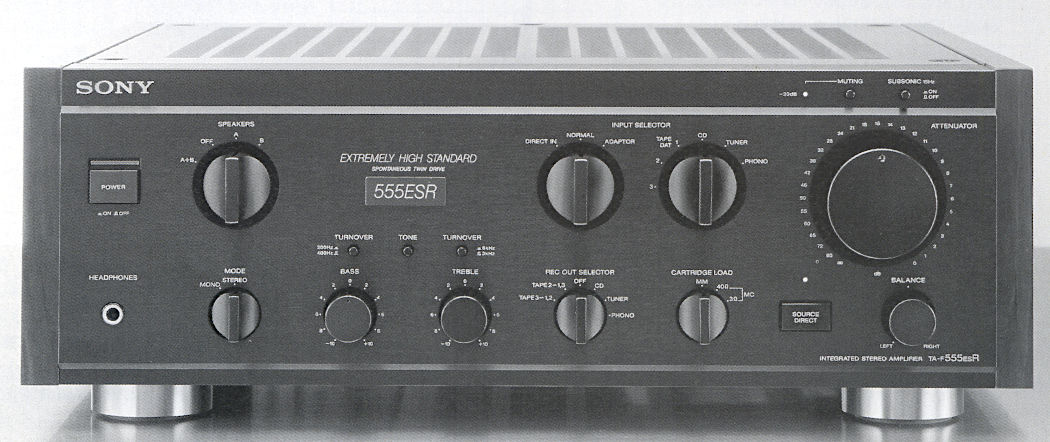
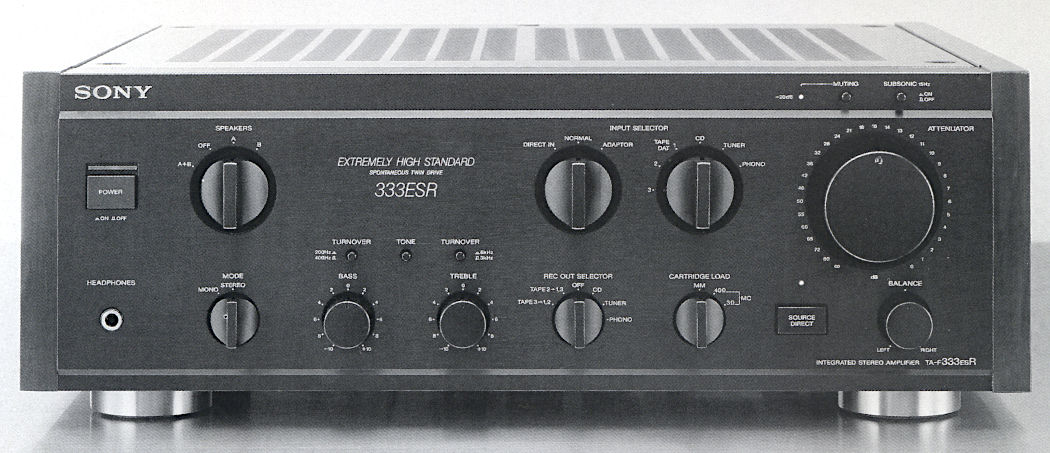
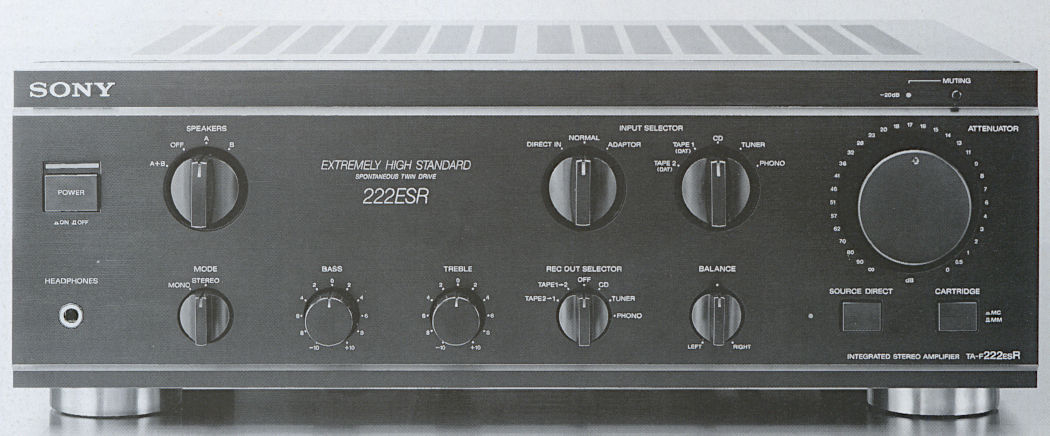
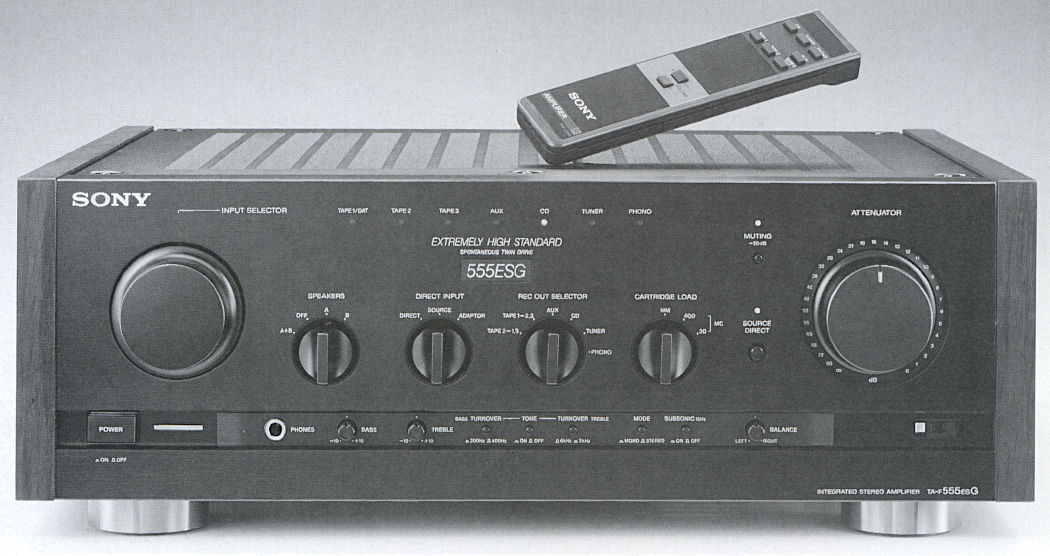
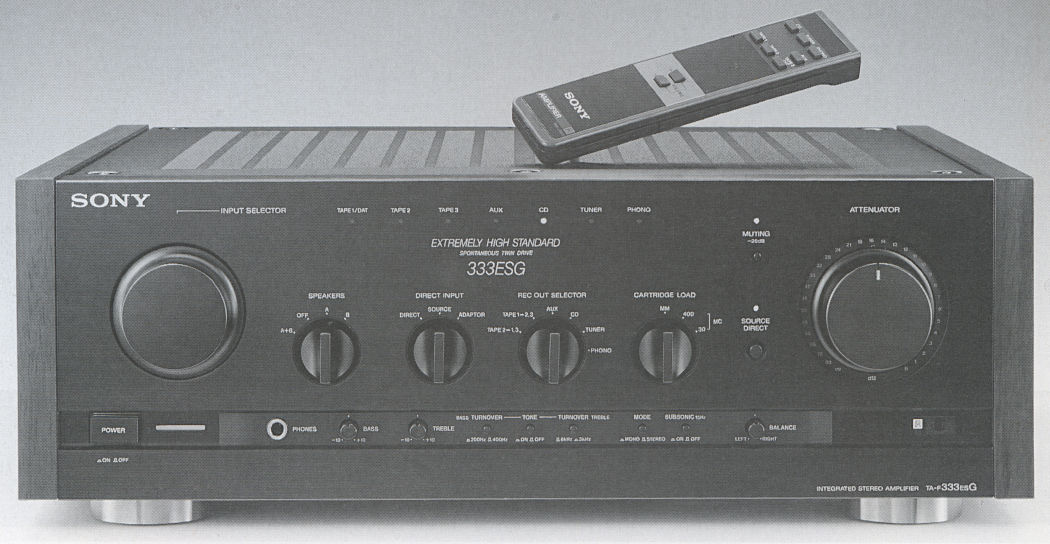
| Japanese model | TA-F555ESR | TA-F333ESR | TA-F222ESR | TA-F555ESG | TA-F333ESG |
|---|---|---|---|---|---|
| USA/Canada model (if different) | not released | not released | TA-F530ES | not released | not released |
| European model (if different) | TA-F830ES | TA-F730ES | TA-F530ES | not released | not released |
| Japanese release | 1988. October | 1988. October | 1989. January | 1989. October | 1989. October |
| Distribution | 1988-1989 | 1988-1989 | 1989-1991 | 1989-1990 | 1989-1990 |
| Amplifier section | |||||
| Circuit type | Pure complementary SEPP | Pure complementary SEPP | |||
| RMS output 8 Ohm 20 Hz - 20 kHz | 2 x 120 W | 2 x 10⁵ W | 2 x 90 W | 2 x 120 W | 2 x 10⁵ W |
| RMS output 4 Ohm 20 Hz - 20 kHz | 2 x 180 W | 2 x 140 W | 2 x 120 W | 2 x 180 W | 2 x 140 W |
| Power bandwith (8 Ohm) | 10 Hz – 100 kHz | 10 Hz – 100 kHz | 10 Hz – 80 kHz | 10 Hz – 100 kHz | 10 Hz – 100 kHz |
| Frequency response (+0/-3 dB) | 2 Hz- 200 kHz | 2 Hz- 200 kHz | 2 Hz- 200 kHz | 2 Hz- 200 kHz | 2 Hz- 200 kHz |
| Damping factor ( 1kHz, 8 Ohm) | 100 | 100 | |||
| Harmonic distortion at 10 W output | 0.002% | 0.002% | 0.003% | 0.002% | 0.002% |
| Intermodulation distortion at rated output | 0.004% | 0.004% | 0.004% | 0.004% | 0.004% |
| Residual noise (8 ohm) | <115 µV | <115 µV | <90 µV | ||
| Speaker out | A – B (4-16 Ω) | A – B (4-16 Ω) | A – B (4-16 Ω) | A – B (4-16 Ω) | A – B (4-16 Ω) |
| Inputs | |||||
| Phono RCA | 1 stereo | 1 stereo | 1 stereo | 1 stereo | 1 stereo |
| 2.5 mV 50 kΩ (MM) 0.17 mV 1 kΩ (MC) | 2.5 mV 50 kΩ (MM) 0.17 mV 1 kΩ (MC) | 2.5 mV 50 kΩ (MM) 0.17 mV 100 Ω (MC) | 2.5 mV 50 kΩ (MM) 0.17 mV 1 kΩ (MC) | 2.5 mV 50 kΩ (MM) 0.17 mV 1 kΩ (MC) |
|
| signal to noise ratio | 87 dB (MM) 70 dB (MC) | 87 dB (MM) 68 dB (MC) | 87 dB (MM) 68 dB (MC) | 87 dB (MM) 70 dB (MC) | 87 dB (MM) 68 dB (MC) |
| RCA other (aux, tuner, tape etc.)2 | 6 stereo | 6 stereo | 5 stereo | 7 stereo | 7 stereo |
| 150 mV 50 kΩ | 150 mV 50 kΩ | 150 mV 50 kΩ | 150 mV 50 kΩ | 150 mV 50 kΩ | |
| 105 dB | 105 dB | 105 dB | 105 dB | 105 dB | |
| Adaptor in | 1 stereo | 1 stereo | 1 stereo | 1 stereo | 1 stereo |
| Outputs | |||||
| Rec out | 3 stereo | 3 stereo | 2 stereo | 3 stereo | 3 stereo |
| specification | 150 mV 1 kΩ | 150 mV 1 kΩ | 150 mV 1 kΩ | 150 mV 1 kΩ | 150 mV 1 kΩ |
| Adaptor out | 1 stereo | 1 stereo | 1 stereo | 1 stereo | 1 stereo |
| Headphone out | 25 mW 8 Ω | 25 mW 8 Ω | 25 mW 8 Ω | 25 mW 8 Ω | 25 mW 8 Ω |
| Functions | |||||
| Bass tone control1 | 100 Hz +4 -3.5 dB (turnover freq. 200 Hz) +6 -5 dB (turnover freq. 400 Hz) | 100 Hz +4 -3.5 dB (turnover freq. 200 Hz) +6 -5 dB (turnover freq. 400 Hz) | 100 Hz ±6 dB (turnover freq. 400 Hz) | 100 Hz +4 -3.5 dB (turnover freq. 200 Hz) +6 -5 dB (turnover freq. 400 Hz) | 100 Hz +4 -3.5 dB (turnover freq. 200 Hz) +6 -5 dB (turnover freq. 400 Hz) |
| Treble tone control1 | 10 kHz +7 -8 dB (turnover freq. 3 kHz) +4 -5 dB (turnover freq. 6 kHz) | 10 kHz +7 -8 dB (turnover freq. 3 kHz) +4 -5 dB (turnover freq. 6 kHz) | 10 kHz ±6 dB (turnover freq. 4 kHz) | 10 kHz +7 -8 dB (turnover freq. 3 kHz) +4 -5 dB (turnover freq. 6 kHz) | 10 kHz +7 -8 dB (turnover freq. 3 kHz) +4 -5 dB (turnover freq. 6 kHz) |
| Low filter1 | 15 Hz, 6 dB/oct | 15 Hz, 6 dB/oct | - | 15 Hz, 6 dB/oct | 15 Hz, 6 dB/oct |
| Balance | x | x | x | x | x |
| Stereo switch | x | x | x | x | x |
| Muting | x | x | x | x | x |
| Remote controller | - | - | - | RM-J350 | RM-J350 |
| Construction | |||||
| Transformator count | 1 (STD) | 1 (STD) | 1 (STD) | 1 (STD) | 1 (STD) |
| Capacitors in the power supply | 96000 µF | 36000 µF | |||
| Power consumption | 300 W 420 W (German model) | 270 W 260 W (AEP model) 800 W (UK model) 370 W (E model) | 235 W 220 W (AEP model) 600 W (UK model) 340 W (E model) | 300 W | 270W |
| Heat sink | aluminium heat sink | aluminium heat sink | aluminium extruded heat sink | aluminium diecast heat sink | |
| Construction | Acoustically Tuned Gibraltar Chassis | Acoustically Tuned Gibraltar Chassis | Acoustically Tuned Gibraltar Chassis | Acoustically Tuned Gibraltar Chassis | Acoustically Tuned Gibraltar Chassis |
| Dimensions | |||||
| Width | 470 mm | 470 mm 430 mm (without side panels) | 430 mm | 470 mm 430 mm (without side panels) | 470 mm 430 mm (without side panels) |
| Height | 170 mm | 165 mm | 150 mm | 170 mm | 165 mm |
| Depth | 435 mm | 435 mm | 370 mm | 435 mm | 435 mm |
| Weight | 24.5 kg | 21.2 kg | 13.5 kg | 24.5 kg | 21.2 kg |
| Original price | 128000 yen | 79800 yen | 50700 yen | 128000 yen | 79800 yen |
| Calculated price in 2025 | 168600 yen | 105000 yen | 65000 yen | 165000 yen | 103000 yen |
1: all tone controls and filters can be turned off
2: including one „Direct in” input
UK models didn’t have wooden side panels.
ESD preamplifiers
In the late 1980s and throughout the 1990s, Sony manufactured very few ES preamplifiers and power amplifiers for the Japanese market. With the discontinuation of the Esprit line, the legendary series of high-end preamplifiers and power amplifiers also came to an end. However, the company did produce highly successful ES preamplifiers and power amplifiers for overseas markets—though those will be discussed in the next article.
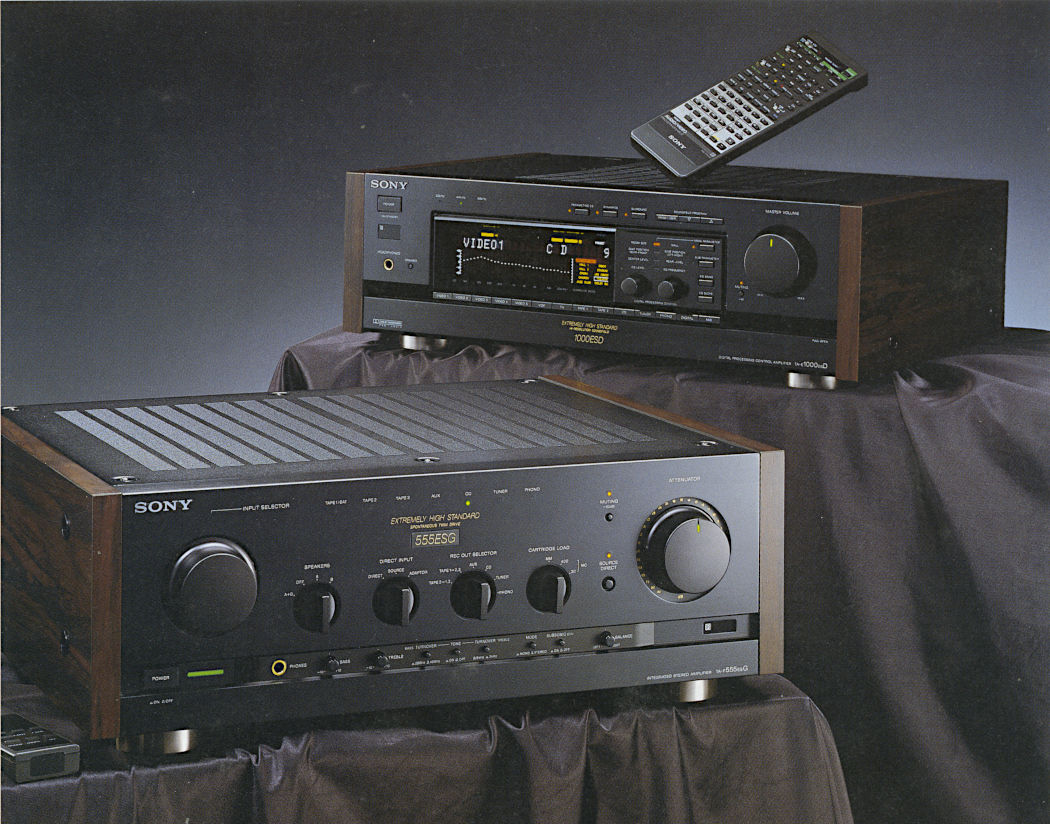
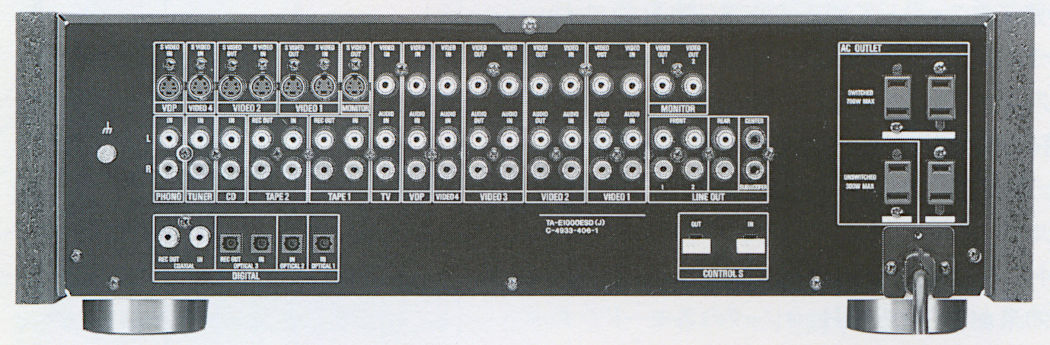
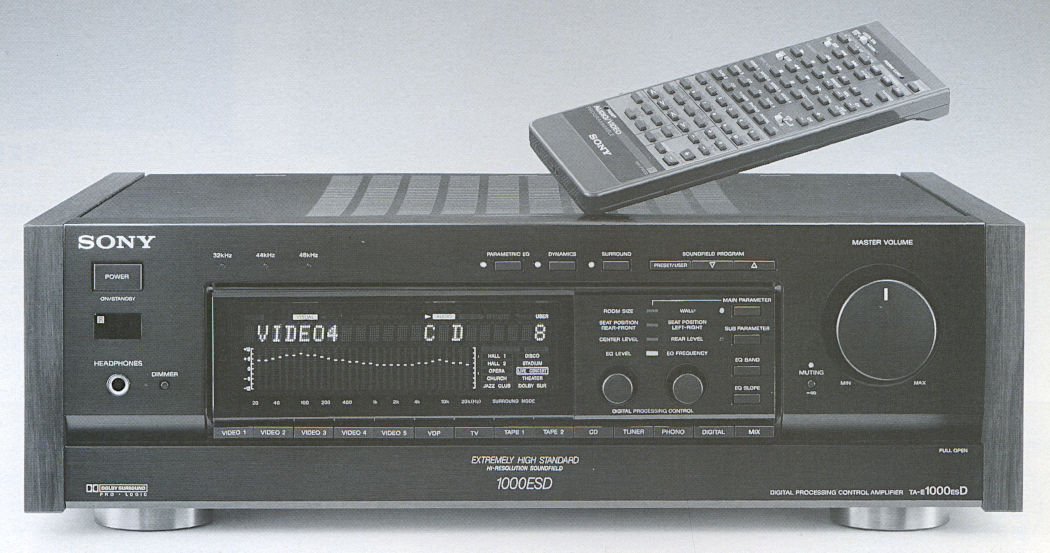
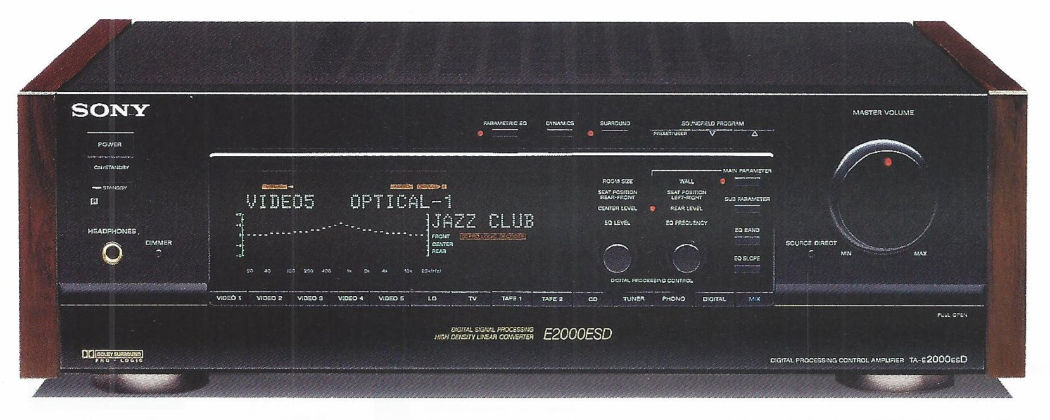
Yet, with the rise of home theater, two preamplifiers appeared on the Japanese market that I definitely wish to showcase. Although home theater is not the focus of this article, these two amplifiers fit perfectly into the ES family.
The TA-E1000ESD home theater preamplifier was released in Japan in October 1989 and overseas in 1990, followed by its successor, the TA-E2000ESD, in 1992. The latter remained on the market until 1996. These amplifiers featured a large number of video inputs and outputs. As the model number indicates, they also included a DAC.
| Japanese model | TA-E1000ESD | TA-E2000ESD |
|---|---|---|
| USA/Canada model (if different) | ||
| European model (if different) | ||
| Japanese release | 1989. October | 1992 |
| Distribution | 1989-1991 (1992 overseas) | 1992-1996 |
| Amplifier section | ||
| Harmonic distortion at rated output | <0,004% (analog) <0,003% (digital) | <0,004% (analog) <0,003% (digital) |
| Intermodulation distortion at rated output | ||
| Residual noise | 10 µV | 10 µV |
| Frequency response on inputs other than phono ±0.1dB | 20 Hz – 20 kHz | 20 Hz – 20 kHz |
| DAC section | ||
| Type | Multi-bit | Delta-sigma |
| Sampling frequencies | 32 kHz; 44,1 kHz; 48 kHz (16 and 18 bits) | 32 kHz; 44,1 kHz; 48 kHz (16 and 18 bits) |
| DAC IC | 2 x PCM1701P 2 x PD6372CX | 3 x CXD2562Q |
| Inputs | ||
| Phono 1 | 1 stereo | 1 stereo |
| 2 mV 50 kΩ | 5 mV 50 kΩ | |
| 84 dB | 84 dB | |
| RCA other (aux, tuner, tape etc.) | 11 stereo | 11 stereo |
| 150 mV 50 kΩ | 250 mV 50 kΩ | |
| 95 dB | 94 dB | |
| Digital optical in | 2 | 2 |
| Digital coaxial in | 1 | 1 |
| 0.5Vp-p ±20% 75 Ω | 0.5Vp-p ±20% 75 Ω | |
| S-Video in | 3 | 3 |
| Video in | 7 | 7 |
| Outputs | ||
| Center channel | 1,5 V | 1 stereo (2.5 V) |
| Rec out (RCA)1 | 7 stereo | 7 stereo |
| 150 mV 1 kΩ | 250 mV 470 Ω | |
| S-Video out | 3 | 3 |
| Video out | 5 | 5 |
| Rear channel | 1 stereo | 1 stereo (2.5 V) |
| Subwoofer out | 1.5 V | 1 stereo (2.5 V) |
| Digital optical | 1 | 1 |
| Digital coax | - | - |
| Headphone out | 15 mW 8 Ω | 25 mW 8 Ω |
| Functions | ||
| Tone controls | 3-band parametric eq, room correction and sub parameters | 3-band parametric eq, room correction, Dolby Pro Logic and sub parameters |
| Low filter | - | - |
| Balance | x | x |
| Muting switch | x | x |
| Construction | ||
| Transformator count | 1 | 1 |
| Power consumption | 30W (Japanese version) 35W | 35 W (Japanese version) 38 W |
| Construction | ||
| Remote controller | RM-P1000 | RM-P2000 |
| Dimensions | ||
| Width | 470 mm | 470 mm (430 mm without side panels) |
| Height | 150 mm | 150 mm |
| Depth | 360 mm | 355 mm |
| Weight | 8 kg | 8.5 kg |
| Color | black | black |
| Original price | 99800 yen | 120000 yen |
| Calculated price in 2025 | 128500 yen | 143000 yen |
| Original price | 2000 DM | 2500 DM |
1: including all „rec out”, „front out” and „video out”
Róbert Sipos (2026)
Unless otherwise noted, all photos are scans from my own original Japanese Sony catalogs.